



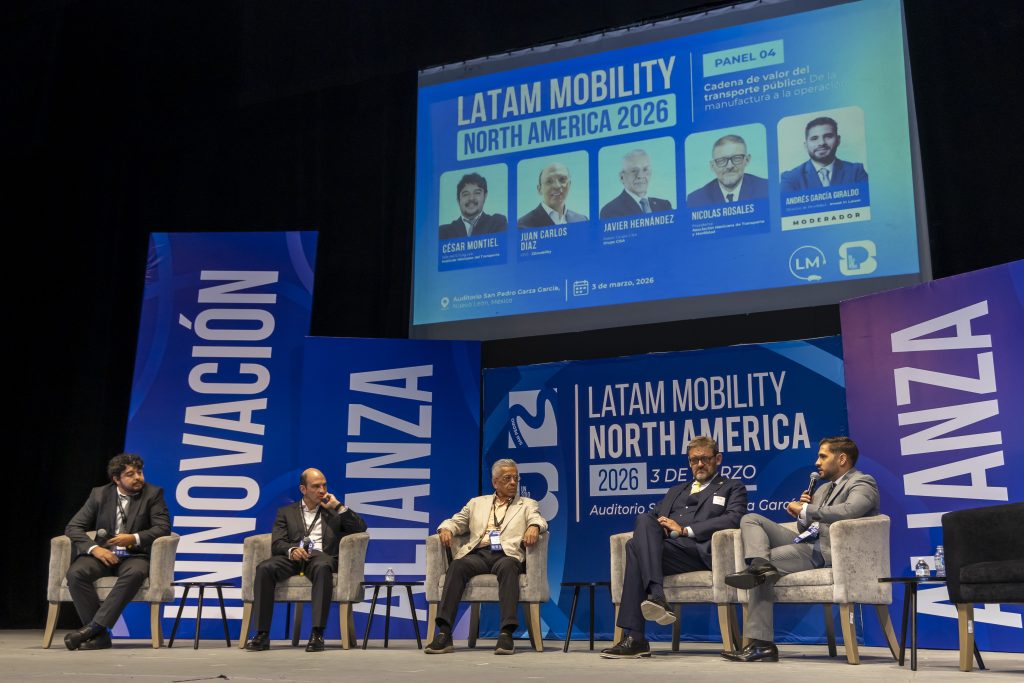
At the “Latam Mobility North America 2026,” held at the Auditorio San Pedro, top-tier experts gathered to analyze one of the most critical links for the decarbonization of cities: the public transportation value chain.
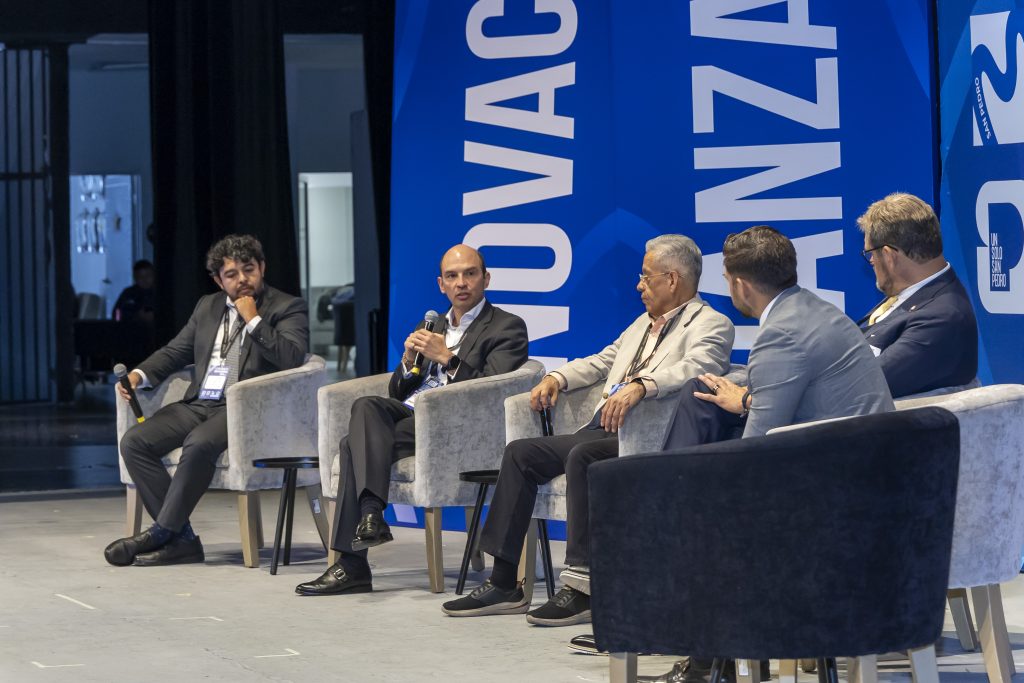
The panel, titled “The Public Transportation Value Chain: From Manufacturing to Operation,” brought together authoritative voices from the academic, business, and trade sectors to dissect the challenges and opportunities involved in the energy transition for mass transit.
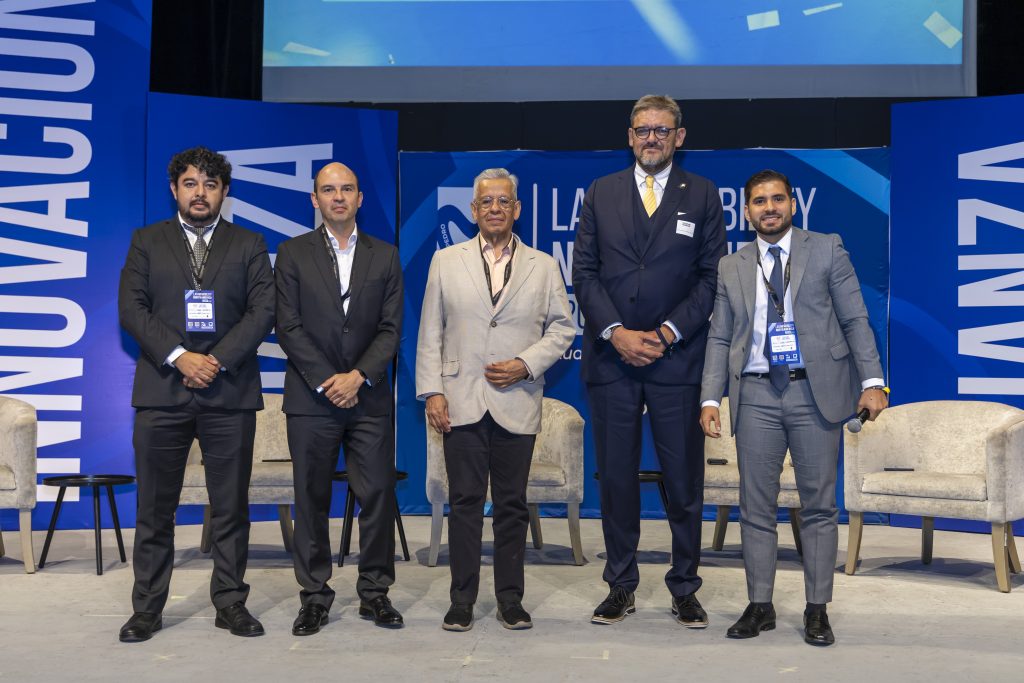
The conversation, moderated by Andrés García Giraldo, Mobility Director at Invest In Latam, featured César Montiel, Head of the National Laboratory Unit for Transportation and Logistics Systems at the Mexican Transportation Institute (IMT); Juan Carlos Díaz, CFO of ZEmobility; Javier Hernández, Advisor to Grupo CISA; and Nicolás Rosales, President of the Mexican Association of Transportation and Mobility (AMTM).
Together, they tackled the complex equation that spans from vehicle design and manufacturing to daily street-level operation, including financing, regulations, and the user experience.
You might also be interested in | Autel Energy: “The Future of e-Trucks Begins with Smart Charging”
The Pillars of a Profound Transformation
Andrés García kicked off the session by posing the central question: how can we ensure that the public transport value chain, from manufacturing to operation, meets the demands for sustainability, efficiency, and equity required by modern cities?
The answer, as the dialogue unfolded, highlighted the need for a systemic approach and unprecedented collaboration among all stakeholders.
From an academic and technical perspective, César Montiel of the IMT emphasized the importance of planning based on evidence and a deep understanding of local dynamics. “We cannot talk about a successful transition if we don’t first understand the specific characteristics of each city and its transportation system,” he stated.
“From the lab, our role is to generate data, norms, and standards that allow vehicle manufacturing—whether electric or using clean technologies—to align with the actual operating conditions in Mexico. This involves evaluating unit performance across different terrains, climates, and usage patterns, so operators have certainty about the investment they are making,” Montiel explained. His intervention underscored the need for solid bridges between technological development and its practical application.
The Viability Link
For his part, Juan Carlos Díaz, CFO of ZEmobility, brought the perspective from the financial sector and solution provision. In his remarks, he highlighted that one of the main bottlenecks for renewing public transport fleets is access to adequate, long-term financing schemes.
“Zero-emission vehicle manufacturing has advanced enormously, but the business model for a concessionaire or a municipality to acquire and operate them remains a major challenge. It’s not just about buying the bus, but financing all the associated infrastructure: the depots, the charging, the specialized maintenance,” he explained.
“At ZEmobility, we are convinced that the key lies in offering comprehensive solutions that accompany the operator throughout the entire vehicle lifecycle, from acquisition to daily operation, thus guaranteeing the project’s profitability and its sustainability over time,” Díaz affirmed.
The Operator’s Experience
The view from the trenches of daily operations was provided by Javier Hernández, Advisor to Grupo CISA, who has extensive experience in managing transportation systems. Hernández was emphatic in pointing out that the technological transition cannot neglect those who operate and maintain the units.
“The leap to new technologies, like electromobility, implies a profound cultural and operational transformation. It’s not enough to receive a new vehicle; you have to train drivers, adapt workshops, redesign routes based on range, and manage charging intelligently to avoid disrupting operations,” he stated.
“At Grupo CISA, we have learned that innovation in manufacturing must go hand-in-hand with innovation in operations and maintenance processes. The reliability of public service depends on the entire chain working in harmony,” he detailed.
Hernández also brought up the need for dialogue with authorities to adapt regulations to new operational realities, from scrappage schemes to defining priority corridors for clean technologies.
The Role of Associations
Closing the round of interventions, Nicolás Rosales, President of AMTM, offered a trade association and public policy perspective, emphasizing the importance of sector unity to engage in dialogue with different levels of government and the manufacturing industry.
“At AMTM, our objective is to be that bridge that brings together the needs of over 60,000 concessionaires and operators in the country. The value chain doesn’t end when the vehicle leaves the factory; it continues on the streets, in the relationship with the user, and in the operator’s ability to provide a dignified and efficient service,” he said.
“We need public policies that incentivize fleet renewal, that standardize criteria nationwide, and that, above all, recognize the importance of public transport as a builder of more just and sustainable cities,” Rosales pointed out.
The president of AMTM also called for collaboration with institutions like the IMT to ensure that the norms generated are applicable and do not represent barriers for small and medium-sized transport providers.
Lessons for the Future
The dialogue among the panelists identified fundamental points of consensus. They agreed that decarbonizing public transport is not a goal achieved solely by acquiring cutting-edge vehicles. It is a complex process that requires:
- Regulatory and Technical Planning: With clear standards adapted to local realities, led by institutions like the IMT.
- Financial Innovation: With business models that make long-term investment viable for operators.
- Capacity Building: So that the operation and maintenance of new technologies are successful.
- Trade Unity and Public-Private Dialogue: To build public policies that provide certainty and foster investment.
The conclusion was unanimous: only through the integration of all links in the chain—manufacturing, financing, regulation, and operation—can we build a public transport system equal to the challenges of the 21st century.
A 2026 of Consolidation for Mobility
“Latam Mobility North America 2026” in San Pedro Garza García reaffirmed the region’s role as a hub for discussion and action regarding sustainable mobility.
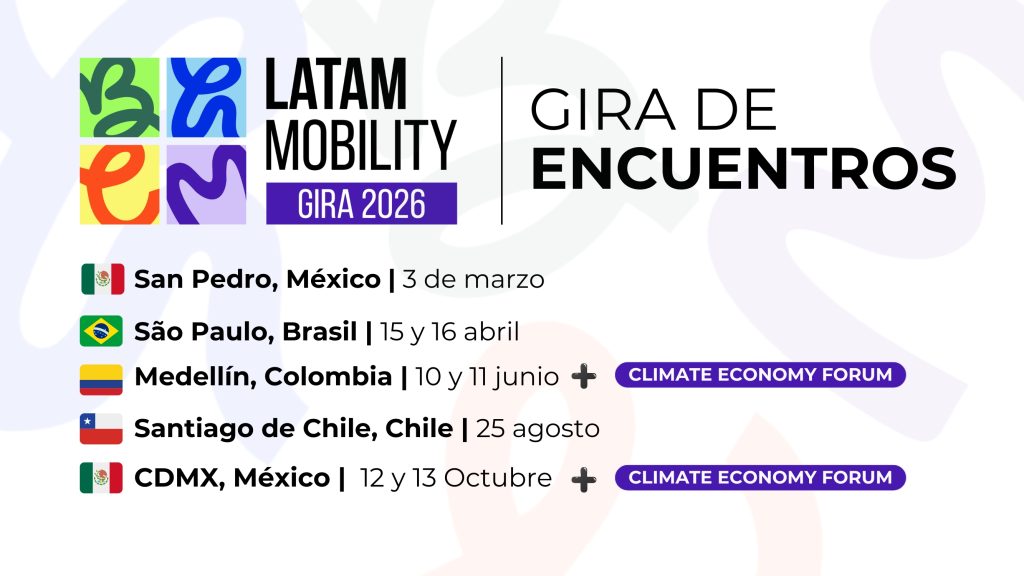
Following the success of this session, the organizers invite the mobility community to stay tuned and participate in the 2026 Latam Mobility Tour, which will visit the region’s key markets.
Through its stops in Mexico City, Brazil, Colombia, and Chile, the platform will continue to promote a collaborative approach to accelerate the transition to cleaner, more efficient, and more inclusive transportation systems, positioning Latin America as a relevant player in sustainable mobility at the global level.
Be part of the movement that is accelerating Latin America’s energy and urban transformation. If you would like to learn more about how to participate and positioning options, click here.