



A recent Geotab study indicates that the average fleet is made up of vehicles from at least 13 different manufacturers, each with specific maintenance, regulatory, and compliance requirements.
This scenario is intensified by the sustained growth of connected vehicles: in 2023, 75% of new cars sold globally already had telemetry systems integrated by the manufacturers themselves, compared to 72% the previous year.
The transformation of corporate transportation is advancing at a rapid pace and places the management of mixed fleets among the main operational challenges for companies and public agencies around the world.
You may also be interested in | Autocab Boosts the Evolution of Digital Taxis with the Launch of MX Taxi in Mexico City
Demand for Integrated Solutions
The diversity of brands, technologies, and regulations has increased the operational complexity of modern fleets. For managers, fragmented information limits their ability to optimize costs, improve asset performance, and make strategic decisions based on reliable data.
In this context, the need for platforms capable of unifying data from multiple OEMs (Original Equipment Manufacturers) and offering a comprehensive real-time view has become a critical factor for competitiveness.
Geotab, a global leader in connected transportation solutions, responds to this demand with an open platform designed to centralize the management of mixed fleets.
Its technology can read data from 157 OEMs and is compatible with nearly 15,000 vehicle makes, models, and years of manufacture, offering operators a consistent and actionable view of their operations, regardless of fleet heterogeneity.
“Companies need solutions that work across the board, regardless of the OEM,” explained Rob Minton, Associate Vice President of Connected Car Business Development at Geotab.
“Our open platform approach, combined with strong partnerships with leading manufacturers, ensures that fleet managers can access consistent and useful data to optimize performance and operational efficiency.”
This vision has enabled Geotab to establish itself as a strategic partner for both fleet operators and vehicle manufacturers, facilitating interoperability and reducing dependence on closed systems.

Strengthening Partnerships
Over the past year, Geotab has expanded and deepened its collaboration with global OEMs such as Rivian, Volvo Cars, and Volkswagen Group Info Services AG.
These partnerships enable deeper data integration and higher quality information, empowering companies to optimize maintenance, improve operational planning, and more efficiently manage the transition to electrified fleets.
One of the most notable advances is the native integration with Rivian, which allows electric vehicle data to be incorporated directly into the Geotab environment without the need for additional hardware. This solution simplifies the adoption of new technologies and accelerates value generation for operators.
“We are very pleased to offer native integration with Geotab in the upcoming launch of our Rivian Commercial Van,” said Tom Solomon, Senior Director of B2B Growth and Business Development at Rivian.
“Customers will be able to view vehicle data seamlessly in the Geotab dashboard, without additional configuration, reducing complexity and improving the management experience.”
Data as a Decisive Factor
Effective access to fleet data has become a determining factor in commercial vehicle purchasing decisions.
With more than 50,000 fleet customers worldwide, including Fortune 500 groups and some of the largest fleets in the public sector, Geotab offers OEMs a gateway to a well-established global ecosystem.
“For manufacturers, partnering with Geotab makes perfect business sense,” added Minton. “Our customer base and OEM telemetry expertise enable us to deliver comprehensive solutions that address the real needs of today’s mixed fleets.”
Geotab‘s expertise in OEM telemetry is based on more than ten years of ongoing collaboration with leading manufacturers in the automotive industry.
This journey has been key to developing scalable, secure solutions that are aligned with the specific challenges of managing diverse and highly connected fleets.
In an environment where connectivity, electrification, and manufacturer diversity will continue to increase, Geotab is positioned as a key enabler of smart mobility, offering a platform ready to accompany the evolution of corporate transportation globally.
To learn more about Geotab‘s solutions for mixed fleet management and its focus on OEM telemetry, click here.
2026: Moving Towards Electric Mobility
Rather than ambitious announcements, 2026 will be a year for measuring results. Electric and low-emission mobility will no longer be evaluated by the number of pilot projects but will be judged by its ability to operate at scale, reduce real emissions, and improve the quality of urban life.
For Latin America, the challenge will be to capitalize on its experience in electric public transportation, close infrastructure gaps, and build stable policies that allow the transition to be not only green but also inclusive and economically viable.
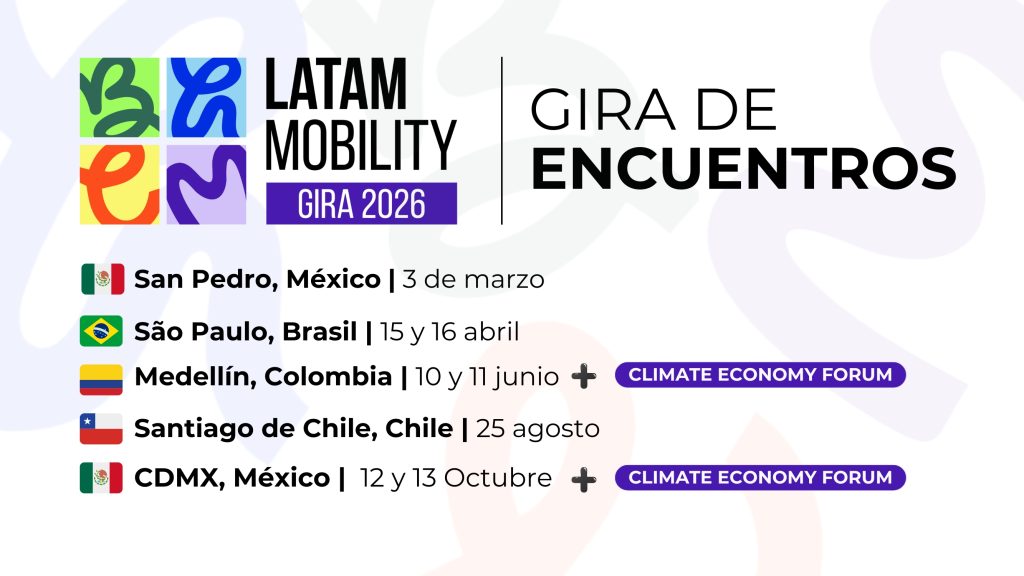
With the 2026 Tour, Latam Mobility reaffirms its commitment to building a regional agenda that connects vision, public policy, innovation, and the market.
Through its stops in Monterrey and Mexico City, Brazil, Colombia, and Chile, the platform will continue to promote a collaborative approach to accelerate the transition to cleaner, more efficient, and more inclusive transportation systems, positioning Latin America as a relevant player in sustainable mobility at the global level.
Be part of the movement that is accelerating Latin America’s energy and urban transformation. If you would like to learn more about how to participate and positioning options, click here.