



The Auditorio San Pedro witnessed the start of «Latam Mobility North America 2026» with a high-level panel that brought together the most authoritative voices on economic development from northeastern Mexico and the Bajío region.
Under the title «North-Greater Bajío Integration and the New Industrial Geopolitics of North America,» the officials agreed on a unanimous message: Mexico‘s competitiveness in the context of nearshoring is no longer measured by the individual capacity of the states, but by their ability to articulate as a region and offer comprehensive solutions to supply chains.
The panel, which marked the beginning of a day focused on connectivity, infrastructure, and fleet management, was moderated by Miguel Cavazos, Vice President of the Board of Directors of Invest Monterrey. He welcomed Betsabé Rocha, State Secretary of Economy of Nuevo León; Esaú Garza de Vega, State Secretary of Economic Development, Science, and Technology of Aguascalientes; and Anabell Flores, Undersecretary of Investment for the Secretariat of Economy of Tamaulipas.
You might also be interested in | VEMO to Invest US$1.5 Billion to Accelerate Charging Infrastructure and Electric Fleet Expansion in Mexico
Mobility and Economic Development
Betsabé Rocha, head of the Secretariat of Economy of Nuevo León, took the floor to explain the paradigm shift the entity is experiencing.
While she celebrated that Nuevo León continues to be a magnet for investment, such as those announced by the Governor during the summit, she emphasized a crucial question: “What do we do with this investment when it arrives? When it arrives, does it find the housing, the mobility, everything necessary to continue being successful?”
Rocha explained that the state faces a growth projection that could take it from 6 to 10 million inhabitants in a decade, which necessitates metropolitan planning that transcends government terms.
In this regard, she highlighted the creation of a Secretariat of Infrastructure and Mobility, elevating the issue to a cabinet-level agency, as well as legislative initiatives to institutionalize a metropolitan committee where mobility is the guiding principle.
“Economic development cannot just be about attracting investment; it must have a social element that we can all verify and experience,” she stated, pointing out the need to coordinate efforts with the Federation and the municipalities to resolve bottlenecks on highways and in industrial parks.

Tamaulipas: The Backbone of Logistics
For her part, Anabell Flores, representing Secretary Ninfa Cantú, presented the fundamental role of Tamaulipas as a logistics platform for Mexican foreign trade.
She underscored that 45% of the road freight flow between Mexico and the United States crosses through the state’s 19 international bridges and three seaports, while 50% of rail freight also transits through its railways.
Aware of this responsibility, Flores detailed strategic infrastructure projects such as the expansion of the Nuevo Laredo International Bridge, which will go from eight to 18 lanes, and the completion of the “Tam-bajío” highway in the southern zone, which will streamline cargo movement between the northeast and the Bajío.
“These mobility projects not only seek to make freight more efficient but also to positively impact the daily lives of the population,” she explained. Additionally, she mentioned the development of industrial hubs such as the port of Matamoros and the port of Altamira, recently named a “Polo de Bienestar” (Welfare Hub) by the Federation, which will be key for the relocation of supply chains.
Aguascalientes and the Challenge of Orderly Growth
Esaú Garza de Vega, Secretary of Economic Development of Aguascalientes, provided the perspective of a state with a dynamic of accelerated growth, exemplified by the consolidation of Nissan’s operations, which will drastically increase its workforce.
For Garza de Vega, Aguascalientes’s advantage lies in its size and internal connectivity, with three ring roads that allow for agile mobility, but which will need to adapt to the new flow of people.
“We are working on tripartite committees with universities, companies, and civil society to analyze peak hours and improve traffic flow,” he detailed.
He anticipated that one of the great challenges will be the transition to electromobility, which implies not only the arrival of electric buses but also the installation of the necessary charging infrastructure.
“We cannot bring in electric buses if we don’t have the charging points. Just as they are effectively doing in San Pedro, that is part of what we are promoting in Aguascalientes,” he stated.

Complementarity as a National Strategy
One of the highlights of the panel occurred when moderator Miguel Cavazos asked about interstate coordination in the context of nearshoring and regional supply chains. The panelists’ response was emphatic: the model has shifted from competition to complementarity.
Betsabé Rocha explained that the Mexican Association of Secretaries of Economic Development (AMSDE) has become the key forum for this coordination, allowing states to understand their vocations and present themselves as a unified front in the absence of a federal strategy as intensive as in the past with ProMéxico.
“We are definitely not competing. We must see ourselves as a single Mexico attracting investments. We have understood our vocations,” she assured. She cited as an example the appliance and heavy transport corridor that integrates Coahuila, Nuevo León, and Tamaulipas, where more than 50% of the suppliers for those sectors are concentrated.
Anabell Flores expanded on this idea, pointing out that companies seeking to strengthen their supply chains evaluate the region as a whole. “Tamaulipas stands out for its logistics platform, but it is companies from Nuevo León and the Bajío that cross and transform value here. They see us as a region, and that’s how we must operate,” she stated.
She noted that the new geopolitical context, with changing rules, demands resilience and adaptation, and that states must work so that investment, regardless of where it lands, stays in Mexico.
Esaú Garza de Vega reinforced the concept by recalling his experience at ProMéxico, when companies would visit several states to understand their comparative advantages. “Today we work in a coordinated and open manner. Beyond competing, we look at how to land a project where it can be most successful,” he said.
Furthermore, he mentioned the need to increase national content to comply with the USMCA and the push for supplier development programs that invite companies from other states to be part of the Bajío’s supply chains.
Flagship Projects and the Vision for the Future
In the final stretch of the panel, Miguel Cavazos posed two specific questions: what is each state’s flagship project, and how are they approaching investment in mobility as a recipient of foreign capital?
Betsabé Rocha was emphatic in stating that the Nuevo León government is making the largest infrastructure investment in its history, with more than 100 billion pesos allocated to over six new highways, including an inter-mountain route that will transform logistics with the center of the country. “Economic development can no longer go alone; it must include social development and sustainability. Mobility is our issue to solve,” she declared.
Anabell Flores highlighted the project of the interior port of Ciudad Victoria, a 1,300-hectare polygon located in the backbone of commerce, which will allow for customs and value-added operations. Regarding urban mobility, she emphasized the investment of 2.5 billion pesos for a BRT system in the southern part of the state, with construction set to conclude by the end of 2027.
Finally, Esaú Garza de Vega shared that Aguascalientes is focusing its efforts on harmonious development, with new industrial parks near residential areas, the installation of semiconductor and electromobility laboratories in universities, and modifications to the law so that new housing includes energy access in garages, laying the groundwork for long-term electromobility. “The mobility agency was just created, which will chart the strategy for all movement within the state,” he concluded.
With a shared vision that the future of the region is built as a team and with mobility as a facilitator of development, the inaugural panel of «Latam Mobility North America 2026» set a precedent for interstate collaboration that will be fundamental for the challenges ahead.
The Agenda to Decarbonize Transportation
Rather than ambitious announcements, 2026 will be a year for measuring results. Electric and low-emission mobility will no longer be evaluated by the number of pilot projects but will be judged by its ability to operate at scale, reduce real emissions, and improve the quality of urban life.
For Latin America, the challenge will be to capitalize on its experience in electric public transportation, close infrastructure gaps, and build stable policies that allow the transition to be not only green but also inclusive and economically viable.
With the 2026 Tour, Latam Mobility reaffirms its commitment to building a regional agenda that connects vision, public policy, innovation, and the market.
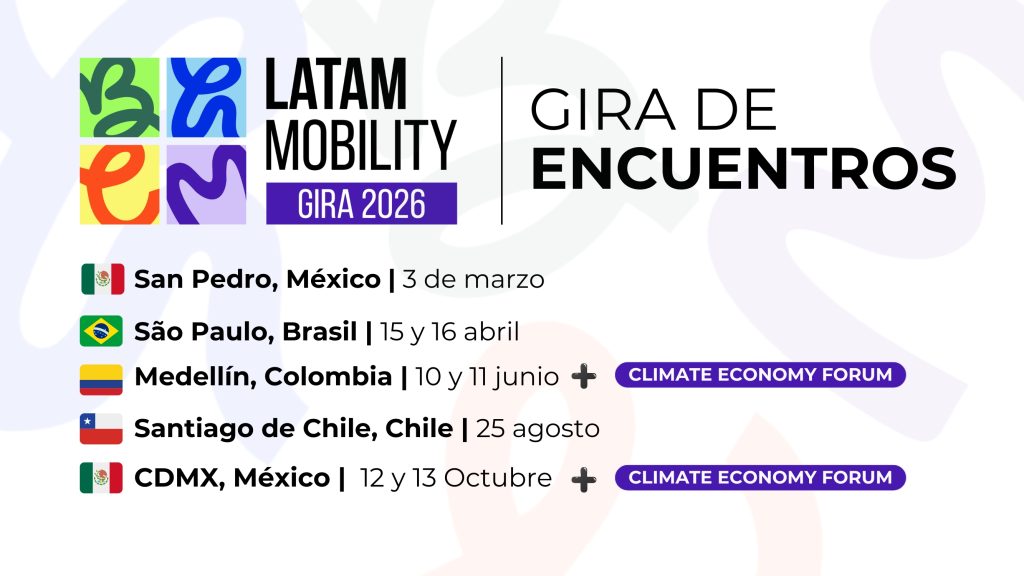
Through its stops in Mexico City, Brazil, Colombia, and Chile, the platform will continue to promote a collaborative approach to accelerate the transition to cleaner, more efficient, and more inclusive transportation systems, positioning Latin America as a relevant player in sustainable mobility at the global level.
Be part of the movement that is accelerating Latin America’s energy and urban transformation. If you would like to learn more about how to participate and positioning options, click here.