


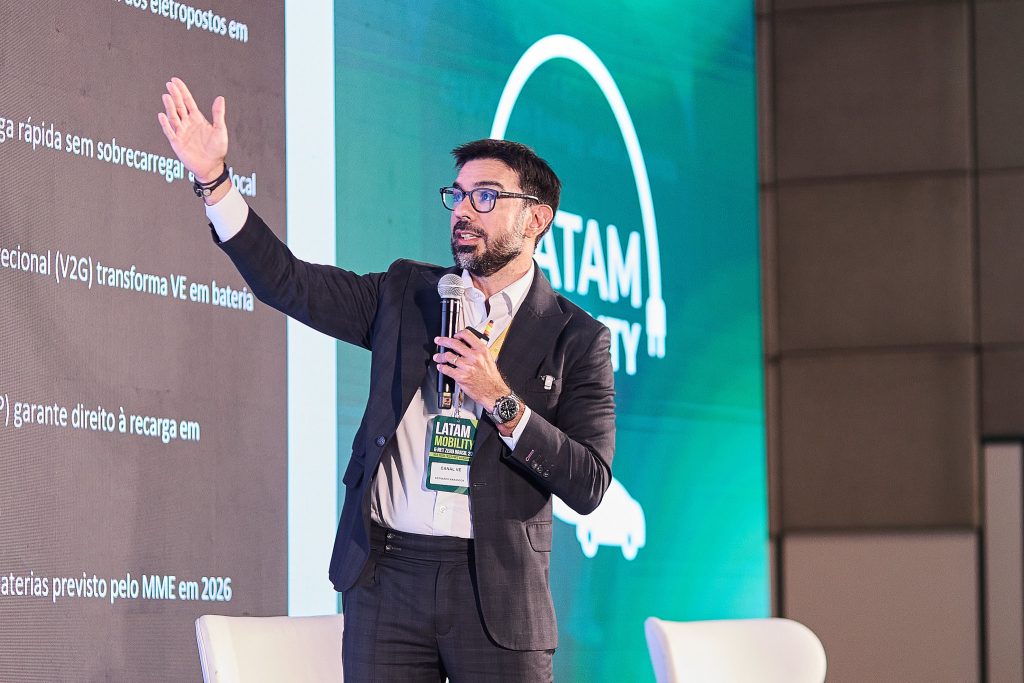
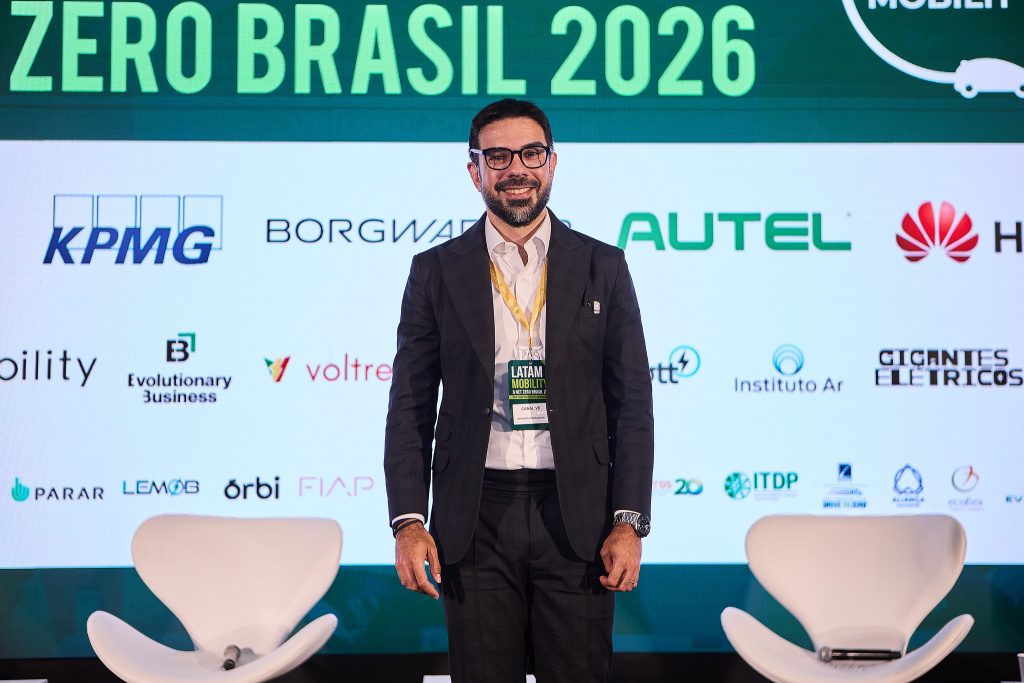
As part of Latam Mobility & Net Zero Brasil 2026, the CEO of Canal Solar, Bernardo Marangón, gave a keynote titled “When solar energy meets asphalt.”
During his presentation, the Brazilian electricity sector expert drew a parallel between the explosive growth of photovoltaic solar energy in Brazil and the equally disruptive potential of electromobility. His message was direct: the electricity sector and mobility share the same future, and that future is now.
Bernardo Marangón, known in the industry for his work leading Canal Solar and as the driving force behind Canal VE (an initiative that links the electricity sector with electromobility), began by highlighting a fact: Brazil’s electricity grid is mostly renewable.
“That’s something we should be proud of,” he said. He added that while hydropower was historically the main source, solar energy has quickly become the country’s second most important source.
You may also be interested in | “Papo de Garagem” proposes at Latam Mobility Brasil 2026 a pact for competitiveness that transcends assemblers and technologies
The Solar Energy Tsunami
One of the most striking moments of the presentation came when Bernardo Marangón put the growth of the solar sector in Brazil into perspective.
“In 2018, I inaugurated a half-megawatt power plant in São Paulo, and that increased the state’s installed capacity by 30%. In nine years, we went from just over 30 megawatts to 55 gigawatts. That was a wave, a tsunami of opportunities,” he emphasized.
The Canal Solar executive explained that this dizzying growth opened up a world of possibilities for integrators, equipment distributors, and the entire value chain. However, he warned that due to changes in compensation rules, the solar sector has entered a plateau.
“It continues to grow, but it’s no longer the exponential growth market it once was,” he noted. And that’s where he introduced his main thesis: electromobility is today’s great opportunity sector, comparable to solar in 2018.
“I remember in 2018 when I started in solar, and I hope that within nine years the electromobility curve will be a tiny dot at the end of an exponential curve. This sector is going to see very strong growth,” he said.
The Need to Build Something that Lasts
Bernardo Marangón shared a lesson learned from the solar industry: “To succeed in anything you want to do, the ideal is to be in a high-growth sector. I often say these are idiot-proof businesses: anyone who enters a rapidly growing market is going to make money.”
But he warned that most of those who did business in the solar sector did not build something that would last. “You’ll have capital, you’ll have people interested in getting in, but you need to have the ability to build something that endures,” he reflected.
Furthermore, the CEO of Canal Solar identified the main obstacle to mass adoption of electric vehicles: charging infrastructure. “How will these cars be charged, whether at home or on the street, through charging stations?” he asked, noting that distribution networks have limited capacity.
He gave the example of what was seen at Latam Mobility Brasil 2026 regarding bus depots: “The distributor’s capacity to charge the buses is limited. Either you expand the network, which is very hard in cities like São Paulo, where no more power is available, or you look for another solution.”
That solution, according to Marangón, is BESS (Battery Energy Storage System). “As long as there’s a growth limit for the grids, BESS appears as a possibility to meet the demand that charging will require, whether in bus depots or condominiums,” he explained.
And he made a prediction: “All parking spaces will have a charger.” That will create a demand problem in condominiums, and the distributor won’t be able to expand the network fast enough. “That’s why the solution lies in BESS,” he stated.
The Solar Ecosystem Migrates toward Electromobility
Bernardo Marangón highlighted a phenomenon that is already happening: the solar energy ecosystem is embracing electromobility. “I see suppliers and integrators who worked with solar panels and inverters, and today they install or sell charging stations,” he reported.
And he noted that this migration will help accelerate growth, because the solar sector has already built a structure of importers, local manufacturers, and distribution channels. “The structure is already in place. As a result, we’re going to grow at a much faster pace,” he said.
One of the most innovative points of his presentation was the concept of V2G (Vehicle to Grid) or V2L (Vehicle to Load). Marangón compared the battery of an electric car—around 35 kWh in a small vehicle—with the needs of a home, which with 5 kWh can run for several hours during a power outage.
“A small car has seven times the need of my house. I could go one or two days without power, and if the battery runs out, I can go to a charging station and come back with it,” he explained. For him, that’s a business with huge potential.
Multiple Opportunities
During his intervention at Latam Mobility Brasil 2026, Bernardo Marangón broke down the four major areas of opportunity he sees:
- Solar generation: still has room, especially in the free market (high-voltage customers) and in shared generation, where current prices make solar energy competitive for factories and commercial establishments.
- BESS (storage) : a market that is just beginning but has an investment potential even greater than solar, because batteries can be installed even in apartments—a customer segment that solar couldn’t reach.
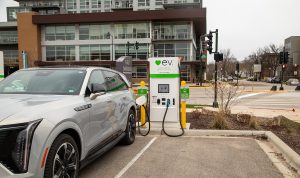
- Electroposts (charging stations) : the necessary infrastructure for cars, trucks, and buses to charge.
- Condominiums: will be a huge market because all their parking spaces will need chargers.
The CEO of Canal Solar also highlighted the role of education. “In the education space, we teach classes on how to install solar generation. Today our best-seller is the BESS course, where we train more than 100 people per month,” he revealed. And he announced that in the second half of the year they will launch a new course on the integration of electromobility.
In his closing, Bernardo Marangón summarized his vision: “Solar energy will help reduce costs, BESS will help with demand and energy quality, and chargers—maybe not the one-megawatt-in-five-minute ones because those would be very expensive, but I don’t doubt the Chinese ability to make solutions cheaper—will be in every parking space.”
And he left with this phrase: “The electricity sector and mobility are the same future, and the time is now.” He then invited the audience to join that wave, assuring that within nine years many of those present will be watching that exponential curve at its peak.
A Year of Consolidation for Mobility
The Latam Mobility 2026 Tour will continue in Medellín, Colombia, on June 10–11, and will later arrive in Santiago, Chile, on August 25, bringing together experts and strategic players to further strengthen the sustainable mobility ecosystem in the region.
The tour will conclude in Mexico City on October 12–13, alongside the Climate Economy Forum, in an event that will bring together leading figures from the sector to continue driving the transition toward more efficient, sustainable, and low‑emission transportation systems in Latin America.
The transition is already underway. The Latam Mobility 2026 Tour will be the meeting point to accelerate decisions, connect key players, and collaboratively build sustainable mobility for Latin America.
colaborativa, la movilidad sostenible de América Latina.