



During “Latam Mobility Colombia 2026,” held at the Orquideorama of the Medellín Botanical Garden, the panel “B2B Charging Infrastructure and CPOs: Transformation, Financial Models and Technology” took place, moderated by Andrés García, Director of Mobility at Invest In Latam.
The panel consisted of César Alor Salinas, Director of Sales for Latin America at Autel; Deibit Lozano Grimaldo, CEO of CIEN by Internacional de Eléctricos; Jefferson Beltrán, Commercial Manager for the Andean Region at Livoltek; Juan David Alfonso, E-Mobility Account Manager at Huawei Digital Power; and Patricia Baires, Business Development Manager for Latin America at SynergEV.
They all agreed that electromobility is no longer a promise but an everyday reality, but warned that critical challenges remain regarding infrastructure, regulation, and user experience.
Andrés García opened the session by noting that the electric vehicle fleet in some Colombian cities is growing at a rate of 300% , and it is estimated to close the year with 400% growth. As of June 2026, more electric vehicles had already been sold than in all of 2025.
Given this reality, the big question cutting across the ecosystem is whether charging points are keeping up with that demand and generating enough confidence for users to travel between cities without range anxiety.
You may also be interested in | Report: Commercial Fleets Abandon the Bet on a Single Technology and Adopt Diversification as a Strategy to Face Economic and Regulatory Uncertainty
User Experience and Network Operation as Central Pillars
César Alor explained that Autel approaches mobility from a unique perspective: deep knowledge of the vehicle. With over 40% market share in automotive scanners, the company has poured its big data on electrochemistry and battery health into its chargers.
He warned that purchasing cheap chargers or those of dubious origin can generate million‑dollar losses when a bus or taxi goes out of service due to charger failures. He stressed the importance of having certifications under RETIE 2024 and local technical support. “What is premium for others, for Autel is the factory standard,” he stated.
For his part, Deibit Lozano Grimaldo put the focus on user experience as the center of everything. His company, with 30 years of experience, has developed a unique ecosystem ranging from transformers and substations to software with artificial intelligence. He highlighted the need to organize charging through intuitive technology and open the brand architecture to work with any manufacturer – because mass adoption will not happen within a single ecosystem.
He also warned about an emerging problem: the capacity of the energy grid. To address this, CIEN by IE is already building solar farms that certify the use of renewable energy to its users, delivering big data for corporate sustainability reports. Regarding fleets, they offer corporate memberships that allow drivers to charge without needing multiple apps or cards.
Integration of Renewable Energy and Storage
Jefferson Beltrán emphasized that Livoltek does not see itself just as a hardware integrator, but as an integrator of technology, software, and electrical experience accumulated over 34 years. He proposed that smart electric mobility must combine photovoltaic systems and storage solutions, especially given grid connection restrictions.
The company is already developing comprehensive projects for bus fleets and private vehicles, emphasizing customer education so they do not buy cheap technology from uncertified platforms, but rather equipment that matches the vehicle’s useful life (10 to 15 years).
Meanwhile, Juan David Alfonso presented Huawei’s proposal based on three pillars: safety (with liquid cooling in power modules), modularity and flexibility (up to 12 connectors in 600 kW chargers), and total cost of ownership – warning that what matters is not the lowest CapEx, but sustainable OpEx over time.
He also shared a personal experience as an electric vehicle user: on a trip from Cali to Bogotá, he could only find one functional charger in Armenia, evidencing the lack of reliable infrastructure on road corridors. He recommended that CPOs maximize availability (uptime above 90% ) and understand that the business is not charging vehicles, but injecting kilowatt‑hours – similar to the logic of gas stations.
Software as a Profitability Tool
Patricia Baires, representative of SynergEV, recalled that 4 or 5 years ago the debate was whether vehicles or infrastructure should come first. Today, the problem is different: infrastructure is growing at a slower pace than the vehicle fleet.
She noted that the type of connectors is no longer an obstacle, and that the real enabler is management software, which must be robust and allow remote charger management, setting differential rates, integrating payments with credit cards and RFID (Radio Frequency Identification), and generating data to evaluate project profitability.
Baires presented the concept of “collaborative charging” : a fleet that uses its chargers at night can open them to the public during the day, generating additional income and accelerating return on investment. This model, together with well‑planned public access stations, is key to making projects economically viable.

Interoperability and Trust as Keys to the Future
One of the most technical moments of the panel came when César Alor outlined the four charging scenarios: residential, destination charging (hotels, restaurants, shopping malls), fast public charging, and fast charging for fleets – plus a mixed model (electric terminals that charge fleets at night and open to the public during the day).
He proposed moving away from “rigid infrastructure” and betting on financial modularity: starting with a lower‑capacity substation and scaling up power using chargers with dynamic power balancing and demand management. This avoids sinking large amounts of capital before demand justifies it. He cited examples from Guatemala and Mexico where this strategy has prevented residential grid collapse and enabled differentiated rates.
For his part, Deibit Lozano was emphatic: Colombia will be one of the first countries in the region to implement interoperability in electric vehicle charging, inspired by the successful toll road experience. He warned that no user wants to have 22 apps on their phone to charge their vehicle.
Therefore, he invited CPOs to prepare their hardware and software to comply with the National Government’s guidelines. He also revealed a concerning fact: about 30% of chargers currently installed in the country are not working correctly, eroding trust. His company contractually guarantees 99.5% uptime through remote asset control and management.
Closing Messages: Great Opportunity and Need to Share Experiences
In the final round, Juan David Alfonso encouraged attendees to develop projects because the market is so underserved that everyone present could become CEOs without competing with each other. He invited them to ask questions without fear and to work toward reaching the goal of 300,000 electric vehicles in Colombia by 2030.
Deibit Lozano insisted that technology is meant to make users’ lives easier – not to complicate them with barriers like fixed‑name billing. He noted that with 80,000 electric vehicles in the country and only 500 charging points (of which 25‑30% are not operating properly), approximately 3,000 charging points would be needed to achieve the optimal ratio of 35 vehicles per charger.
César Alor closed with a key word for the Colombian investor: certainty. Autel offers equipment with immediate delivery, RETIE certification, and local technical support through its partner Molpartes – eliminating logistical and technical anxiety.
Patricia Baires called for sharing information and experiences among all ecosystem actors. “We are not many, but we have to be the most effective,” she said, and asked to evaluate each step of the projects to shorten return on investment timelines.
Finally, Jefferson Beltrán summarized the spirit of the panel with a phrase: “The sun shines for everyone.” And he concluded: “There is a gigantic opportunity combining customer service, quality, and opportunity. We have everything to do and everything to support you.”
Moderator Andrés García thanked the panelists and recalled that just as years ago people asked when electric vehicles would arrive, today the question is when more charging points will arrive. The answer, according to the experts, is already underway: with technology, collaboration, smart regulation, and above all, trust.
A Year 2026 of Consolidation for Mobility
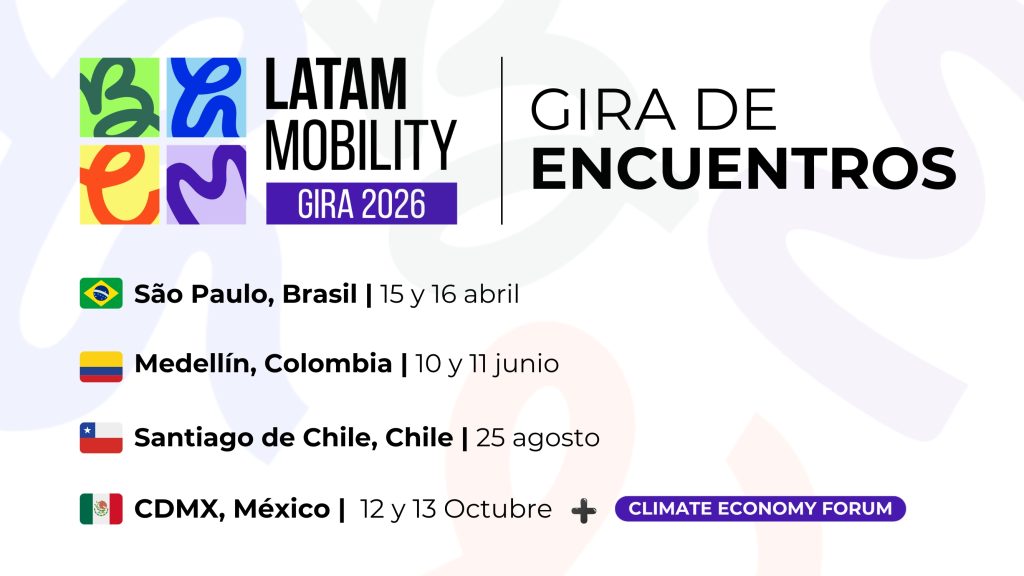
The Latam Mobility 2026 Tour will continue in Santiago, Chile, on August 25, bringing together experts and strategic players to further strengthen the sustainable mobility ecosystem in the region.
The tour will end in Mexico City on October 12 and 13, alongside the Climate Economy Forum, in a meeting that will bring together sector leaders to continue driving the transition toward more efficient, sustainable, low‑emission transportation systems in Latin America.
The transition is already underway. The Latam Mobility 2026 Tour will be the meeting point to accelerate decisions, connect key players, and collaboratively build sustainable mobility in Latin America.