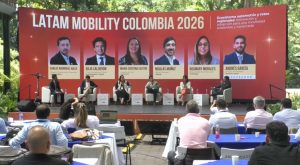


As part of Latam Mobility Colombia 2026, held at the Orquideorama of Medellín’s Botanical Garden, the panel “Logistics 360: TCO, Renting and the Renewal of Clean Fleets in Supply Chains” took place, moderated by Daniela García, Brazil Country Manager for Latam Mobility.
The session featured Clarita María García (Executive Director of Defencarga), Francesco Pileggi (General Manager of Budget), Patrick Sullivan (President and Managing Director of Michelin Colombia & Ecuador) and Santiago Giraldo Gómez (General Manager of Edinsa).
The panel tackled the challenges and opportunities for achieving cleaner, more efficient and profitable logistics in the region.
You may also be interested in | Autel, CIEN, Huawei Digital Power, Livoltek and SynergEV Agree That Interoperability and Financial Modularity Are Key for Charging Infrastructure in Colombia
The Myth of Financial Infeasibility
Daniela García opened the conversation by raising the need to bust the myth that switching to sustainable fleets is financially unworkable in Colombia.
Francesco Pileggi, General Manager of Budget, explained that renting plays a central role by converting the need for CAPEX (capital investment) into predictable, steady spending. “The upfront CAPEX is high and real. Renting turns that need into a management decision,” he said. He also highlighted that incentives from Law 1715 and its amendments get passed on to the leasing fee, making the bet viable.
Clarita María García, Executive Director of Defencarga, broadened the view: “The main challenge is often not the financial side, but the inefficiency of the logistics system.” She shared striking data: Colombia has a fleet of over 378,000 public cargo service vehicles, with an average age of 21 years. Furthermore, 58% of tractor‑trailer owners are small operators, and in other configurations, 82% are small operators.
Add to that 760 road disruptions so far this year, a technological bottleneck from the National Cargo Dispatch Registry (RNS) with 427 hours of failures impacting 1.8 million trips, and 37 new transportation regulations in the past year. “The conversation can’t only look at the financial side, but must take all these inefficiencies into account,” she stated.
Santiago Giraldo Gómez, General Manager of Edinsa, reinforced this point by noting that asset utilization in Colombia hovers around 22% of calendar time. “A tractor‑trailer worth 600 or 700 million pesos gets used only 6 effective days per month. The barrier isn’t just the asset price, but also technological and road infrastructure, plus social issues.”
In that context, OpEx (operational expense) becomes relevant: improving asset utilization dilutes the investment cost and allows progress toward sustainable mobility.
Concrete Experiences from the Field
The panel delved into the innovations and strategies organizations are implementing to make the cost per kilometer of clean fleets competitive against fossil fuels.
Santiago Giraldo shared Edinsa‘s progress, the logistics company of Postobón. “We have 12 electric distribution trucks, the first electric tractor‑trailer in Colombia with a 52‑ton capacity, and we’re finishing 235 tests with a hydrogen combination (diesel‑hydrogen hybrid),” he detailed.
He explained that they use benefits from the Mining and Energy Planning Unit (UPME) as a fiscal shield to make projects viable, and noted that operating electric fleets reduces wear components and improves OpEx compared to fleets that are 21 years old.
Patrick Sullivan of Michelin Colombia & Ecuador spoke in English and was translated by the moderator. He stressed that the key is educating fleets – from large companies to individual owners – about the impact of tires on fuel consumption. “A tire optimized for the routes and the fleet can save 1 liter of fuel every 100 km, which is substantial,” he said.
For Michelin, speaking the language of TCO (total cost of ownership) is essential: the tire must be seen as an investment that improves productivity and energy efficiency. As vehicles electrify, the tire becomes a central point for extracting extra miles from the battery.
Francesco Pileggi added two areas of work from Budget. On one hand, uncertainty about the residual value of clean vehicles in the secondary market (they haven’t yet completed their cycle in Colombia) raises lease rates. To mitigate this, they work with scenario models based on more mature markets.
On the other hand, they are expanding their network of partners for clean fleet maintenance, because while these vehicles have lower maintenance costs, the lack of qualified technical capacity nationwide can cancel out that benefit.
New Urgencies in Risk Management
In a context of climate stress and operational volatility, the panelists agreed that risk assessment criteria have changed drastically when operating low‑emission fleets.
Clarita María García introduced the concept of “operational resilience,” which became central since the pandemic. She pointed to three priority elements: infrastructure as an enabling condition (it used to be just an optimizer; today, without charging infrastructure, you can’t operate); predictive maintenance (which no longer just optimizes costs but guarantees operational continuity); and dynamic route management given the five or six daily disruptions from blockades or accidents in Colombia.
“We need real‑time information to react flexibly. Risk management, when dealing with clean technologies, is much more demanding,” she said.
Santiago Giraldo added that at Edinsa, sustainability is embedded throughout the supply chain. They don’t just evaluate projects by NPV or payback; they also incorporate objective qualitative criteria tied to the value of sustainability, which is overseen by hyper‑regulation and environmental commitment. “Today we’re reaching financial parity, but we also need to factor sustainability criteria into the equation,” he argued.
Francesco Pileggi broke down the three risk factors that are magnified with clean fleets: the asset (lack of a secondary market), the operation (insufficient charging infrastructure that hurts productivity), and the context (regulatory benefits mainly go to the first buyer, affecting secondary market development). “For Budget, it’s imperative that a secondary market develops and that there’s enough infrastructure for fleet managers,” he explained.
Patrick Sullivan closed this block by highlighting the use of data and sensors to move from reactive to proactive management. Michelin manufactures tens of millions of tires a year and captures data at every step. “Measuring and capturing data from every aspect of fleet operation allows you to predict and optimize, achieving fleets that are more reliable, productive and connected,” he said.
Decarbonization Can’t Be a One‑Actor Show
At the panel’s close, the experts agreed on a common diagnosis and outlined shared lines of action. The transition to clean fleets in cargo logistics is not a challenge that any single actor can solve; it requires systemic coordination between the public sector, private sector, trade associations, and logistics operators of all sizes.
The panelists stressed that renting, smart tire management, electrification and hydrogen use are complementary tools, not mutually exclusive. Each of these solutions contributes from its own link to reducing total cost of ownership (TCO) and lowering emissions.
The key, they agreed, is using real data to make decisions, strengthening predictive maintenance, and developing dynamic route management to navigate the region’s operational volatility.
They also highlighted the urgency of creating enabling conditions such as a secondary market for clean vehicles, expanding charging infrastructure, and technically training the maintenance network so that the operational benefits of sustainable fleets don’t get diluted.
The panelists called on local and national governments to base public policies on solid data rather than perceptions, and to ensure that regulatory incentives reach all links in the chain, including small owners and large companies alike.
Moderator Daniela García thanked the leaders for sharing their experiences and best practices, and noted that Latam Mobility will continue to be a meeting space to build a joint roadmap. “This ecosystem vision is the only way to transform logistics in Latin America. We invite you to keep working together for the rest of the event and beyond,” she concluded.
2026: A Year of Consolidation for Mobility
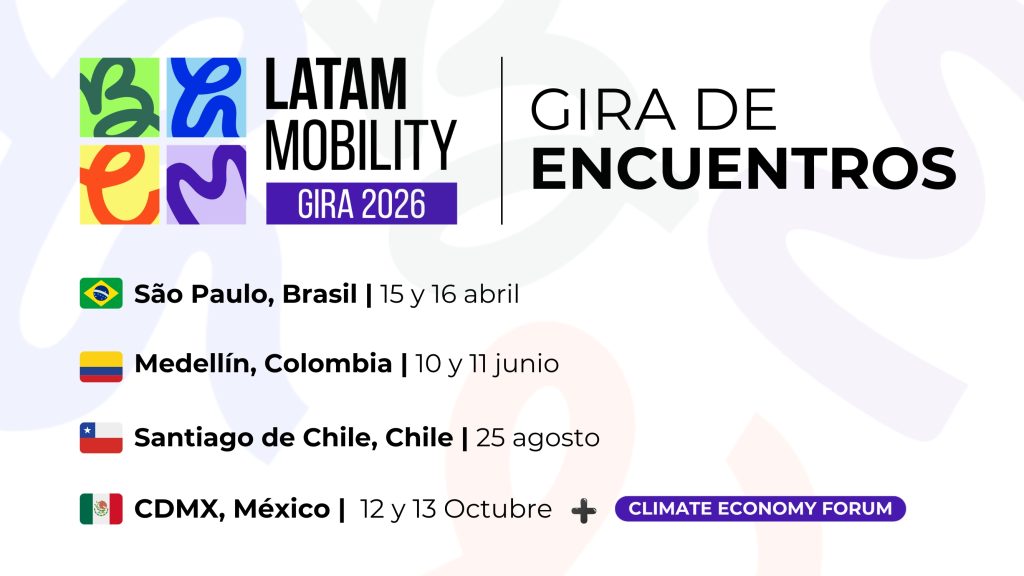
The Latam Mobility 2026 Tour will continue in Santiago, Chile on August 25, bringing together experts and strategic players to further strengthen the sustainable mobility ecosystem in the region.
The tour will end in Mexico City on October 12 and 13, alongside the Climate Economy Forum, in a meeting that will bring together industry leaders to continue driving the transition toward more efficient, sustainable and low‑emission transportation systems in Latin America.
The transition is already underway. The Latam Mobility 2026 Tour will be the meeting point to accelerate decisions, connect key players and collaboratively build sustainable mobility in Latin America.