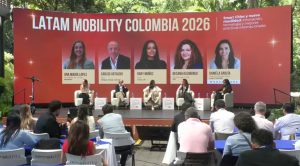


During the eighth edition of “Latam Mobility Colombia 2026” , held at the Orquideorama of the Medellín Botanical Garden, Costa Rica participated as a guest country in a featured panel discussion organized in partnership with ASOMOVE (Costa Rican Electric Mobility Association).
The session brought together leaders of Costa Rica’s sustainable mobility ecosystem to share experiences, best practices, and concrete solutions that can be replicated in Colombia and throughout the region.
You might also be interested in | Autel, CIEN, Huawei Digital Power, Livoltek, and SynergEV agree that interoperability and financial modularity are key to charging infrastructure in Colombia
Comprehensive Public Policy As A Driver Of Change
Moderator Silvia Rojas, director of ASOMOVE, opened the conversation with data. She explained that Costa Rica passed Law 9518 on Electric Mobility in 2018, a comprehensive public policy that included tax exemptions, incentives for charging infrastructure, and exclusive promotion of 100% electric vehicles — excluding hybrids because they are considered transition technologies that still pollute.
The result of the law has been exponential growth: in the last months of 2026, more than 20% of new vehicles sold in Costa Rica are 100% electric.
Silvia Rojas highlighted that thanks to the incentives, electric vehicles already cost the same or even less than combustion vehicles at the time of purchase, without even considering operational savings (Opex). “Opening the market generated competition, all the brands arrived, and prices dropped,” she said.
Jorge Asch Revilla, president of ASOMOVE, added that the association is a user organization, not a sellers’ organization, with approximately 1,500 members. Its mission is to promote the use of electric vehicles and create tools that facilitate the transition.
“In Costa Rica, we asked ourselves an uncomfortable question starting in 2015: are we going to incentivize many technologies for years, or are we going straight to zero emissions? We decided to go straight,” he stated.
One App To Unify Charging Infrastructure
One of the biggest challenges for electric vehicle users is the multiplicity of apps and the lack of standardized information about chargers. Jorge Asch presented the solution developed by ASOMOVE: a mobile application that unifies information on all public chargers in the country.
The app allows users to know in real time the availability of each charger, whether it is in use, if it has faults, what type of connector it has, which utility company it belongs to, and how to make the payment.
Costa Rica has six electricity distributors with chargers and four different types of connectors (Chademo, CCS combo one, combo two, and GBT — the latter with 70% presence). The app resolves user uncertainty by indicating which chargers are compatible with their vehicle.
Additionally, ASOMOVE generates usage statistics and heat maps that it shares with authorities (Ministry of Environment and Energy, and the Public Services Regulatory Authority) and with the distributors.
“If we detect an area with many people looking for chargers and there are none, we suggest that distributors install new stations there,” explained Asch. The moderator added that this inter-institutional coordination has been key to the tool’s success.
Heavy-Duty Fleet Electrification
Maynor Sandoval López, general manager of Automotores Cabus S.A. , shared his company’s experience in incorporating 100% electric tractor-trailers of up to 50 tons in Costa Rica. Currently, they have already placed around 20 heavy-load units operating in the country, and the first project with six tractor-trailers has logged more than 180,000 kilometers over three years.
Sandoval emphasized that they did not wait for the ecosystem to be fully articulated: “Someone had to do everything. While we waited for a series of things to be coordinated, we weren’t going to develop the projects.”
His company developed its own economic model, used specialized modeling software, measured real-world data in the field, and trained technicians in China to understand the electric vehicle powertrain.
The results are astonishing in terms of operational savings, especially when compared to low-efficiency vehicles (the most common in Latin America, with fleets 15 to 20 years old).
“Profitability becomes very attractive for business owners,” he said. His message for Colombia: the technologies are available, there are solutions for all scales and projects, and you need to start taking steps without waiting for everything to be fully in place.
Lithium Battery Circular Economy
Daniel Rivas Garcia, commercial advisor for Lithium Batteries and Circular Economy at Fortech, presented his company’s work in recovering and recycling lithium batteries, developing proprietary technology to process end-of-life batteries and also scrap (factory rejects) in Costa Rica and Mexico.
In Costa Rica, they have an installed capacity of 1,500 tons per year, and in Mexico they will reach 6,000 tons by the end of 2026 through their SIMEQ system: a process that recovers critical materials such as lithium, cobalt, nickel, copper, aluminum, plastics, and electrolytes, reintroducing them into the value chain. 100% of the battery returns to industry.
Rivas highlighted the environmental benefits: for every 1,000 tons of batteries recovered (instead of mining minerals), 1.5 million cubic meters of water are saved (equivalent to the annual consumption of 14,000 families) and 4,865 metric tons of CO2 are avoided (equivalent to removing 1,000 combustion vehicles for one year).
The business model is based on the circular economy: manufacturers pay for the responsible management of their batteries, and the recovered materials generate economic returns. “True sustainability is not just about using clean energy; it’s about being responsible from start to finish. We are excited to be part of the solution and to demonstrate that advanced waste management is the engine of the future,” Rivas concluded.
Move Forward Without Postponing
In closing, Silvia Rojas reminded the audience that Colombia is already working on a public energy efficiency policy for vehicles (efficiency standard). “We don’t want Colombia or Costa Rica to be left behind,” she said.
Jorge Asch announced that Costa Rica has just approved a bill allowing private companies to participate in public charging, so the ASOMOVE app will evolve to also integrate private chargers and offer recommendations based on the user’s profile.
For his part, Maynor Sandoval reiterated that there is no need to worry about power or distances, but rather to take the necessary steps without postponing the transition.
Daniel Rivas announced that Fortech already has a representative in Colombia and is ready to manage battery recycling in the country, ensuring safe and responsible final disposal.
Silvia Rojas closed the panel with an uncomfortable question for Colombia: “How fast do you want to go to zero emissions? The time it takes depends on you and the decisions you make about the public policies you are analyzing today.”
The panelists thanked Latam Mobility for the invitation, reaffirming their commitment to continue building bridges between Costa Rica and Colombia to accelerate sustainable mobility in the region.
A Year 2026 of Consolidation for Mobility
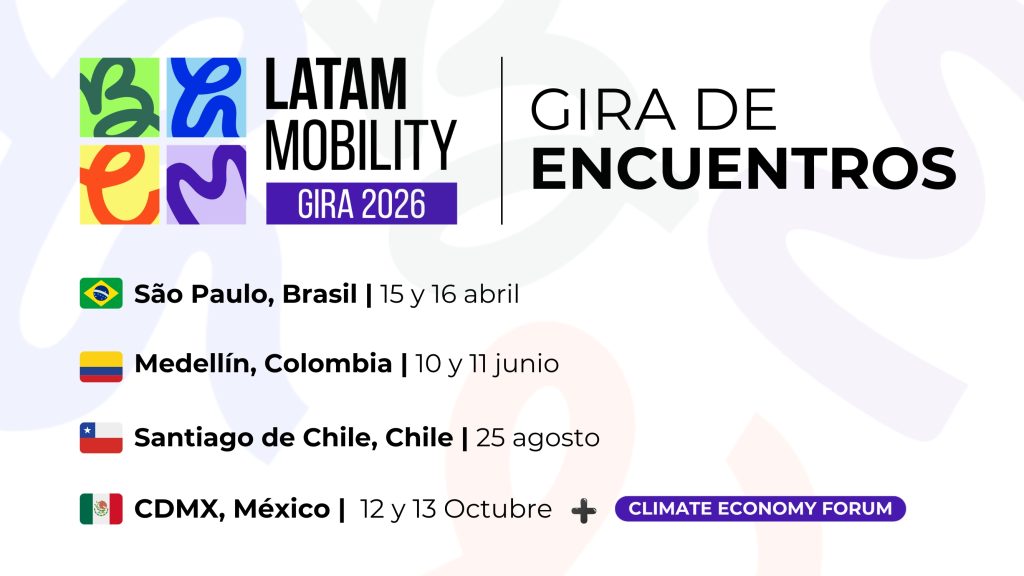
The Latam Mobility 2026 Tour will continue in Santiago, Chile, on August 25, bringing together experts and strategic players to further strengthen the sustainable mobility ecosystem in the region.
The tour will end in Mexico City on October 12 and 13, alongside the Climate Economy Forum, in a meeting that will bring together sector leaders to continue driving the transition toward more efficient, sustainable, low‑emission transportation systems in Latin America.
The transition is already underway. The Latam Mobility 2026 Tour will be the meeting point to accelerate decisions, connect key players, and collaboratively build sustainable mobility in Latin America.