


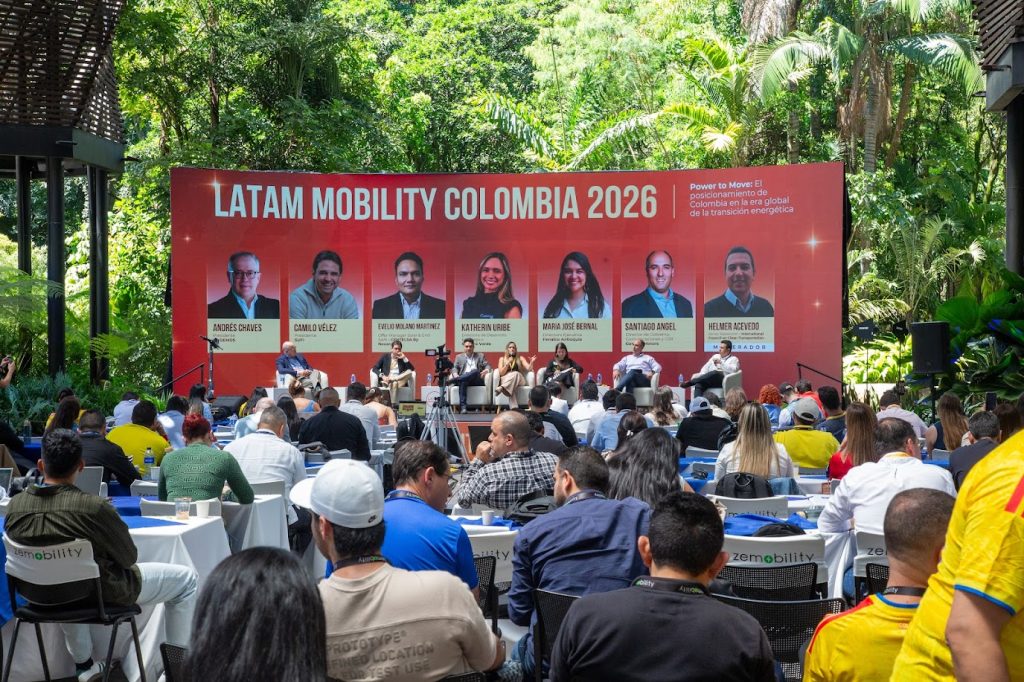
As part of the Latam Mobility Colombia 2026 meeting in Medellín, the panel “Transition to Zero and Low-Emission Mobility: Market Challenges, Regulation, Financing and Scalability” took place.
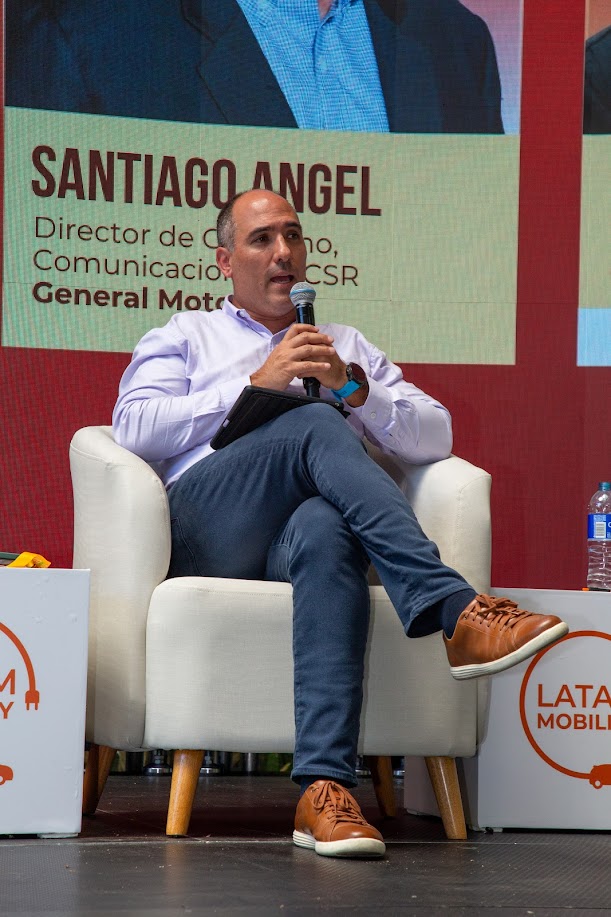
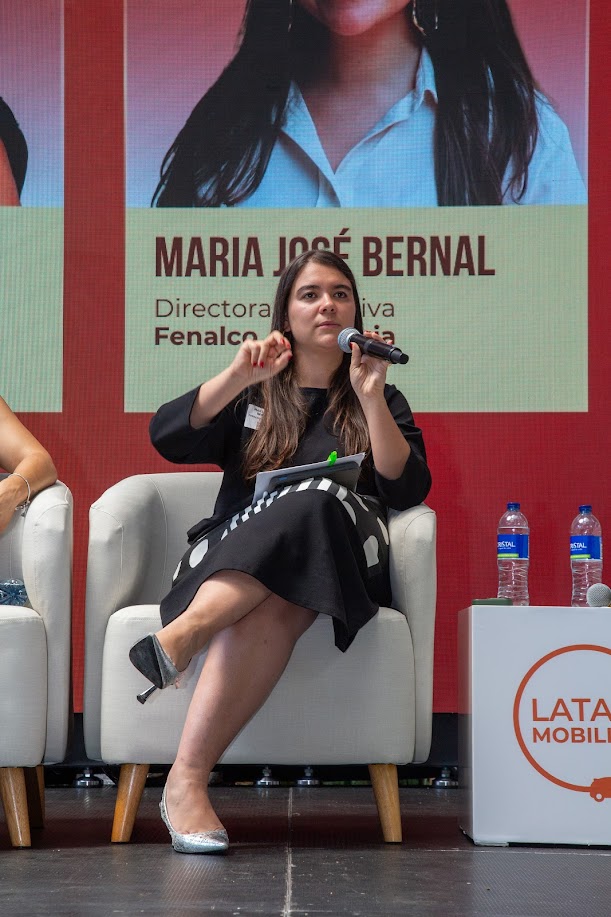
The conversation, moderated by Helmer Acevedo (Senior Researcher at the International Council on Clean Transportation – ICCT), brought together six key players: Andrés Chaves (President of Andemos), Camilo Vélez (President of Sufi), Evelio Molano Martínez (Offer Manager Solar & Grid SAM at Centelsa By Nexans), Katherin Uribe (Director of Strategic Development at Sistema Verde), María José Bernal (Executive Director of Fenalco Antioquia), and Santiago Ángel (Director of Government, Communications and CSR at General Motors).
Throughout the session, panelists agreed on a shared diagnosis: Colombia is experiencing a historic acceleration in the adoption of low and zero-emission vehicles, but the transition still faces critical bottlenecks in infrastructure, regulation, financing for SMEs, and the circular economy.
The dialogue made one thing clear: there is no single recipe. The future of sustainable mobility will depend on the ability to articulate stable policies, coordinated investments, and a profound cultural shift.
You May Also Be Interested In | Indigo, JET, Taxia Life and Medellín’s Tourism Secretary Agree: without Control and without Data, there is no Sustainable Mobility
Explosive Market Growth: Figures Transforming the Landscape
The panel opened with a diagnosis of the sector’s current state. María José Bernal (Fenalco Antioquia) shared data that set the tone: between January and May 2026, electric vehicle sales grew 217% in Colombia and 288% in Antioquia compared to the same period in 2025. Hybrids, for their part, increased 72% nationwide.
“Consumer trends have changed. Buyers are now demanding and are opting for much more sustainable mobility alternatives,” she said. She warned that this growth has not been matched by equivalent expansion of charging infrastructure, creating a gap that threatens to slow the positive momentum.
Santiago Ángel (General Motors) added a long-term perspective. He recalled that just a few years ago, electric vehicles represented less than 1% of sales, whereas today they reach nearly 15%. “If you add hybrids, nearly 50% of the new fleet is new energy vehicles. No one else in the region has that,” he emphasized.
Ángel attributed this achievement to a combination of growing supply, well-calibrated incentives, and greater environmental awareness. Still, he warned that heavy-duty and cargo vehicles face unresolved technological challenges – such as range and battery weight – making their electrification more complex.
Andrés Chaves (Andemos) agreed that the market has responded favorably but focused on the fragility of that growth. “Colombia is a country with a very high interventionist vocation, but it represents barely 0.22% of the global automotive market. We cannot influence major global decisions, but we can scare away investment with contradictory local regulations,” he warned. For Chaves, regulatory stability is not a minor detail – it is the condition that makes continued expansion possible.
Camilo Vélez (Sufi) provided the financial perspective. He revealed that three years ago, only 20% of Sufi’s business was linked to sustainable mobility; today that figure reaches 64%. “We finance more than 3,000 units per month and have a portfolio exceeding 6 trillion pesos. Our contribution is not just rates, but an integrated value proposition,” he explained. He highlighted that the financial institution has had to evolve its traditional credit models to serve segments such as small truck owners and SMEs, whose cash flows don’t fit conventional banking standards.

Charging Infrastructure and the Electrical Grid: Present Technical Challenges
One of the strongest points of consensus was the urgent need to expand and modernize charging infrastructure. María José Bernal provided figures illustrating the magnitude of the gap: in Medellín, there is one charging station for every 377 electric vehicles; in Envigado, the ratio plummets to one for every 1,968 vehicles. “We need a clear roadmap to close that gap,” she emphasized. She also mentioned the challenge of residential charging, especially in older buildings not designed to handle the extra demand.
Evelio Molano (Centelsa By Nexans) shifted the debate to the electrical distribution network, which he called “the arteries of electromobility.” He noted that much of the current infrastructure dates back to the 1950s, 1960s, and 1970s, severely limiting transmission capacity. “There is conductor technology that allows doubling current capacity with the same infrastructure. The cable exists; it is RETIE-certified. The challenge is not technical – it is about upgrading and political will,” he emphasized.
Molano also stressed the need for technical training for electricians, engineers, and communities, as well as simplifying connection procedures. “Vehicle sales will no longer be a discussion among dealerships, but among whoever has the best distribution network,” he stated.
Santiago Ángel agreed that the virtuous cycle of electromobility will only be completed when users can travel anywhere in the country without fear and find reliable charging stations. “Years ago, infrastructure providers said they wouldn’t install charging because there wasn’t enough demand. Today demand exists. Now it’s up to all of us to support the growth of stations,” he said. He warned, however, that without a robust network and stable incentives, consumer confidence could crack.
Meanwhile, moderator Helmer Acevedo introduced an additional concern: the El Niño phenomenon, whose probability of occurrence exceeds 90% in the second half of the year, with a high chance of being severe. Molano responded that renewable energies are safe but require storage, citing Chile as an example, where BESS (battery energy storage systems) are becoming widespread alongside solar and wind farms.
“Colombia should begin to scale up that technology so it doesn’t depend so much on climate phenomena,” he proposed, and insisted on the need to update RETIE to facilitate access to these solutions.
Regulation and Incentives: Instability as a Brake
The second major block of the panel focused on public policy and its impact on investor confidence. Andrés Chaves was forceful when referring to the recent imposition of a 25% tariff on zero and low-emission vehicles, a measure he called “a perverse incentive.” “We cannot be regulating cars. We are regulating people’s needs: urban supply, the country’s competitiveness, and urban mobility. If we put the burden on citizens, this will never work,” he stated.
He also noted that the average age of Colombia’s vehicle fleet exceeds 19 years for passenger vehicles and reaches 21 years for heavy cargo, highlighting the urgency of replacement policies rather than penalization.
Santiago Ángel supported this view and added that incentives must be maintained over time. “Every time there’s a change of government, the discussion comes up about what should be kept and what shouldn’t. The recommendation is that hopefully what exists stays,” he requested. He pointed out that heavy and cargo vehicles face additional technological challenges (range, battery weight, economic feasibility), so making those products even more expensive is counterproductive. “That policy prevents that market from taking off at the same speed and intensity as light vehicles,” he concluded.
María José Bernal added the voice of the business community. “Business owners demand simple, clear, and stable regulation. No more changes every four years. We need confidence to make structural decisions,” she stated. She highlighted that driving restrictions, tariff benefits, and tax incentives weigh heavily on purchasing decisions, and asked that these tools be maintained over the medium and long term. She also mentioned that road infrastructure is another forgotten component: the growth of the vehicle fleet has not been matched by equivalent investments in roads and connections.
Camilo Vélez agreed that regulatory stability is essential for the financial sector to offer long-term products. “There cannot be back-and-forth. Trust is built with clear rules that endure,” he argued.
Inclusive Financing: Small Truck Owners and SMEs
Camilo Vélez delved into a less visible but important topic: financing for small transporters and SMEs. “The big challenge is not large companies with leasing, but SMEs and small truck owners. We have to move away from traditional credit studies and understand their reality: their contracts, their cash flow, their operation,” he explained.
He revealed that Sufi has developed flexible credit models through its Consumer Finance division, moving away from traditional banking to serve this segment. “We have to believe in and bet on that business model,” he stated.
As necessary milestones for scaling sustainable financing, Vélez mentioned three elements: regulatory stability, a clear perception of profit for businesses, and building trust in the sustainable mobility ecosystem. “If we solve that, I am sure we will be much more effective in development, both for small truck owners and for any mobility sector,” he concluded.
Andrés Chaves supported this approach, noting that without vehicle fleet replacement policies and accessible financing lines, the transition will become slower and more unequal. “It’s not about selling more new cars, but about replacing old, polluting vehicles with safer, cleaner ones. That requires public and private resources working together,” he stated.
Circular Economy: The Invisible But Vital Link
Katherin Uribe (Sistema Verde) introduced an aspect that adds another dimension: what happens to the waste generated by the transition. “We don’t understand sustainable mobility if we don’t also look at closing the loop. For 10 years we have been working on circular management of used tires, lead-acid batteries, and automotive sector packaging,” she explained.
Uribe issued a long-term warning: within 8 to 15 years, Colombia will face an avalanche of spent lithium-ion batteries. “The accelerated growth of electric mobility is wonderful, but we need infrastructure, research, and technology to provide an environmental solution. And today we have neither a clear policy nor incentives for this,” she noted.
She proposed three key signals for the next government: regulatory stability, maintenance of incentives, and rules of the game set for 15 or 20 years.
She also called for greater enforcement of extended producer responsibility, to prevent companies that comply with environmental regulations from competing unfairly with those that do not. “Many companies invest significant resources to close the loop on their waste, but others stay outside. That’s unfair competition,” she denounced.
Helmer Acevedo valued Uribe’s intervention as a call not to remain only in the euphoria of sales, but to plan for the end-of-life of components starting now.
Future Perspectives: Messages to the Next Government
At the panel’s close, the moderator asked each participant for a direct message to Colombia’s next president. The responses reflected a shared diagnosis but with different emphases:
Andrés Chaves (Andemos): “The energy transition in the automotive sector is a people-driven phenomenon. We need to regulate only what is strictly necessary and make it easier for people to continue embracing it. Without regulatory stability, without a vehicle fleet replacement policy, we will be condemned to have old, polluting fleets for many more years.”
Camilo Vélez (Sufi): “Mobility is a basic need for people and businesses. It must be an industry that receives a lot of attention, development, and stability. We need the new government to understand that financing sustainable mobility is not charity – it’s a bet on the country’s efficiency and competitiveness.”
Evelio Molano (Centelsa By Nexans): “We need support for Colombian manufacturing industry. There are companies that comply with all regulations and export. The new government needs to understand that the energy transition is also built with domestic industry. Not everything can be imported. We all build the electrical grid together.”
Katherin Uribe (Sistema Verde): “Strengthen companies. They are the ones generating economic impact, research, and development. The president should keep them very much in mind on his agenda. And he should not forget that sustainability does not end when the vehicle leaves the dealership – it ends when its waste also has an environmentally safe destination.”
María José Bernal (Fenalco Antioquia): “Without security, there is no confidence for investment. This sector requires strategic investment and foreign trade relations. Less taxes and less regulation: business owners dedicate more than 5,000 hours a year to complying with state regulations. The effective tax rate exceeds 70%. For every 100 pesos a company earns, 70 go to the state. The next government will have to have a unique ability to cut public spending, lower taxes, and renegotiate debt. All of that sends signals to investment.”
Santiago Ángel (General Motors) was not present at the close due to scheduling commitments, but during the panel he left a clear message: “The recommendation is that hopefully what exists (in terms of incentives) stays. Colombia has been doing its homework well. Let’s not dismantle what has cost us to build.”
A Transition with Clear Rules and Coordinated Work
The panel “Transition to Zero and Low-Emission Mobility” left several certainties.
First: the Colombian market has already changed. Consumers are massively choosing clean technologies, and the growth figures (217% in electrics, 72% in hybrids) prove it.
Second: infrastructure is not keeping pace – there are critical deficits in charging stations, electrical distribution networks, and residential charging.
Third: regulation has become a factor of uncertainty rather than an enabler, with measures like the 25% tariff causing alarm in the sector.
Fourth: financing for SMEs and small truck owners requires innovative models that break from traditional banking standards.
Fifth: the circular economy cannot continue to be the forgotten link – lithium batteries, tires, and packaging urgently need a management roadmap.
Sixth: and perhaps most cross-cutting – without trust, without stability, and without public-private coordination, the transition will slow down.
As Helmer Acevedo summarized at the close: “Regulatory stability, conditions that favor investment, long-term vision, strengthening of the electrical grid, clear regulation in the circular economy, and partial protection of domestic industry in those sectors where we are potentially successful. That is the recipe this panel leaves us with.”
2026: A Year of Consolidation for Mobility
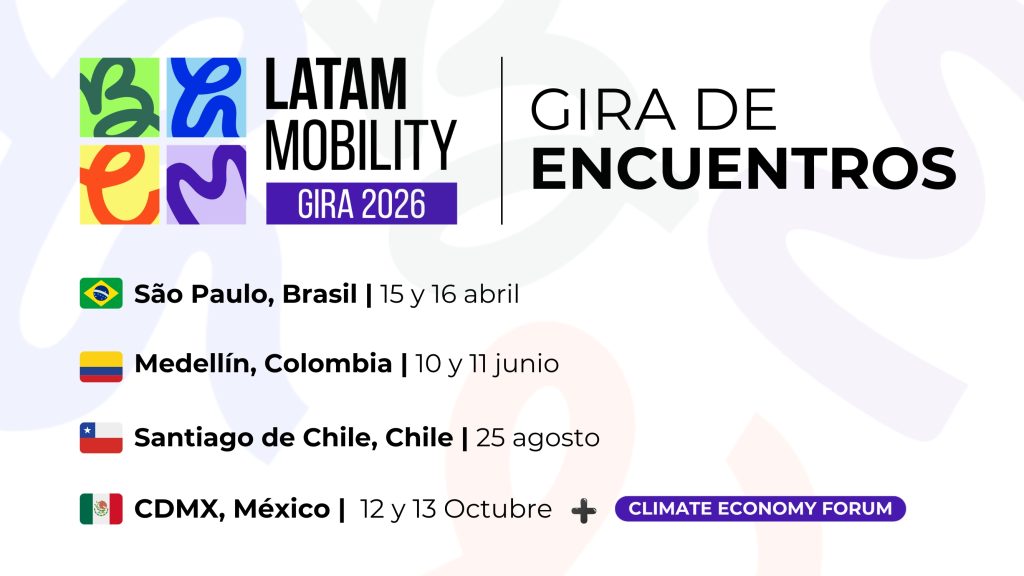
The Latam Mobility 2026 Tour will continue in Santiago, Chile on August 25, bringing together experts and strategic players to further strengthen the sustainable mobility ecosystem in the region.
The tour will end in Mexico City on October 12 and 13, alongside the Climate Economy Forum, in a meeting that will bring together industry leaders to continue driving the transition toward more efficient, sustainable and low‑emission transportation systems in Latin America.
The transition is already underway. The Latam Mobility 2026 Tour will be the meeting point to accelerate decisions, connect key players and collaboratively build sustainable mobility in Latin America.