



Researchers at Kiel University have taken a decisive step toward solving one of the major challenges in the energy industry: getting a precise picture of exactly what happens inside each battery cell while it is in operation.
The team developed a novel communication system that allows sensors to be installed inside the cells and transmit their measurements to the outside using the very same electrical connections already used for charging and discharging—without the need for additional communication cables.
This breakthrough, dubbed by its creators as a “communicative battery” or “talkative battery,” represents a paradigm shift in the management of energy storage systems.
According to an initial cost estimate by the team, the system could reduce expenses by around 35% compared to conventional solutions, which rely on independent wiring for sensors. The concept was presented by Dr. Hamzeh Beiranvand (from the Chair of Power Electronics at Kiel University) in the journal Communications Engineering.
You may also like | Report: Global Electric Vehicle Charging Station Market to Reach USD 143 Billion by 2035
The Problem of Monitoring a Battery From the Outside
Modern batteries—whether those in electric vehicles or large stationary storage systems for renewable energy—are made up of hundreds or thousands of individual cells. Each one experiences slight variations in temperature, pressure, and electrochemical behavior during charge and discharge cycles.
Current battery management systems (BMS) collect information on voltage, current, and temperature to control the operation of the entire pack, but most thermal sensors are placed on the outer surface of the cells.
That location introduces a critical limitation: dangerous heat can begin to build up inside the battery before it is detectable from the outside. By the time the temperature rise reaches the surface, the internal problem may already be at an advanced stage.
Installing sensors inside the cells would provide much more accurate and earlier information, but until now each sensor required additional electronic components and connections to transmit data, consuming valuable space and complicating the design.
A Battery That Uses Its Own Terminals
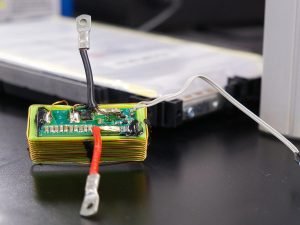
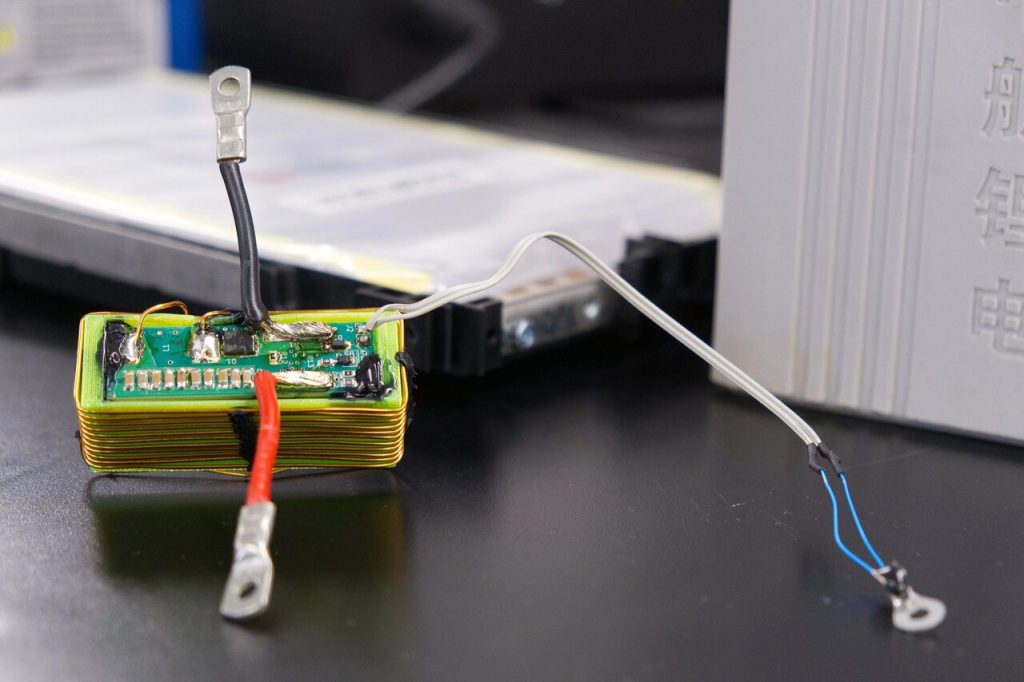
The solution developed in Kiel starts from a clever idea: leveraging the existing electrical connections to also carry sensor data. The team integrated a small electronic circuit directly inside the battery cell.
This device, which takes up very little space, receives measurements from the temperature sensor and converts them into a digital signal. The information then travels to the outside using the same terminals used for charging and discharging the battery, with no need for separate connections.
Furthermore, the system takes advantage of the power electronics that already control the charging and discharging process to facilitate communication. In this way, the battery uses its own electrical infrastructure to report on what is happening inside.
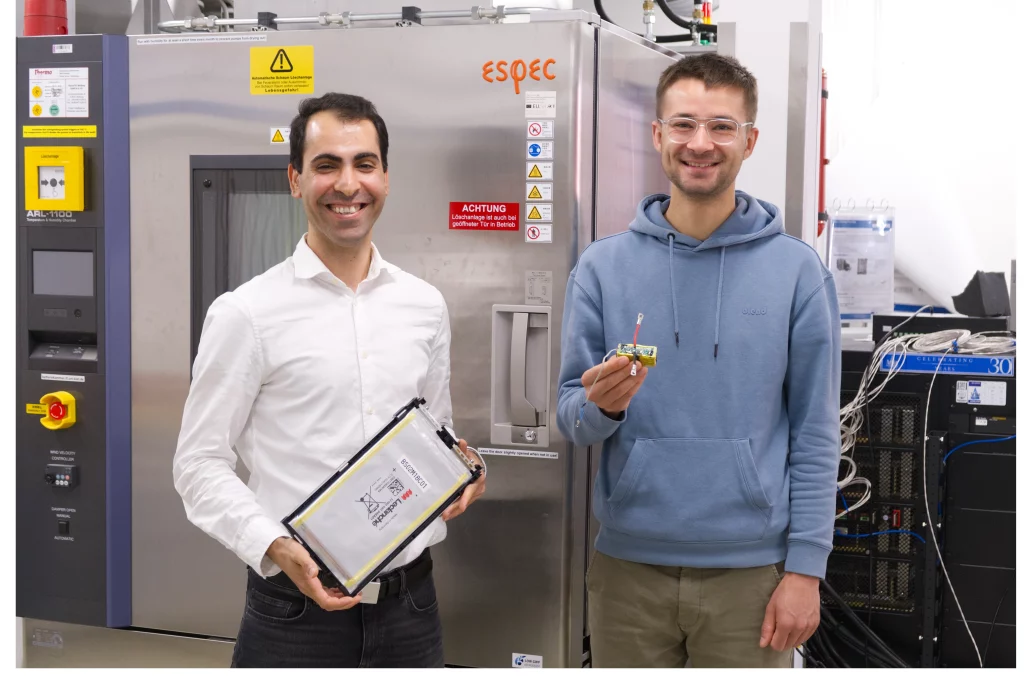
“Our work is a first step toward smart batteries that continuously monitor and report their own status,” said Beiranvand. “This could make battery systems safer and more cost-effective.”
Detecting Signals Before the Problem Advances
Temperature is one of the most important parameters for controlling battery safety. An abnormal rise can indicate internal defects, unwanted chemical reactions, or the onset of processes that rapidly degrade the cell.
Having internal sensors would allow detection of these changes much earlier than systems that measure only from the outside. The information could be sent continuously to the battery management system, which could then reduce charging power, limit current, activate cooling systems, or isolate a problematic cell before the failure affects the rest of the pack.
The major advantage is that the battery would cease to be a relatively opaque component and instead become a provider of detailed, real-time information about its own condition.
The concept developed by Kiel University is not limited to thermal sensors. Johannes Diers, a doctoral researcher at the Chair of Power Electronics and first author of the study, noted that “in principle, the concept is not limited to temperature sensors. Pressure sensors, gas sensors, or other types could also transmit information from inside the battery in exactly the same way.”
This capability would be particularly interesting for detecting degradation processes. During battery aging, internal changes can occur that affect performance long before an obvious failure emerges. Knowing these variations would allow for more precise diagnostic systems and better estimation of the real state of health of each battery.
From Scheduled to Predictive Maintenance
Currently, many batteries are serviced according to maintenance schedules or when symptoms of performance loss appear. The availability of internal data would allow a shift toward predictive maintenance models.
Management algorithms could analyze the evolution of each cell and detect abnormal patterns. A small recurring temperature increase, pressure changes, or gas formation could serve as early warning signs. Maintenance could be performed exactly when it is needed: neither too early nor too late.
For large storage operators, this capability can translate into lower operating costs and greater facility availability. For residential users, it could mean solar batteries capable of reporting their actual condition and remaining useful life more accurately.
The system developed by the Kiel researchers is still in the research phase. Before it can be incorporated into commercial batteries, it will have to demonstrate long-term operation, withstand thousands of charge and discharge cycles, and adapt to different chemistries and cell formats.
It will also be necessary to study how to manufacture these circuits on a large scale without introducing new risks or complicating industrial processes. Miniaturization will be another important aspect: the smaller the sensors and the required electronics, the easier they will be to integrate inside the batteries.
Even so, the demonstrated principle opens an interesting path: obtaining information directly from inside the cells without adding a complex network of communication cables.
A Year 2026 of Consolidation for Mobility
The Latam Mobility 2026 Tour will arrive in Santiago, Chile, on August 25, bringing together experts and strategic players to further strengthen the sustainable mobility ecosystem in the region.
The tour will end in Mexico City on October 12 and 13, alongside the Climate Economy Forum, in a meeting that will bring together sector leaders to continue driving the transition toward more efficient, sustainable, low‑emission transportation systems in Latin America.
The transition is already underway. The Latam Mobility 2026 Tour will be the meeting point to accelerate decisions, connect key players, and collaboratively build sustainable mobility in Latin America.