


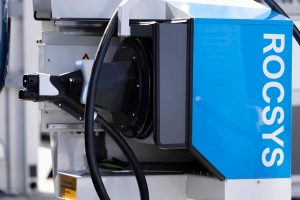

The robotaxi industry is advancing in leaps and bounds toward full autonomy, but it faces a logistical paradox: self-driving vehicles still require a human operator to plug them in at the end of their shift.
To resolve this disconnect, technology company Rocsys has unveiled the Rocsys M1, a robotic charging system specifically designed to operate in autonomous fleet depots.
Billed as the world’s first hands-free charging solution capable of serving multiple bays in robotaxi operations, the Rocsys M1 represents a quantum leap over existing technologies.
Its modular architecture allows a single unit, sliding along an elevated rail, to charge up to 10 electric vehicles simultaneously and completely autonomously.
You may also be interested in | Stellantis joins Wayve and Uber to develop robotaxi fleets on a global scale
The Manual Charging Bottleneck
The global robotaxi market is projected to reach $45.7 billion by 2030, implying exponential growth in fleets operating 24/7. Companies like Waymo are already completing approximately 500,000 paid trips per week with a fleet of 3,000 vehicles in the United States.
This scale turns manual recharging—which requires workers to plug and unplug chargers hundreds of times per shift—into a critical bottleneck for operational continuity.

At the heart of the system is a long-reach robotic arm mounted on an overhead rail. Using a combination of AI-enhanced computer vision and patented soft robotics, it detects the vehicle’s arrival, opens the charge port flap, plugs in the connector, and, once charging is complete, unplugs it.
The company claims the system achieves a plug-in success rate of 99.9% or higher in real-world environments —a reliability backed by more than six years of operational data from previous deployments in ports and highly demanding logistics settings.
The M1 is designed to adapt to variations in lighting, adverse weather, and different parking positions, operating in a temperature range from -30°C to +50°C.

Crijn Bouman, CEO and co-founder of Rocsys, said: “Without unmanned operations, autonomy stops at the depot.” With the M1, the company aims to remove that barrier, turning recharging into an automated process that maximizes uptime and boosts productivity.
Interoperability and Cost Savings
One of the M1’s major advantages is its complete interoperability. The system is compatible with any electric vehicle model, any charger brand, and any type of connector. This allows fleet operators to deploy the technology without costly vehicle modifications or locking themselves into a single charging provider.
From an economic standpoint, automated recharging has a direct impact on the bottom line. Rocsys calculates that in a depot with 50 parking spaces, installing the M1 could increase operational efficiency by up to 75% with the same staff and generate annual savings of up to $1.7 million.
To drive development and commercialization of the M1, Rocsys closed a $13 million Series A extension, bringing its total funding raised since founding to $56 million. The round was led by Capricorn Partners, with participation from Scania Invest, Forward.One, SEB Greentech Venture Capital, and Graduate Ventures.
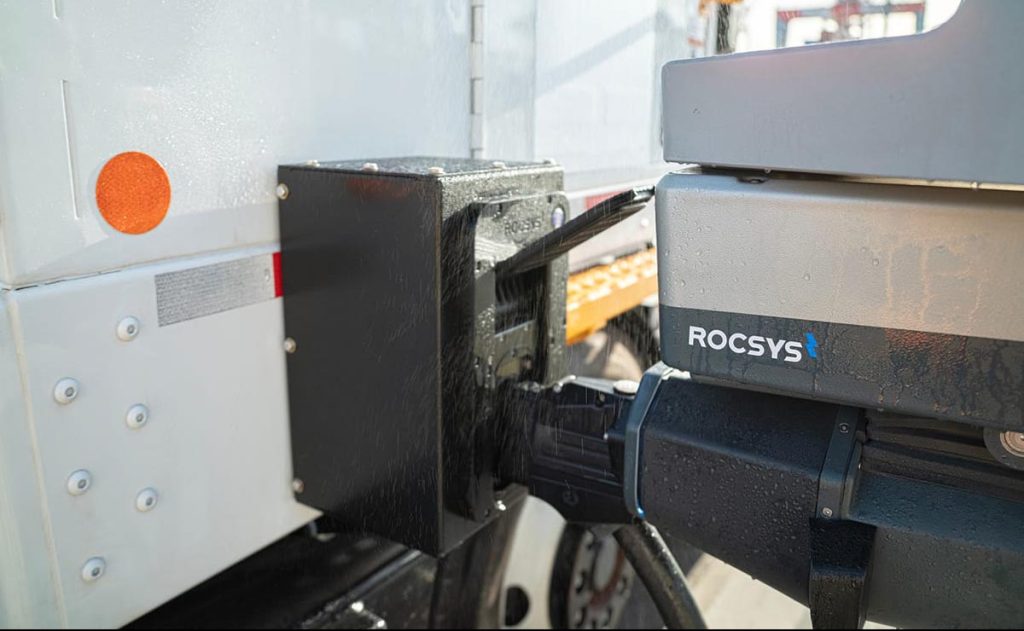
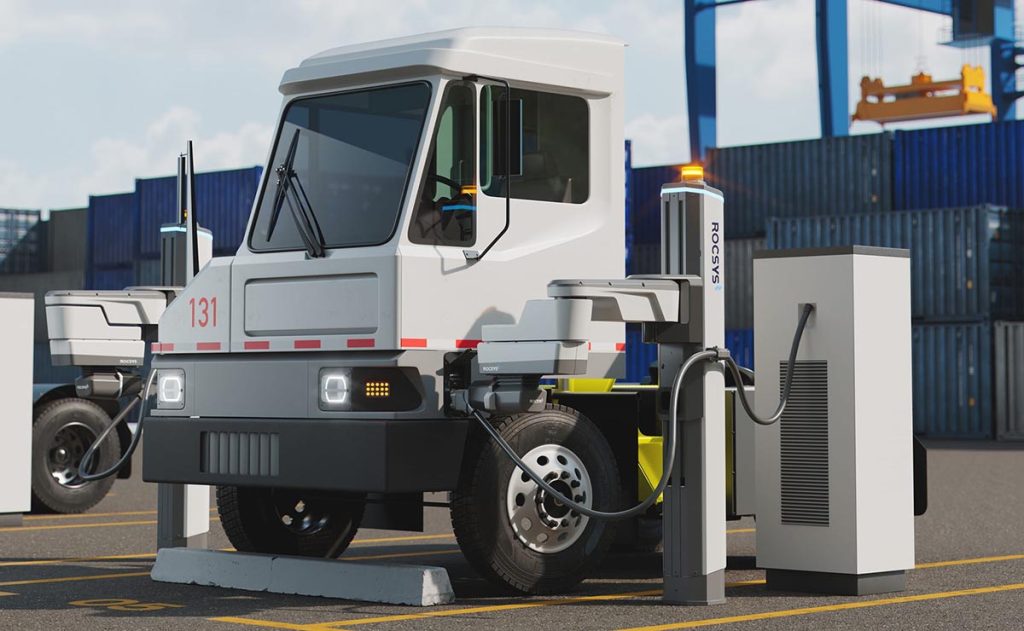
Currently, the M1 is in the pilot deployment phase, further validated by an agreement with a major, undisclosed robotaxi operator. It is scheduled to begin large-scale deployment in 2027, with the goal of supporting thousands of charging bays across North America and Europe over the next five years.
Headquartered in Rijswijk (Netherlands) and Portland (Oregon, USA), Rocsys is positioning itself as a key player in autonomous mobility infrastructure, offering a solution that not only solves a current logistical problem but also lays the groundwork for the automated depots of tomorrow.
A Year 2026 of Consolidation for Mobility
The Latam Mobility 2026 Tour will arrive in Santiago, Chile, on August 25, bringing together experts and strategic players to further strengthen the sustainable mobility ecosystem in the region.
The tour will end in Mexico City on October 12 and 13, alongside the Climate Economy Forum, in a meeting that will bring together sector leaders to continue driving the transition toward more efficient, sustainable, low‑emission transportation systems in Latin America.
The transition is already underway. The Latam Mobility 2026 Tour will be the meeting point to accelerate decisions, connect key players, and collaboratively build sustainable mobility in Latin America.