

During Latam Mobility Cono Sur 2026, the panel “OEMs, Manufacturers, and Importers: Industrial Leadership in the Southern Cone’s Transition” brought together major players from the automotive and technology industries to examine the role of manufacturers, distributors, and infrastructure providers in consolidating electromobility across the region.
The session was moderated by Florencia Guglielmetti, editor of Mobility Portal, and featured Sebastián Díaz (Huawei Digital Power Chile), Santiago Ángel (General Motors), Andrea María Meneghetti (Grupo Inchcape), and Gustavo Hunter (Chile’s National Automotive Association – ANAC).
The conversation covered the regional supply of electric vehicles, price trends, the role of hybrids as a bridge to full electrification, the critical importance of charging infrastructure, and the ongoing challenge of building consumer trust.
You May Also Be Interested In | The Battery War Heats Up: BYD and CATL Vie for Solid-State Leadership With Nearly Identical Timelines
Broad and Diverse Supply: Chile as a Case Study
The panelists quickly agreed that Chile has become a one-of-a-kind market in the region, offering abundant supply and unprecedented competition.
Andrea Meneghetti of Grupo Inchcape noted that the company—present in more than 48 global markets—is committed to a multi-technology strategy that adapts to local realities. “The transition to electric mobility is very local. It depends on charging infrastructure, consumer readiness, and whether the entire ecosystem is aligned,” she explained.
Santiago Ángel of General Motors dug deeper into Chile’s distinctive dynamics: “Chile is a case study unlike any other in the world. It’s a market with more than 90 brands in full competition—something you don’t see even in the most advanced markets.”
“Despite strong regulations and robust competition, electric and plug-in vehicles still don’t exceed 6% penetration here, compared to nearly 40% in Uruguay or 30% in Colombia,” he pointed out, raising the central question: how do we grow from that 6%?
Gustavo Hunter of ANAC explained that Chile’s open economy—with zero tariffs for most manufacturing countries and flexible homologation that accepts U.S., European, and Chinese standards—has turned the country into one of South America’s most competitive auto markets, second only to Brazil in annual sales volume, with roughly 320,000 units sold per year.
Sebastián Díaz of Huawei Digital Power Chile added the infrastructure enabler’s perspective. While Huawei isn’t a full vehicle manufacturer, it plays a fundamental role in two key areas: autonomous control systems (AIS) plus advanced sensors and infotainment—and the powertrain, including electric motors and power systems.

New Technologies as a Bridge to Electrification
The panelists agreed that hybrid technology is serving as a critical bridge to full electrification, especially in markets where charging infrastructure is still developing or users struggle with range anxiety.
Andrea Meneghetti observed that “the growth of new energy vehicles in the Americas topped 50% last year, and that’s largely driven by hybrids. Hybrid technology is an excellent bridge to the electric future.”
Gustavo Hunter provided data from ANAC: “Through June 2026, nearly 10,000 plug-in vehicles have been sold in Chile. Of those, 55% are fully electric and 45% are plug-in hybrids—which are coming with increasingly better electric range, and when you add combustion range, they reach up to 1,000 kilometers on a single trip.” He explained that this type of vehicle directly addresses the needs of Chilean consumers, who value that extended range capability even if they only drive south once a year.
Santiago Ángel added that General Motors has been on this path for over 30 years, starting with the EV1, one of the first modern electric vehicles. “Today, the technology has arrived. But not every consumer needs the same thing. We want a vehicle for each type of consumer, which is why we offer multiple technologies,” he said, also highlighting the rise of range-extended vehicles (REX) as a compelling intermediate option.

Education, After-Sales, and Debunking Myths
One of the most debated topics was user trust, which the panel identified as a structural barrier to mass EV adoption.
Sebastián Díaz addressed the issue from the infrastructure side: “Huawei started with a disadvantage as a Chinese brand. That’s why, out of our 213,000 employees, roughly 130,000 work in innovation and development. We have to build more reliable products with the best availability on the market.” He also emphasized that Huawei focuses on customer experience and digitalization, using AI and telemetry to predict failures and keep charging points operational.
Andrea Meneghetti shared findings from an Inchcape study called “Engines of Change,” which revealed that 80% of Latin Americans see their car as essential for access to work and education—so mobility is a necessity, not a luxury. However, the study also showed that while people believe they have moderate knowledge about EVs, more than 50% would not be ready to switch to an electric vehicle for their next purchase.
“There are a lot of myths to bust. Trust is built through information and education,” she said, adding that Inchcape is actively building alliances with Copec Voltex and financial institutions to ease adoption and reduce charging anxiety.
Santiago Ángel underscored that education is essential and that the ecosystem is still being built: “We don’t just have to teach about the vehicle—we have to teach about chargers, charging types, safety, insurance, and financing. All of these are new challenges the industry must tackle.” He highlighted that Chile has a unique advantage: real-time charging apps that monitor point availability—something many markets still lack. “That’s a differentiator that very few countries have,” he noted.
The Scalability Challenge
The panel also addressed the infrastructure challenge, especially in a country with vast distances like Chile.
Sebastián Díaz explained that Huawei is working on both private charging (residential and mining fleets) and public projects, such as the Santiago-Concepción green corridor. He emphasized that the company offers modular solutions scaling from 7 kW to 1.4 MW, and that its chargers are compatible with the CCS2 standard, the most widely used in Chile. He also noted that Huawei integrates its chargers with photovoltaic systems and battery energy storage (BESS), allowing operators to control peak consumption, avoid penalties, and take advantage of solar and wind surplus in the north and south.
“We’re already seeing 120 electric models available in the Chilean market. Our equipment is technically compatible with every single one, so we’re pushing public solutions with industry players who want to develop that business,” he stated.
Andrea Meneghetti added that Inchcape signed an alliance with Copec Voltex to improve access to charging and reduce user anxiety. She also stressed the importance of financing, citing a case in Peru where they partnered with Santander to offer financial products tailored to informal markets.

After-Sales, Safety, and Technical Training
Moderator Florencia Guglielmetti raised the issue of after-sales and safety in a market with such a wide variety of brands and technologies.
Andrea Meneghetti emphasized that Inchcape takes responsibility for educating consumers at the point of sale, making sure customers understand how to calculate EV costs, what maintenance is required, and how it compares to a combustion vehicle. She also highlighted the importance of training technicians and fire departments to handle EV accidents, as high-voltage batteries require specialized knowledge.
Santiago Ángel reinforced that point: “General Motors is over 100 years old. We’re not improvising. We ask you to give us the opportunity to accompany you—with the warranty, after-sales, and backing that define us. In a market of 90 brands, not all of them can offer that.”
Sebastián Díaz added that Huawei has a team of 600 people in Chile, covering pre-sales, after-sales, and technical service, and that the company is fully committed to the quality and availability of its infrastructure.
A Call to Action and Collaboration
In their closing remarks, the panelists delivered reflections that captured the spirit of the discussion and the road ahead.
Gustavo Hunter acknowledged that technology is advancing, but “regulatory and normative adjustments are still needed so users can easily acquire an electric vehicle.” He invited attendees to stay engaged with the technology and to work on incentives—including vehicle registration fees and charging infrastructure in residential buildings.
Sebastián Díaz urged the audience to “dare to deploy enabling infrastructure,” noting that the technology is available and that Huawei has the technical support to sustain growth. “Public or private incentives are still needed to roll it out on a large scale,” he concluded.
Andrea Meneghetti reminded the room that the automotive industry accounts for 15% of global emissions—making the transition urgent. Still, she insisted that technology cannot be placed above people, and that mobility is fundamentally a tool for accessing work and education. She also pointed to circularity, safety, and technical training as complementary challenges.
Santiago Ángel closed with an optimistic and galvanizing message: “We are all agents of change. We have to try new technologies, test them, and bust the myths. General Motors has been building cars for over a century and has 30 years of experience with electric vehicles. The time has come. Give us the chance to test it, to accompany you. We want to be part of this change.”
Next Stop: Latam Mobility México 2026
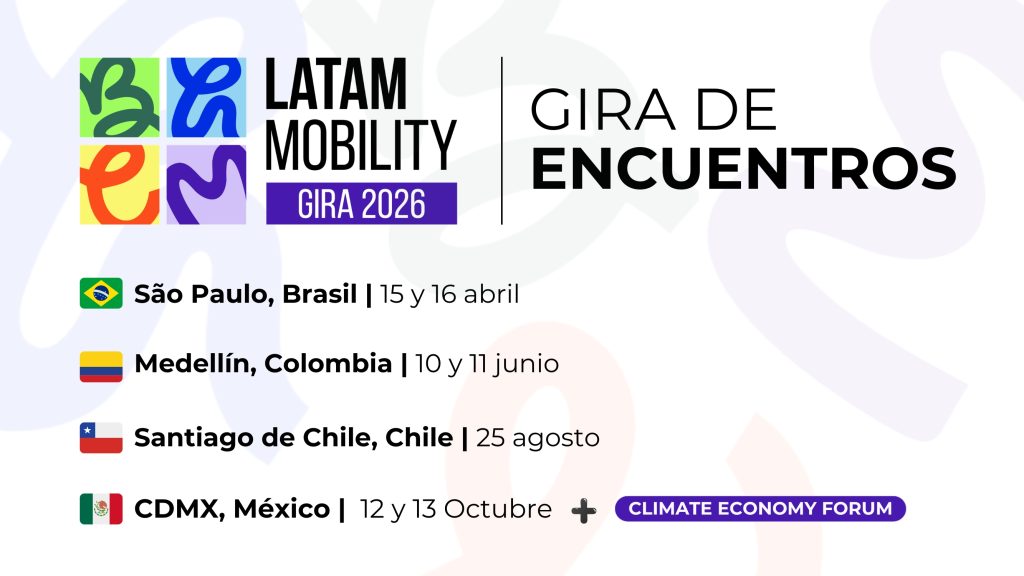
The Latam Mobility 2026 Tour will continue its journey across the region, with the next stop in Mexico City on October 12–13, 2026.
This event is shaping up as the year’s grand finale for the sector, bringing together public, private, academic, and civil society leaders from across Latin America to keep driving the transition toward cleaner, more efficient, and sustainable mobility.
Latam Mobility México 2026 will offer a unique platform to strengthen partnerships, explore the latest innovations, and map out joint roadmaps that accelerate transportation decarbonization across the region.
Latam Mobility thus reaffirms its commitment to being the region’s premier hub for energy transition and networking—connecting the ideas, projects, and people who are transforming the way we move.