

A panel titled “Critical Infrastructure: Charging, CPO, and Destination Charging” took center stage at Latam Mobility Cono Sur 2026, bringing together top industry experts to dissect the challenges and opportunities in rolling out EV charging infrastructure across the region.
The session, moderated by Andrés Barentín (CharIn Ambassador in Chile), featured César Alor Salinas (Autel), Claudio Padilla (Itelogic), Ignacio Román (CHASS), and Rodrigo Rojas (Vega Chargers). The conversation tackled everything from the evolution of the electromobility ecosystem and grid capacity constraints to electricity rate structures and the end-user experience.
You May Also Be Interested In | Imports Surpass Fiat and Lead the Market in Brazil, With China as the Main Source and Electrified Vehicles Reaching a Record Share
Retail, Mining, and Highways Emerge as Strategic Axes
Asked where growth opportunities will concentrate over the coming years, the panelists converged on three major verticals: retail, mining and industry, and highway charging corridors.
Rodrigo Rojas of Vega Chargers pointed to retail as a highly promising niche—especially in shopping mall and supermarket parking lots, where vehicles typically sit for 15 minutes to three hours. “Today, we shouldn’t put chargers where we think they should go, but rather where the cars actually are,” he stated.
He noted that European markets already feature business models where supermarkets offer rates up to 50% lower through loyalty programs, effectively turning grocery chains into charging operators. He also highlighted highway corridors as a major opportunity for heavy transport and light-duty users, powered by high-speed solutions that integrate batteries and renewables.
Ignacio Román of CHASS added that his startup is already deploying mixed-use models in shopping centers—chargers available to retail customers during the day and leased to fleets during off-peak hours. “It serves as a draw for the mall and guarantees us a baseline utilization rate,” he explained.
Claudio Padilla of Itelogic shifted the focus to mining and industry, where his company has delivered large-scale projects. He spotlighted the Lithium Route, connecting the Salar de Atacama with the Salar del Carmen, where they installed charging infrastructure for electric fleets. “What matters isn’t how many chargers we install, but how many hours of critical operation we can guarantee,” he emphasized.
César Alor of Autel brought a user-centric lens, recounting his own 700-kilometer road trip in an EV—which took 12 hours versus the usual 8 hours in a gas vehicle—due to unreliable infrastructure. “Today, users don’t just demand to find a charger—they demand to find one working at 100%,” he said. He highlighted three pillars of Autel‘s approach: reliability, intelligent battery diagnostics, and AI-driven demand management and dynamic power balancing.

The Power Challenge: Modular Solutions, Storage, and Collaboration
Grid capacity constraints emerged as a universal pain point across the region. The panelists agreed that the answer lies in modular, scalable designs that pair energy storage with intelligent load management.
Claudio Padilla underscored Battery Energy Storage Systems (BESS) as a game-changer for keeping stations running 24/7 and compensating for weak grid connections. He noted that Huawei offers an integrated solution combining photovoltaics, inverters, batteries, and power modules—and floated an innovative idea: transporting energy via mobile storage systems, much like fuel is trucked today, to move surplus solar power from northern Chile to deficit areas.
César Alor added that Autel tackles the problem with two critical tools: dynamic power balancing (avoiding demand-overage penalties) and demand management (leveraging unused capacity when building or mall loads are low). He announced that Autel will soon inaugurate a charging station in Colombia that operates 100% off the grid, powered entirely by a solar canopy and battery storage.
Rodrigo Rojas delivered a stark reality check on Chile’s distribution gap: the national average sits at just four chargers per 100,000 inhabitants, and regions like Aysén have near-zero coverage. “Electromobility will not grow if we don’t focus energy on the regions,” he warned, urging prioritization outside the Metropolitan Region.
Ignacio Román explained that CHASS designs projects based on available capacity—starting with a modest offering and leaving room to scale. “Payback periods are around 2 to 3 years with utilization rates of 20 to 30%,” he noted, stressing the importance of flexibility and forward planning.

Remaining Challenges and Key Hurdles
Moderator Andrés Barentín raised the issue of peak-hour electricity rates, which drive up charging costs and limit point availability during high-demand windows. The panelists offered complementary perspectives.
Ignacio Román acknowledged that peak rates are a real obstacle, and CHASS avoids offering service during those hours unless they have a free-market customer contract. He pointed to dedicated flat rates as the way forward, incentivizing charging during off-peak windows.
Claudio Padilla, speaking from the mining sector, said his clients structure fees based on usability rather than per-kilowatt-hour charges, leveraging low-cost clean-energy contracts in the north. “The priority is keeping operating costs predictable for fleets,” he explained.
César Alor insisted the core problem isn’t just rates—it’s grid capacity. “You can’t pull more from the grid than what you’ve contracted. The solution lies in hardware and software that perform dynamic balancing,” he said, emphasizing that chargers must be equipped with smart power-management algorithms.
Rodrigo Rojas brought it back to the user experience. He argued that price isn’t the primary barrier—payment friction is. “95% of people want to charge the way they fuel up with gasoline. We need credit card readers on every public charger,” he stated. Sharing his own struggles on the road, he urged the industry to debunk EV myths and make the charging experience as fast and seamless as filling a tank.

Charging Infrastructure as a Critical Link
In their closing remarks, the panelists unanimously called for stronger public-private collaboration and knowledge-sharing to keep pushing electromobility forward in the Southern Cone.
Rodrigo Rojas praised the attendees and noted that Latin America has both the motivated professionals and the available technology to make the leap.
Ignacio Román stressed the need for regulation that supports flat-rate structures and quality service for end-users, adding a simple invitation: “Keep doing things right.”
Claudio Padilla emphasized cooperation across companies, manufacturers, and transporters as the only path to scale. “Sharing experiences and backing new ideas is absolutely essential,” he said.
César Alor closed with a powerful message: “In the Southern Cone, we’re no longer talking about pilot projects—we’re talking about real projects that demand standards, reliable equipment, and intelligent software. Success won’t be measured by how many charging points we install, but by how many are actually operational and connected.”
Next Stop: Latam Mobility México 2026
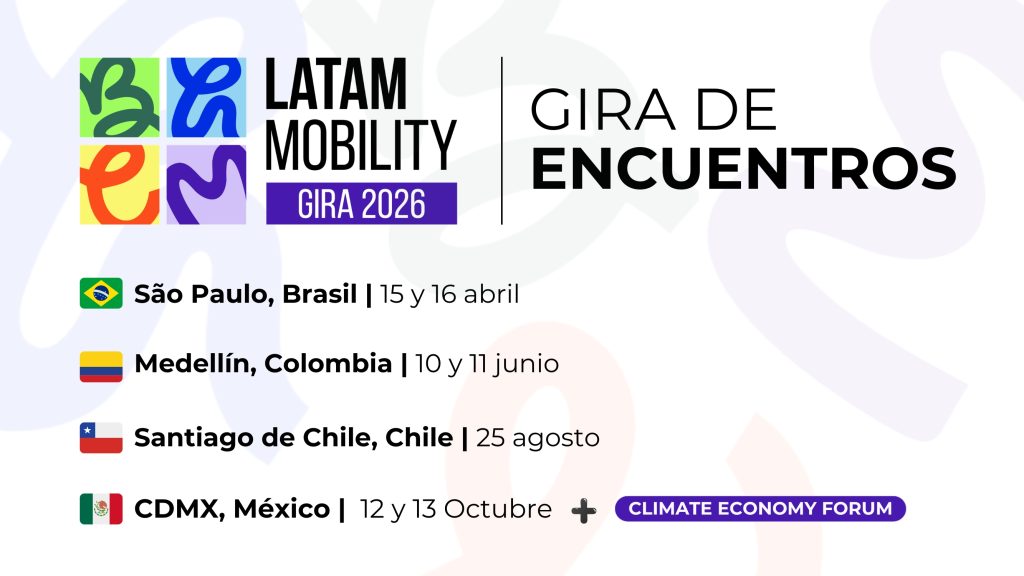
The Latam Mobility 2026 Tour continues its regional journey with Latam Mobility México 2026, a must-attend stop in the Mexican capital scheduled for October 12–13, 2026.
This event is shaping up as the year’s grand finale for the sector, bringing together public, private, academic, and civil society leaders from across Latin America to drive the transition toward cleaner, more efficient, and inclusive mobility.
Mexico—with its fast-growing EV market and strategic regional position—will provide the perfect setting to dive deeper into charging infrastructure, new business models, regulation, and public-private collaboration.
The date is set for Mexico City, where the future of sustainable mobility will continue to be written with active participation from every stakeholder in the ecosystem.
Latam Mobility thus reaffirms its commitment to being the region’s premier hub for energy transition and networking—connecting the ideas, projects, and people who are transforming the way we move.