



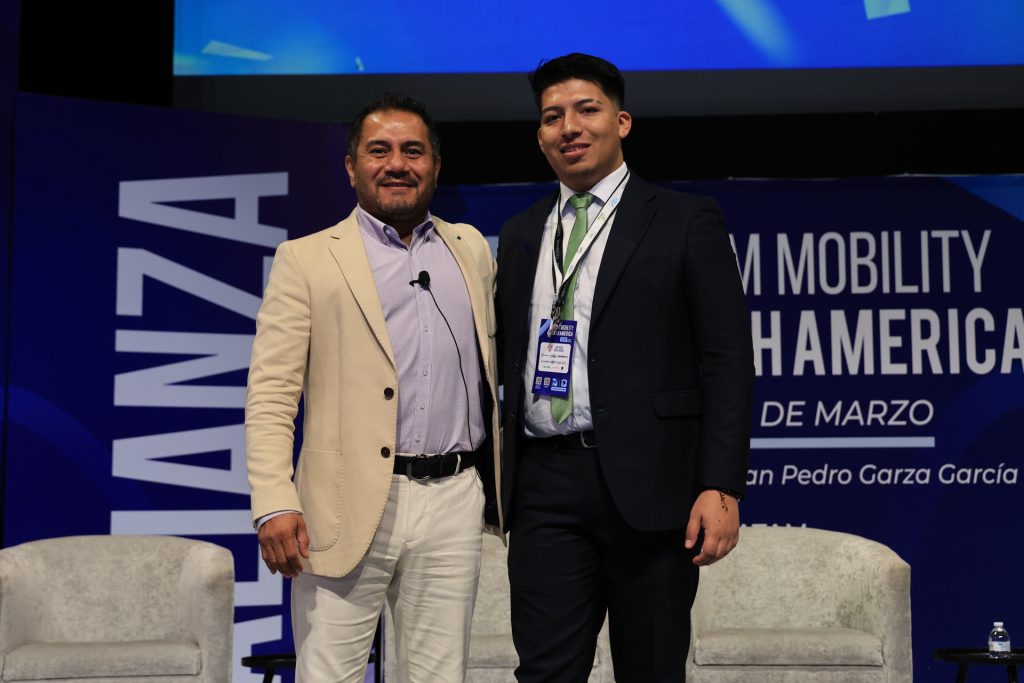
Within the framework of «Latam Mobility North America 2026,» César Alor Salinas, EV Sales Director Latam at Autel Energy, delivered a presentation titled “Strategic Infrastructure for the New Era of the e-Truck,” in which he painted a clear picture of the transformative moment facing heavy transport in Mexico and Latin America.
With concrete data, examples of pioneering companies, and an in-depth analysis of the barriers to be overcome, Alor positioned charging infrastructure as the central axis around which the transition to sustainable fleets must revolve.
The keynote started from a forceful premise: in some Latin American countries, tractors and heavy trucks represent more than 50% of polluting emissions, despite constituting barely 35% of the automotive fleet.
This reality places the transportation sector at the center of decarbonization strategies and opens an unprecedented window of opportunity for electromobility.
You might also be interested in | Autel Energy Drives the Next Generation of Chargers with AI, Interoperability, and V2G Solutions
From Pilots to Commercial Scale
Alor presented data that evidences a turning point in the Mexican market. While 2023 and 2024 saw a stage of pilot projects on key corridors, the year 2025 marked the beginning of an accelerated phase of real adoption.
Investments in electric tractors and heavy trucks, which hovered around 25 million dollars in 2025, have a growth projection that could reach 100 million dollars by 2033.
“Today we are already seeing real adoption in the market. We went from pilots on key corridors to being a real alternative that many companies are already working on today,” he added, highlighting that the nearshoring phenomenon and the heavy cross-border freight transport between Mexico and the United States are driving this transformation.
The Autel executive dedicated a special segment to recognize Mexican companies that have stepped forward, complying with their ESG policies and scaling their operations with electric fleets. Among them, he mentioned Grupo Marva, Valley Express, Trayecto, Bimbo, Heineken, Eléctrico, and YoRide, focusing on three emblematic cases.
Grupo Marva, an indisputable pioneer, already operates more than 120 100% electric tractors and last year celebrated a milestone: reaching one million kilometers of zero-emission freight transport. Their objective, Alor explained, is to scale up to dozens of tractors as their conventional fleet reaches its renewal point.
Valley Express, for its part, marked a milestone in 2024 by becoming the first company to carry out cross-border transport with cargo between Mexico and the United States using an electric tractor, while Trayecto, another prominent company, began incorporating electric tractors in 2024 with the clear goal of having a 100% sustainable fleet on key corridors.

The Five Critical Barriers
However, the path towards the massification of e-trucks is not without obstacles. César Alor identified five critical barriers that must be overcome for the transition to be successful and sustainable over time.
The first is the high initial cost. An electric tractor or heavy truck currently costs between two and three times more than its diesel equivalent, representing a significant financial challenge for transport companies. Here, Alor called on the actors present at the summit, manufacturers, financing companies, lessors, to take advantage of these spaces and build collective solutions that include tax incentives and accessible financing schemes.
The second barrier, and perhaps the most critical, is insufficient charging infrastructure. “This is the biggest barrier faced by companies that say: ‘I’m transitioning, and where do I charge?’,” Alor emphasized. Without a reliable and strategically located charging network, the adoption of electric heavy vehicles simply cannot scale.
The third challenge relates to energy availability. It is not enough to install chargers; it is necessary to guarantee that there is enough electrical power to feed them. This implies the development of smart grids, the integration of renewable energy, and energy storage solutions that allow demand to be managed efficiently.
Fourth, Alor placed the regulatory framework. The lack of standardization in connectors and charging protocols is a tangible problem for companies beginning to scale their fleets. “Today many companies face the issue of having tractors that come with one type of connector and others with another. How do I scale my infrastructure?” he questioned, underscoring the need to keep pushing, working with industry associations in Mexico, to move towards clear and unified regulation.
Finally, he mentioned the limited range of vehicles, which currently hovers between 350 and 450 kilometers per charge. This characteristic forces companies to rethink their logistics strategies, adopting models such as the “relay race” to optimize routes and charging times.

Autel: A Technology Partner for Fearless Charging
Faced with this panorama of challenges and opportunities, César Alor presented Autel as the strategic ally capable of solving the most complex equation: heavy-duty charging infrastructure. With over 22 years of experience in developing automotive scanners and a 40% share of the global market in this area, Autel has integrated its technological knowledge into next-generation charging solutions.
The company offers a complete range of solutions, from alternating current chargers (7 to 22 kW) to direct current chargers covering from 40 kW fast charging up to 3 MW ultra-fast charging, with connectors compatible with all market standards: GB/T, NACS, CCS2, CCS1, practically whatever each manufacturer requires.
But Autel‘s true differentiating value, Alor explained, lies not only in the hardware but in the ecosystem that accompanies it. The company has a management, control, and monitoring platform that even includes a payment gateway, allowing operators to maximize the return on their infrastructure investment.
One of the most notable innovations presented by the executive is the integration of artificial intelligence into the chargers, enabling functions such as dynamic power balancing. “I can tell my charger, along with adaptive load management, that it cannot exceed 200 or 500 kW. I can balance between chargers at the same site and not exceed the maximum energy availability,” he explained, directly addressing the problem of limited energy capacity.
Another crucial factor is local support. Unlike other providers who rely on support centers in distant time zones with non-Spanish speaking staff, Autel has local warehouses and inventory in Zapopan, Jalisco, and Spanish-speaking technical personnel capable of resolving issues quickly and efficiently.
“At Autel, we are the ally that solves charging in depots, corridors, and charging centers, allowing these companies that are already undertaking these electromobility projects in heavy vehicles and tractors to scale fearlessly,” Alor stated.
Scalability and Interoperability: The Keys to the Future
The Autel executive concluded his presentation by highlighting two essential attributes of the company’s solutions: scalability and interoperability. He cited an example of a client who today acquires a 140 kW charger, but thanks to Autel‘s scalability system can expand it to 240 kW in the future, adapting to the growth of their fleet without needing to make obsolete investments.
“Autel not only provides hardware but accelerates fleet electrification by providing our clients with solutions that are interoperable and scalable,” he affirmed.
With an optimistic yet realistic vision, César Alor invited attendees to look forward with determination. “The future of electric tractors in LATAM begins with smart charging, and that reliable partner is called Autel. Let’s make it a reality together,” he concluded.
The presentation at «Latam Mobility North America 2026» made it clear that the electrification of heavy transport in Mexico is no longer a promise of the distant future, but a reality under construction.
Pioneering companies are already on the road, the challenges are identified, and technological solutions, such as those offered by Autel, are available to accompany fleets in this transition.
The Agenda to Decarbonize Transportation
Rather than ambitious announcements, 2026 will be a year for measuring results. Electric and low-emission mobility will no longer be evaluated by the number of pilot projects but will be judged by its ability to operate at scale, reduce real emissions, and improve the quality of urban life.
For Latin America, the challenge will be to capitalize on its experience in electric public transportation, close infrastructure gaps, and build stable policies that allow the transition to be not only green but also inclusive and economically viable.
With the 2026 Tour, Latam Mobility reaffirms its commitment to building a regional agenda that connects vision, public policy, innovation, and the market.
Through its stops in Mexico City, Brazil, Colombia, and Chile, the platform will continue to promote a collaborative approach to accelerate the transition to cleaner, more efficient, and more inclusive transportation systems, positioning Latin America as a relevant player in sustainable mobility at the global level.
Be part of the movement that is accelerating Latin America’s energy and urban transformation. If you would like to learn more about how to participate and positioning options, click here.