

The Brazilian automotive market is undergoing an unprecedented transformation. According to the most recent data from the Brazilian Electric Vehicle Association (ABVE), the country recorded 57,386 registrations of light electrified vehicles—including pure electric (BEV), plug-in hybrids (PHEV), conventional hybrids (HEV), and flex hybrids (HEV Flex)—during the month of August 2026.
With this volume, the fleet accumulated since 2012 stood at 950,183 units, putting Brazil less than 50,000 vehicles away from the long-awaited one million electrified vehicles in circulation. However, ABVE president Ricardo Bastos announced last Thursday, September 24, that the national fleet of electrified light vehicles reached one million units.
August’s performance not only represents a 184% growth compared to the same month in 2025, but also confirms that the market is operating at a new monthly standard: for the second consecutive month, sales exceeded 50,000 units.
The accumulated total from January to August 2026 already adds up to 328,477 units sold, which represents a 160.5% growth compared to the same period in 2025, when 126,071 units were sold. In just eight months, the sector has already surpassed by 47% the entire volume recorded during the full year 2025, which closed with 223,912 units.
You may also be interested in | AUTEL Energy makes the MaxiCharger DH120 with GB/T standard available to Latin America
Electrified Vehicles Lead Growth and Account for 22% of the Market
One of the most revealing data points from ABVE is the growing share of electrified vehicles in the total market. In August 2026, electrified vehicles represented 22% of light vehicle sales in Brazil, meaning that 22 out of every 100 new vehicles sold in the country are already electrified.
Within this segment, vehicles with external charging (plug-in), which include BEV and PHEV, concentrated 83.1% of electrified sales in August, with 47,701 units.
Fully electric vehicles (BEV) led the segment and reached a new monthly record with 27,166 registrations, representing 47.3% of the total electrified vehicles. Plug-in hybrids (PHEV) added 20,535 units.
The Southeast region concentrated the majority of sales in August, with 24,010 vehicles, and the state of São Paulo led among the federative units with 14,982 registrations.
The expansion of charging infrastructure accompanies this growth: Brazil already has 25,429 public and semi-public chargers for electrified vehicles.

Citi Study: The Impact of Electrification Is Already Real and Growing
The accelerated adoption of electrified vehicles is not only transforming the Brazilian automotive fleet, but is already beginning to reshape the fuel consumption map in the country.
A study by the American bank Citi, cited by CGTN, concludes that the impact of electrification on gasoline and ethanol demand “is already real and growing,” although still modest.
According to the institution’s estimates, in 2025 electrified vehicles displaced 700 million liters of gasoline and ethanol, a figure equivalent to about 1% of domestic demand for both fuels.
“We are feeling the impact of fuel consumption coming from these electrified vehicles. Future scenarios indicate a rise in Brazil of electrified vehicles,” said Gabriel Barra, a Citi analyst and author of the study along with Pedro Gama and Pedro Ferreira de Mello.
The scenario considered most likely by Citi projects that electric and hybrid vehicles will displace about 5 billion liters of gasoline and ethanol in 2030, equivalent to 8% of effective demand, and 9 billion liters in 2040, when they would represent 14% of the total.
In a more aggressive scenario for electric vehicle penetration, gasoline and ethanol use could fall in 2040 to 27% below the peak.
Structural Change in the Transportation Energy Matrix
The Citi report considers that growing electrification represents a structural and long-term change in the energy matrix linked to transportation. According to its projections, consumption of so-called Otto cycle fuels (gasoline and ethanol) will still grow in 2025 and 2026 in line with the economy, only to begin declining from 2027 onward, even if the Gross Domestic Product (GDP) continues to expand.
Citi analysts warn that the issue should turn on “a yellow light” for fuel sector companies such as Vibra and Ultrapar, as well as ethanol groups such as São Martinho, Jalles, and Adecoagro.
“The dynamic suggests this should accelerate, and the market may be underestimating how quickly an inflection point is approaching,” says the team led by Gabriel Barra.
Citi’s projections consider a penetration of electric vehicles in Brazil that would reach 47% of new sales in 2035, in line with the global average.
A faster adoption scenario, using China as a reference, could raise that share to 68% in the same period. However, the effect on fuel use is gradual because new electric vehicle sales take time to reflect in the total fleet, a phenomenon observed in all countries.
A Unique Market: Biofuels and Electrification
Brazil has a particular characteristic that makes this change especially relevant: the majority of vehicles manufactured in the country are flex-fuel, capable of using gasoline and ethanol—the latter produced mainly from sugarcane and, to a lesser extent, from corn.
This particularity means that electrification in Brazil competes not only with fossil fuels, but also with biofuels, a strategic sector for the national economy.
The market transformation is occurring while Brazil experiences a rapid expansion of the electrified automotive market, largely driven by the arrival of Chinese manufacturers. Between January and August 2026, sales of Chinese vehicles grew 146.6% year-over-year, and automaker BYD became the fourth-largest car manufacturer in the country, in addition to advancing with the opening of a production plant on Brazilian soil.
The growth of electrified vehicles contrasts with the still small weight they have in the total automotive fleet. According to the American consultancy Integrate Data Facts (IDF) , these vehicles represented 21.1% of total sales in July 2026, although by the end of 2025 they constituted only 1.3% of the light vehicle fleet in circulation.
This gap between sales and accumulated fleet explains why the impact on fuel consumption, although growing, is still moderate.

A Future of Accelerated Transformation
The combination of record sales, expansion of charging infrastructure, and growing price competitiveness is driving an accelerated transformation of the Brazilian automotive market.
The reduction in the price gap compared to traditional vehicles is one of the reasons for the advance of electrified models. In 2012, when the first imported electrified vehicle was launched in Brazil, the market was practically nonexistent.
ABVE highlights that the current growth rate, with a monthly sales average in 2026 of 41,060 units, 260% higher than the 2025 average, indicates that the market is operating under a new structural standard.
The sequence of consecutive monthly growth reflects a change in Brazilian consumer behavior, who increasingly value energy efficiency, lower operating costs, and sustainability.
With one million electrified vehicles in sight and a growing impact on the fuel market, Brazil positions itself as one of the most dynamic electromobility markets in the world, in a process that redefines not only the automotive industry, but also the country’s transportation energy matrix.
Next Stop: Latam Mobility México 2026
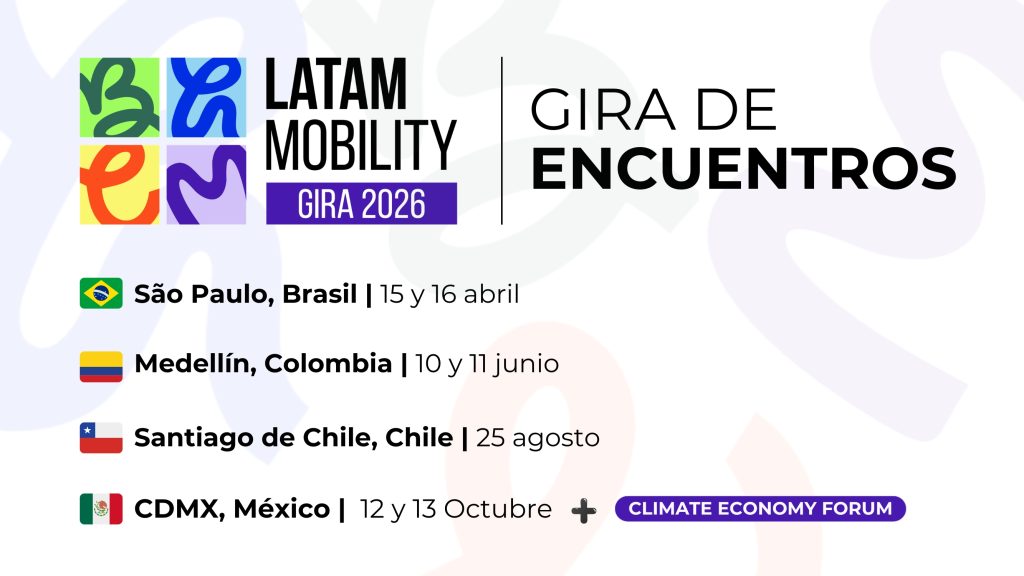
The Latam Mobility 2026 Tour will continue its journey across the region, with the next stop in Mexico City on October 12–13, 2026.
This event is shaping up as the year’s grand finale for the sector, bringing together public, private, academic, and civil society leaders from across Latin America to keep driving the transition toward cleaner, more efficient, and sustainable mobility.
Latam Mobility México 2026 will offer a unique platform to strengthen partnerships, explore the latest innovations, and map out joint roadmaps that accelerate transportation decarbonization across the region.
Latam Mobility thus reaffirms its commitment to being the region’s premier hub for energy transition and networking—connecting the ideas, projects, and people who are transforming the way we move.