


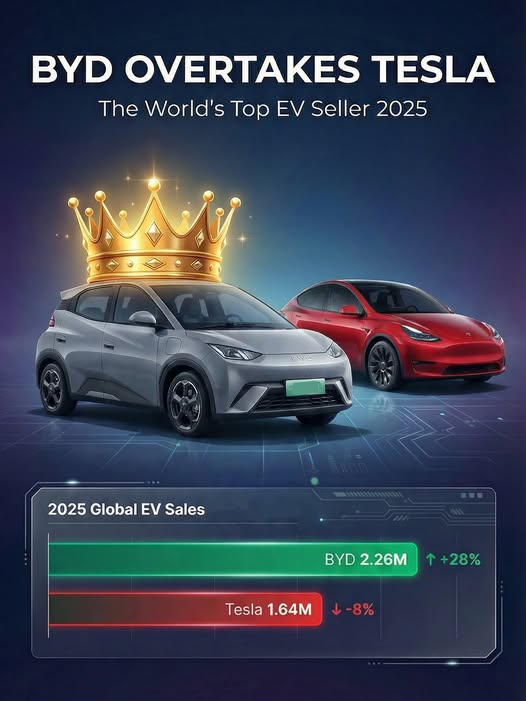
In early 2026, various automotive industry analyses and international financial reports confirmed a key milestone for the electric mobility industry: BYD surpassed Tesla to become the world’s largest seller of electric vehicles in 2025.
The result marks a turning point in global EV market leadership and reinforces the growing influence of Chinese manufacturers in the transition to zero-emission technologies.
According to information released by China Daily, BYD‘s global sales of electric vehicles grew by nearly 28% year-on-year in 2025.
During that period, the company sold approximately 2.26 million units, surpassing Tesla‘s volume and positioning itself for the first time as the world’s leading seller of electric vehicles.
This performance can be explained by a combination of factors, including the breadth of its model portfolio, which ranges from pure electric vehicles to plug-in hybrids, as well as an aggressive expansion strategy in international markets.
You may also be interested in | Latin America accelerates in electric mobility: challenges and opportunities for 2026
Structural Change in the EV Market
Published analyses highlight that BYD‘s leadership is not a temporary phenomenon, but rather the result of a structural transformation of the automotive market.
In recent years, Chinese manufacturers have increased their competitiveness in terms of costs, battery technology, and industrial capacity, rapidly scaling up their presence outside Asia.
In this context, BYD has managed to capitalize on its vertical integration, which includes the development and production of batteries, semiconductors, and propulsion systems, as a strategic advantage over other global competitors.
This capability has allowed it to respond more flexibly to variations in demand and changes in incentives and regulations in different markets.
The reports also highlight the growing dominance of Chinese manufacturers in the global automotive market, particularly in the electric vehicle segment.
In addition to BYD, other Chinese brands have increased their share of sales, exports, and technological development, challenging the historical leadership of American, European, and Japanese manufacturers. Let’s take a look:
- Leapmotor became one of the fastest-growing brands, with 596,555 deliveries in 2025, exceeding its target for the year, and celebrated its tenth anniversary by nearly doubling its sales volume compared to 2024. It aims to deliver one million electric vehicles in 2026.
- Xpeng also posted strong growth, with 429,445 sales for the year, up 126% from 2024. Deliveries peaked in September and October, following the launch of its Mona series in September.
- Nio recorded 326,028 deliveries in 2025, a year-on-year increase of 46.9%. Approximately half of its deliveries were attributed to Nio‘s eponymous premium brand.
- Without specifying its annual delivery figures, Xiaomi recorded more than 50,000 sales in December, setting a new record. The company delivered more than 410,000 electric vehicles in 2025, exceeding its target of 350,000, and aims to reach 550,000 deliveries in 2026.
Global Impact and Outlook for 2026
This phenomenon is occurring in a context of accelerating energy transition, where electric vehicles are establishing themselves as a central pillar of transport decarbonization strategies.
Large-scale production capacity and rapid technological innovation have been decisive factors in the positioning of Chinese companies in this scenario.
Therefore, BYD‘s leadership in 2025 reinforces its global influence ahead of 2026, a year that is shaping up to be decisive for the expansion of electric mobility in multiple regions.
Although many of the published analyses focus on global figures and do not break down specific results for Latin America, BYD‘s global performance has direct implications for emerging markets, where the adoption of electric vehicles is progressing steadily.
With this new positioning, BYD begins 2026 as one of the main players in the EV market, in an increasingly competitive environment marked by the consolidation of new industry leaders in the transition to low- and zero-emission mobility.
2026 as a Year of Consolidation
Rather than ambitious announcements, 2026 will be a year for measuring results. Electric and low-emission mobility will no longer be evaluated by the number of pilot projects but will be judged by its ability to operate at scale, reduce real emissions, and improve the quality of urban life.
For Latin America, the challenge will be to capitalize on its experience in electric public transportation, close infrastructure gaps, and build stable policies that allow the transition to be not only green but also inclusive and economically viable.
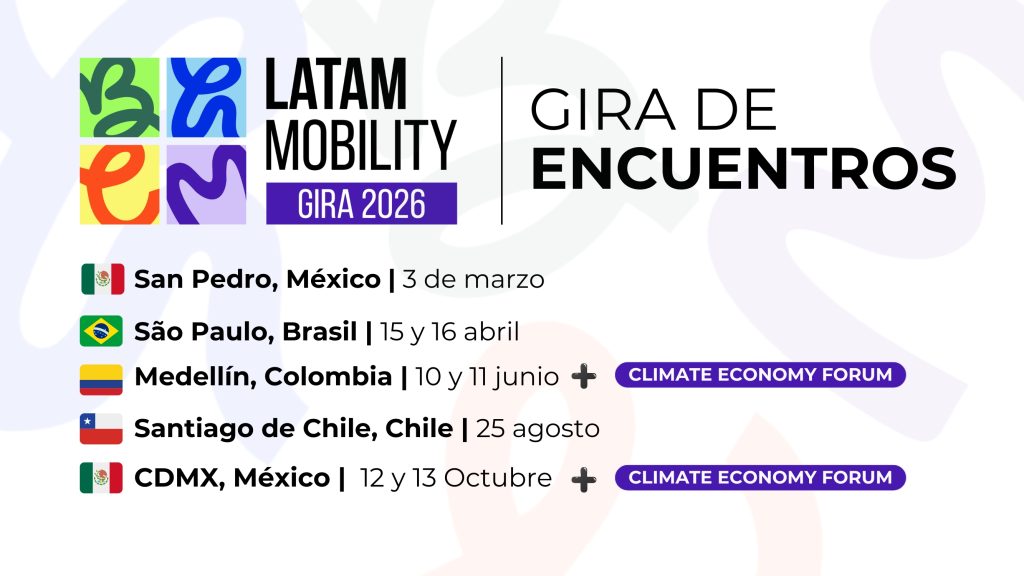
With the 2026 Tour, Latam Mobility reaffirms its commitment to building a regional agenda that connects vision, public policy, innovation, and the market.
Through its stops in Monterrey and Mexico City, Brazil, Colombia, and Chile, the platform will continue to promote a collaborative approach to accelerate the transition to cleaner, more efficient, and more inclusive transportation systems, positioning Latin America as a relevant player in sustainable mobility at the global level.
Be part of the movement that is accelerating Latin America’s energy and urban transformation. If you would like to learn more about how to participate and positioning options, click here.