

During the Latam Mobility Cono Sur 2026, the opening panel—”Integration of Sustainable Mobility in the Southern Cone: Governance and Coordination for a Shared Regional Agenda“—brought together top officials from Chile and Paraguay. They tackled the challenges and opportunities of building cleaner, more efficient, and more inclusive transportation systems across the region.
The session was moderated by Paola Tapia Salas, Director of Technology Transfer at the Center for Advanced Transportation, Logistics, and Economic Competitiveness (CATLEC). Panelists included Eduardo Koffmann (Chile’s Ministry of Public Works), Emiliano Fernández (Paraguay’s Vice Ministry of Transport), Marta Cabeza Vargas (Superintendent of the SEC), and Natalia Aguilar (Chile’s Ministry of Housing and Urban Planning).
The panel opened with a note of solidarity and resilience, referencing the recent earthquakes that affected Colombia and Venezuela. The speakers underscored the need to factor such events—alongside artificial intelligence and cybersecurity—into the design of future sustainable mobility policies.
You May Also Be Interested In | Santiago, São Paulo, and Bogotá Concentrate 7,000 Electric Buses and Lead the Region’s Transportation Revolution
Cross-Sector Coordination: The Biggest Hurdle in Public Governance
Moderator Paola Tapia Salas set the central question: How can we achieve sustainable mobility through coordinated governance across different sectors? The goal is to move past the usual fragmentation, where each ministry guards its own turf instead of aligning on an integrated vision.
Eduardo Koffmann responded by pointing out that the rigid regulatory frameworks common in Roman-law countries (like Chile) often hinder coordination, unlike more flexible Anglo-Saxon systems. However, he announced a groundbreaking institutional innovation for the region: the creation of the Interministerial Committee on Infrastructure.
Chaired by the Ministry of Public Works and with technical secretariat under the Planning Directorate, this committee unites 12 ministries to align public investment, prevent missteps like “a hospital without an access road or social housing without urban infrastructure,” streamline permitting, and—most importantly—build a pipeline of long-term strategic projects that outlast any single administration.
“Our big goal is that investment priorities rely on technical, economic, and strategic criteria—not on who shouts the loudest in politics,” Koffmann stated. He also invited CATLEC to participate as an academic observer in the process.

Paraguay’s Playbook: Macro Stability as the Launchpad for Reform
Emiliano Fernández shared Paraguay’s ongoing public transportation reform, which is squarely focused on citizen well-being. He highlighted Paraguay’s trump card: macroeconomic stability, with controlled inflation (3–4% annually), sustained growth above the regional average, and public debt under 35% of GDP.
On top of that, Paraguay boasts a world-class strategic asset: the Itaipú Dam—the world’s largest clean energy generator—which gives the country a 100% renewable electricity matrix and power costs of just 5 cents per kWh, well below its neighbors.
“That gives us a massive head start for boosting electromobility,” Fernández emphasized. He announced that Paraguay already has 90 electric buses on the road, with 40 more expected shortly—up from just 2 units two years ago, putting the country on track for over 120. He also noted that a new transportation law, approved after 20 years of debate, is now in place, and the country is finalizing its first tender for the mass incorporation of electric buses.
Fernández also cautioned against ignoring the public-private equation: affordability for passengers, profitability for operators, and fiscal sustainability for the state must all balance. “It’s not just about buying buses; it’s a whole implementation process that has to address far more than the purchase itself,” he stressed.
The SEC’s Technical Role: Safety, Quality, and Real-Time Info for Users
Superintendent Marta Cabeza Vargas highlighted the SEC’s institutional work in helping Chile advance electromobility with high safety and quality standards. She noted that the SEC (an agency under the Ministry of Energy) has expanded its legal mandate to include accessibility and created a dedicated sustainability unit to tackle energy transition challenges.
Cabeza argued that the main challenge today isn’t infrastructure or technology—it’s making users actually want to choose electric. She spotlighted the Ecocarga app, developed by the SEC together with the Energy Sustainability Agency, which lets drivers locate available charging points in real time across the country.
She also noted that Chile is home to the largest charging station in Latin America and that all recharging infrastructure must undergo rigorous safety certification. She invited attendees to explore the SEC‘s website for courses, technical guides, and explanatory videos on installing chargers in homes, buildings, and public spaces.

Housing and Urban Planning: Putting Citizens at the Center of Design
Undersecretary Natalia Aguilar focused on the State’s mission to serve people, insisting that housing projects cannot be isolated solutions—they must be coordinated with transportation, public works, and other essential services.
“It’s not enough to hand over housing units; we have to deliver services, access, and a genuine improvement in quality of life,” she said. Aguilar explained that her ministry is expanding its focus beyond vulnerable sectors to reach the middle class, with measures like freezing the VAT for 12 months and raising housing caps to 6,000 UF.
She acknowledged that electromobility is a relevant factor for new urban projects, but stressed that social housing remains the ministry’s top priority—and that fiscal responsibility must go hand in hand with transportation transformation, so that one area doesn’t compromise the other.
Financing and New Business Models: The Make-or-Break Factor
In the final Q&A round, moderator Paola Tapia Salas pushed the panel on the challenges of financing and new public-private partnerships.
Eduardo Koffmann tackled the freight transport sector, where the decision to go electric is entirely in private hands. He explained that while electric trucks have a lower lifetime cost per kilometer, Chile’s regulation capping maximum weight at 40 tons effectively penalizes them—because batteries add up to 3 tons, raising the cost per ton-kilometer.
“Right now, the incentive is to stick with diesel,” he admitted. To fix this, the Ministry of Public Works and the Ministry of Transport are studying a regulatory change to relax weight limits, letting private fleets choose electric based on economic convenience rather than state mandate.
Emiliano Fernández reinforced that the transition requires looking at the total cost of ownership (12 to 13 years), not just the sticker price—and that returns must be measured in social and environmental benefits too. “Electromobility is cheaper over the project’s lifespan—but we have to prove it with hard numbers to the finance ministry,” he said.
Marta Cabeza Vargas closed the discussion by underscoring the importance of solid information for decision-making and the SEC’s role in infrastructure certification, while Natalia Aguilar reiterated her ministry’s commitment to integrated urban planning that incorporates electromobility without losing sight of its core housing mission.

A Shared Regional Agenda
The dialogue in this first panel reaffirmed a shared conviction: sustainable mobility is a non-negotiable pillar for equitable, sustainable development in Latin America.
The experiences of Chile and Paraguay prove that, despite institutional and contextual differences, it is entirely possible to build collaborative bridges that accelerate progress for everyone. Coordinated governance spaces and structural reforms are firm steps toward a more connected, cleaner, and fairer region.
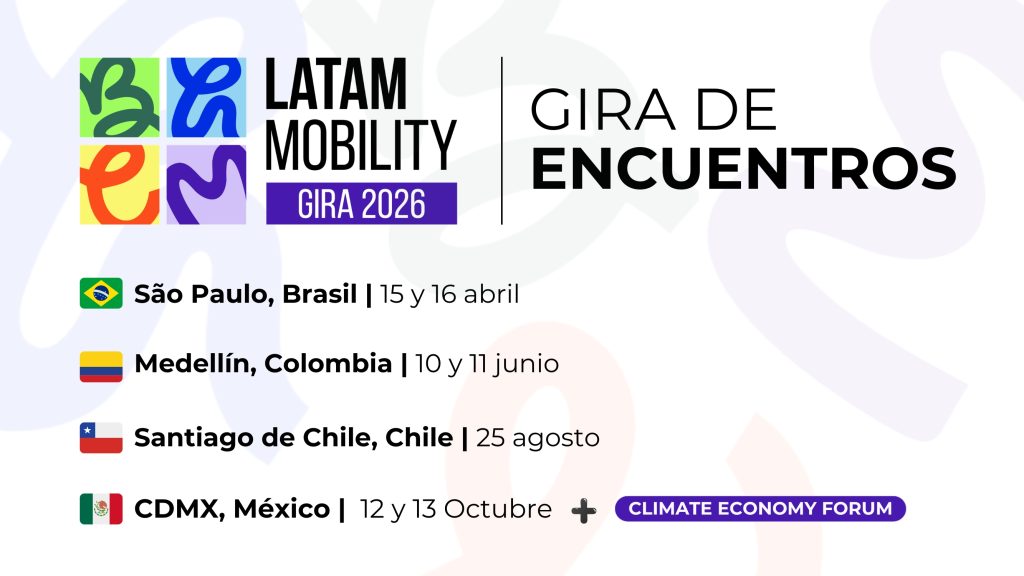
But this is just the beginning. The invitation remains open for more players to join the movement at Latam Mobility México 2026, taking place on October 12–13 in Mexico City.
There, governments, companies, academia, and civil society will continue weaving the collaborative network that will make sustainable mobility a continental reality. Optimism isn’t naivety—it’s the certainty that by working together, change is absolutely possible.