

At Latam Mobility Cono Sur 2026, the panel “Shared Mobility, Urban Micromobility, and Passenger Transport” brought together key players from the public, private, and academic sectors to examine the challenges and opportunities of integrating different transport modes across the region’s cities.
The session was moderated by Julio Villalobos Contreras (Director of the Transport and Logistics Center at Andrés Bello University – UNAB) and featured Eduardo Castro Ibáñez (DTPM), Nicolás Costa (Mastercard), Sebastián Galarza (CMS), and Pablo Pastega (FlixBus).
The conversation covered mode integration, payment digitalization, electromobility in intercity transport, public space usage, and the role of data in shaping sustainable mobility policy.
You May Also Be Interested In | The Battery War Heats Up: BYD and CATL Vie for Solid-State Leadership With Nearly Identical Timelines
Mode Integration: Infrastructure, Payment Methods, and Last-Mile Coverage as Fundamental Pillars
Moderator Julio Villalobos opened the panel by posing a central question: how can cities move toward truly integrated mobility when multiple modes coexist—mass transit, bicycles, scooters, taxis, ride-hailing, and intercity buses? The challenge is making all these systems function as one coherent, sustainable ecosystem.
Eduardo Castro of DTPM noted that integration rests on three pillars: infrastructure, access and payment methods, and last-mile reach. He cited the Los Libertadores intermodal station—where metro and intercity buses converge—as a model, and noted that DTPM is working to expand such spaces across the city.
“Infrastructure enables interoperability between different modes,” he said, adding that the last mile—especially at night—requires integrating taxis, ride-hailing platforms, and scooters so users can get all the way home.
Pablo Pastega of FlixBus reinforced this from the intercity perspective, emphasizing that intercity buses are public transport too—moving millions efficiently and sustainably—and must be part of the mobility mix. He also pushed for extending this logic to airports, so mobility doesn’t stop at city limits. “It’s essential that when infrastructure and mobility solutions are proposed, intercity transport is taken into account,” he stressed.

Digital Payment Methods: Interoperability and Trust
Nicolás Costa of Mastercard dove into the second pillar: payment methods. He noted that Chile has made significant strides in integrating digital payments into public transport, with examples like EMV (the interoperable standard) payments on Santiago’s metro and trains, and in Valparaíso, where four electric transport modes were linked with digital payments.
“Users choose how they want to pay—today they can use credit, debit, prepaid cards, or digital wallets,” Costa explained. He noted that 80% of card payments on Chilean public transport are made with debit and prepaid cards, debunking the myth that only credit is viable. He also pointed out that 40% of payments in Santiago are now made via digital wallets—adoption rates well above the Latin American average.
Costa raised the challenge of extending interoperability to all modes, including intercity transport, and previewed that Mastercard is working on the “Plug and Pay” standard for EV charging infrastructure, so users can pay with any method without needing exclusive apps. “Mobility must be paid for, and the way to do it must be simple,” he stated.
The Role of Public Transport and Technology
Sebastián Galarza of the Center for Sustainable Mobility (CMS) brought an economic and sustainability lens. He underscored that public transport is vital not only for lower per-passenger emissions but also for making more efficient use of urban space amid rising motorization.
“Thinking that motorization rates will double or triple in Latin American cities is unrealistic,” he stated.
Galarza highlighted that technology and data are critical allies for decision-making. He mentioned the Transport Data Commons initiative—coordinated by GIZ—which his organization is helping bring to Latin America to standardize and share information for better planning and decarbonization.
“Everything we’re discussing generates vast amounts of data, but often it’s not comparable or reliable. We need a framework to share data,” he explained. He also stressed the importance of electromobility in intercity and freight transport, where charging infrastructure challenges are even greater.
“It doesn’t make sense to build exclusive charging infrastructure for one company—it needs to be interoperable and intermodal,” he proposed, calling for broader coordination across public and private actors.

Intercity Transport and Electromobility
Pablo Pastega shared FlixBus‘s experience transitioning to electric vehicles. He noted that the company has been testing electric and biogas buses for over 7 years, and that today’s technology already offers ranges of nearly 400 kilometers with commercially available products.
He cited Portugal as an example, where FlixBus operates two electric buses on the Lisbon-Porto route successfully. However, he warned that the main bottleneck remains charging infrastructure—which must be developed by relevant authorities.
“Chile has an excellent charging network for urban buses; it would be worth studying how to leverage it for intercity transport as well,” he suggested.
On payment integration, Pastega acknowledged that intercity transport has unique challenges—like seat assignment—that complicate direct interoperability with urban payment systems. Still, he expressed openness to collaborating on technological solutions that enable deeper integration.
Public Space Usage: Coexistence and Operational Efficiency
Eduardo Castro addressed public space usage—a sensitive issue in any city. He recalled that diesel buses once generated noise, pollution, and oil spills, fueling neighborhood rejection. Today, with fleet electrification (over 4,300 electric buses in Santiago), buses are quieter, cleaner, and more environmentally friendly—which has eased dialogue with municipalities to secure operational layover spaces.
“Municipalities are recognizing they need to grant us public space so the system can operate efficiently,” Castro said. He added that empty deadhead trips (terminal to terminal) increase system costs, making on-street regulation critical.
Still, he acknowledged ongoing challenges with citizen coexistence and nighttime safety, which hinder last-mile operations.
Castro also mentioned that DTPM is evaluating cable car integration as a new transport mode, though he cautioned that fare and technological integration models remain undefined, as they could impact the public transport subsidy.

Certainties, Evolving Technology, and Collaboration
In the closing round, panelists shared their outlooks.
Pablo Pastega called for continued focus on intermodality and joint efforts to reduce fraud while improving transport safety and reliability. He emphasized that the technology already exists—what’s lacking is the will to collaborate.
Sebastián Galarza reiterated the need for reliable, comparable data to drive planning and decarbonization, and highlighted CMS‘s work on initiatives like Transport Data Commons for Latin America.
Nicolás Costa closed with a message about technology adoption in Chile. He noted that users are ready to pay digitally and that interoperability is a one-way street. He previewed that the future points toward biometric payments (face, fingerprint, or palm)—already being deployed in Asia and likely to reach the region in the coming years.
Eduardo Castro focused on the most fundamental, everyday goal: delivering certainty to users. “We want the bus to arrive when we say it will. We want it to stop when you signal. We want users to pay however they prefer,” he stated. He acknowledged that DTPM‘s biggest challenge is the last mile—especially at night, where safety and coverage fall short—and called for collaboration with all stakeholders to solve it.
The panel made it clear that shared mobility, micromobility, and passenger transport are interdependent parts of a single system. Their integration demands a holistic vision, cross-sector coordination, and genuine public-private collaboration.
Next Stop: Latam Mobility México 2026
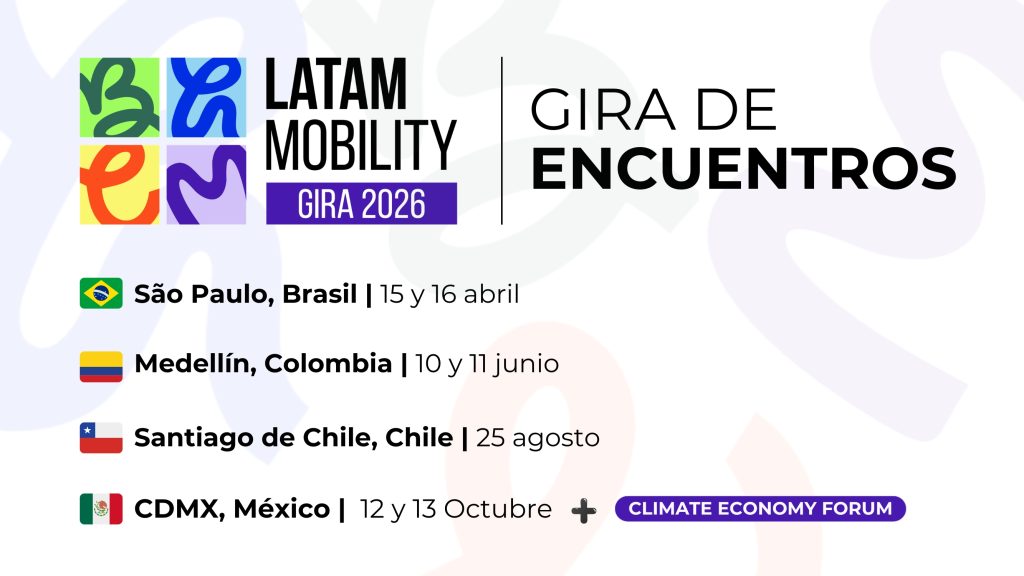
The Latam Mobility 2026 Tour continues its regional journey, with the next stop in Mexico City on October 12–13, 2026.
This event is shaping up as the year’s grand finale for the sector, bringing together public, private, academic, and civil society leaders from across Latin America to keep driving the transition toward cleaner, more efficient, and sustainable mobility.
Latam Mobility México 2026 will provide a unique platform to deepen partnerships, explore cutting-edge innovations, and map out joint roadmaps that accelerate transportation decarbonization across the region.
Latam Mobility thus reaffirms its commitment to being the region’s premier hub for energy transition and networking—connecting the ideas, projects, and people who are transforming the way we move.