

The final panel of Latam Mobility Cono Sur 2026, titled “Opportunities for Scaling Sustainable Mobility in Argentina and Uruguay,” brought together industry leaders to debate the future of mobility in the region.
The session, developed in partnership with Mobility Portal, featured Maximiliano Mesa (Vice President of the Sociedad de Transporte de Mendoza), Martín Piñeyro (Founder and CEO of SWAPY), and Juan Manuel Carrillo (New Energies Manager at Distrocuyo). The discussion was moderated by Florencia Guglielmetti (Editor at Mobility Portal).
The closing of the seventh edition of the Latam Mobility gathering in Santiago de Chile was marked by a lively and insightful discussion, where panelists analyzed the progress, challenges, and concrete opportunities to accelerate the energy transition in transportation across Argentina and Uruguay. They offered a comparative look that highlighted the different realities and strategies of both countries.
You may also be interested in | ANAC, General Motors, Huawei, and Inchcape analyze industrial leadership and the challenges to surpass 6% electric penetration in Chile
A Tour through the Panelists’ Experiences
To set the stage for the debate, Guglielmetti invited each participant to present their organization and their role in the sustainable mobility ecosystem.
Juan Manuel Carrillo began by introducing Distrocuyo, the high-voltage electric power transmission company operating in the Argentine provinces of Mendoza and San Juan. With 30 years of experience, it manages 2,500 kilometers of lines and 15 transformer substations.
In addition to its core business, Distrocuyo has evolved toward building renewable energy parks (exceeding 2 GW) and has a digital division, 6 Energy, which has implemented three of the five most important automation systems in the Chilean electrical grid. Carrillo detailed that his New Energies area is exploring verticals such as hydrogen, electromobility, and data centers.
For his part, Martín Piñeyro presented SWAPY, a Uruguayan startup that aims to make the energy transition viable in the delivery sector, with a model focused on solving three key problems: access to the vehicle, range (necessary to cover more than 200 km per day), and charging times.
To that end, SWAPY has developed a battery-swapping network for electric motorcycles, allowing delivery riders to save significantly on operating costs compared to a combustion motorcycle. They currently operate in Montevideo and Punta del Este and plan to expand to new cities in the region.
Finally, Maximiliano Mesa described the Sociedad de Transporte de Mendoza as a public transit operator with state participation, a pioneer in sustainable mobility in Argentina that has been operating electric buses since 2019 and, since 2023, has incorporated CNG (Compressed Natural Gas) units.
Additionally, it is currently executing the extension of the Mendoza Tramway, which will double its current route and reach the airport. Mesa highlighted the regional government’s comprehensive approach, which prioritizes the user through the integration of payment methods and the diversification of the energy matrix.
Lessons from Uruguay: State Policies and Public-private Coordination as Keys to Success
Piñeyro, as the sole Uruguayan representative, shared his country’s experience, where electric vehicle sales have exceeded 40% market share in recent months. He attributed this success to a State policy initiated a decade ago, with effective coordination among ministries, public companies, and local governments.
The approach consisted of identifying use cases with the strongest economic cases, supporting them with subsidies and tax incentives so that private players would dare to take the first step. Today, Uruguay is already in a phase of withdrawing those incentives, demonstrating the maturity of the market.
Piñeyro underscored the importance of public policy being an enabler rather than an obstacle, allowing regulations to adapt to innovation. In that regard, he mentioned the regulatory sandbox as a key tool for new business models to be tested without being tied to rigid regulatory frameworks.
He also highlighted the need to think of charging infrastructure in layers, with high-power networks for sporadic trips and low-power networks for overnight charging in urban environments—a challenge that still requires better coordination between the public and private sectors.
The Coexistence of Technologies: The Role of CNG and Electromobility in Argentina’s Energy Transition
A central topic of the debate was the coexistence of different technologies. Carrillo stated that in Argentina, with a long history of CNG use and competitive gas costs, this technology will not disappear.
In his view, the future will be a technology mix where CNG will remain for long-distance logistics and heavy vehicles, while electromobility will gain ground in the short-distance urban segment. He highlighted that the compressed gas refueling infrastructure is already deployed across the country, giving it a competitive advantage in certain niches.
Mesa agreed that they are compatible and noted that, in the case of Mendoza, the natural transition points toward CNG due to the province’s strategic location, surrounded by gas basins. However, he considered that the future is electromobility and that CNG is an intermediate step in that transition.
For this evolution to happen faster, he called for greater operational incentives that generate real revenue for service providers using clean energy. He also stressed the importance of awareness campaigns to dispel unfounded fears about battery range, a phenomenon he attributed to the erroneous comparison with the lifespan of mobile phone batteries.

Challenges and Barriers to Scaling up in Argentina
When asked what is missing to accelerate sustainable mobility, the panelists were emphatic. Carrillo emphasized the absence of a national regulatory framework in Argentina, which—unlike Chile or Uruguay—lacks an electromobility law to align the provinces.
The lack of technical and safety criteria for charging infrastructure is a bottleneck preventing the massive deployment of charging points, which in turn limits user autonomy. For him, it is urgent to generate regulations that enable that infrastructure and financing mechanisms that equalize the prices of electric and combustion vehicles.
Mesa delved into the economic barriers. From his operational and accounting perspective, tax burden, tariff barriers, and currency controls make electric vehicles more expensive, rendering them uncompetitive. While the Large Investment Incentive Regime (RIGI) is beginning to drive the economy, he considered it essential to modify the regulatory framework to create a competitive scheme that allows for large-scale adoption.
He also highlighted the experience of Mendoza as a successful case of a comprehensive approach, which has turned sustainable mobility into a State policy with a future outlook.
The Value of Shared Learning
The conversation concluded with a message of optimism and collaboration. Carrillo highlighted that Argentina “has awakened” and that this is a turning point, with much to be done and a unique opportunity to coordinate the public, private, and academic sectors.
Piñeyro reiterated the need to embrace all technologies and for public policies to be an enabler so that companies—which take the risks—can innovate. He also drew attention to the importance of planning the battery lifecycle, including second use and recycling—a challenge that Uruguay is already beginning to address with master plans and specific regulatory frameworks.
Mesa closed with a positive assessment of his first experience in this type of panel, valuing the learning that comes from knowing the realities of more advanced countries like Chile and Uruguay. He invited everyone to learn about the Mendoza model, which has implemented a public bike-sharing system and is developing a commuter train, demonstrating that sustainable mobility transcends motorization and encompasses territorial planning and citizens’ quality of life.

Next stop: Latam Mobility Mexico 2026
The gathering, which featured over 500 attendees and online viewers from around the world, demonstrated that the region is increasingly closer to decarbonized mobility. After the session, attendees were invited to the exhibition area for a networking activity, closing another edition of Latam Mobility in Santiago de Chile.
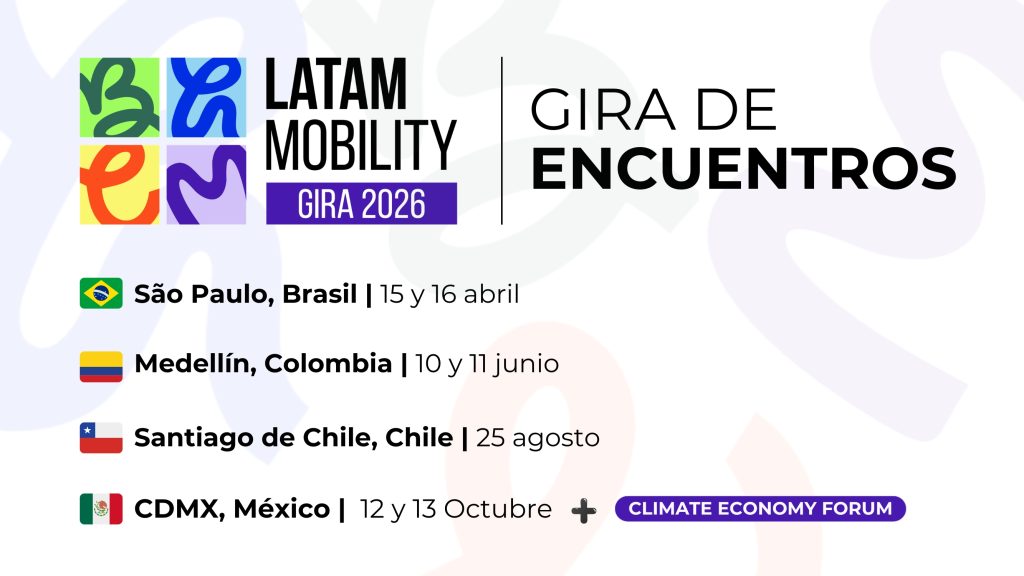
But the tour does not end here. The 2026 Tour will continue its journey through the region and makes its next stop in Mexico, where Latam Mobility & Net Zero México 2026 will be held—the largest edition of the year.
The event will take place on October 12 and 13, 2026, at the World Trade Center in Mexico City. Significant participation is expected, solidifying it as the largest gathering of the sustainable mobility ecosystem in the region.
The organizers invite all industry stakeholders—governments, companies, startups, academia, and organizations—to join this unmissable event to continue building the future of mobility in Latin America together. Ticket sales are now open.