



American automotive company Ford Motor Company officially announced the launch of Ford Energy, a new wholly owned subsidiary dedicated to the manufacturing and supply of Battery Energy Storage Systems (BESS) for utilities, data centers, and large industrial and commercial customers in the United States.
This move represents a strategic shift for the iconic automaker, redirecting part of its industrial capacity—originally intended for electric vehicle batteries—toward one of the fastest-growing markets in the energy sector.
The creation of Ford Energy comes amid a broader reconfiguration of the company’s EV strategy. At the end of 2025, Ford reported a $19.5 billion accounting charge and streamlined its electric vehicle assets and product roadmap in the U.S., due to lower-than-expected demand.
Against that backdrop, the company and its partner SK On agreed to dissolve their BlueOval SK joint venture, which had been established in 2021 as part of an $11.4 billion investment plan to build three battery plants in the country.
Faced with a slowdown in automotive battery demand, Ford opted to repurpose that industrial capacity to meet the growing need for dispatchable energy storage.
You may also be interested in | Autel, CIEN, Huawei Digital Power, Livoltek, and SynergEV agree that interoperability and financial modularity are key to charging infrastructure in Colombia
Investment of $2 Billion and 20 GWH Annual Capacity
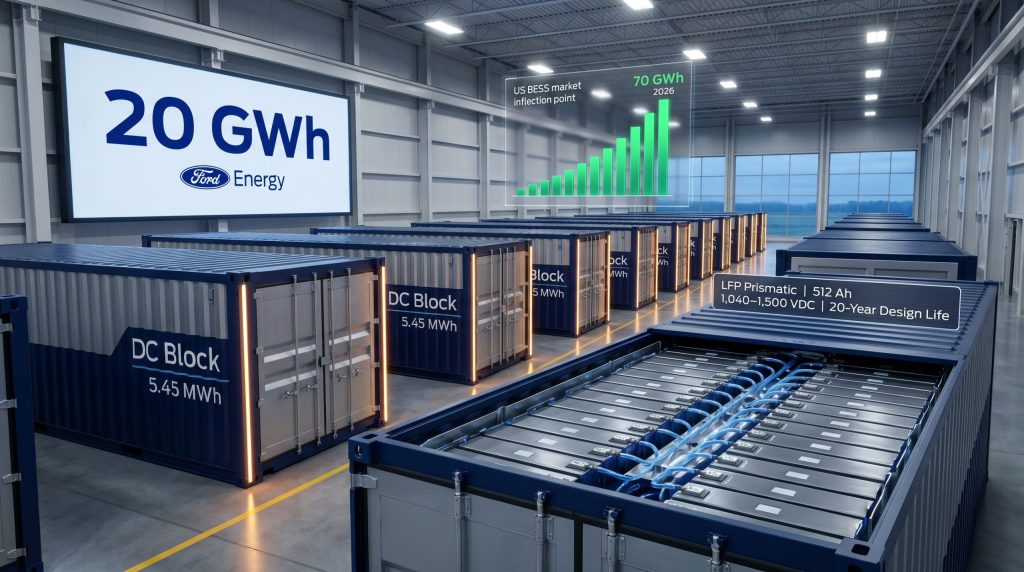
Ford confirmed it will invest approximately $2 billion over the next two years to consolidate this new business unit and begin initial commercial deliveries by the end of 2027. The strategy entails deploying at least 20 GWh of annual energy storage capacity, utilizing existing industrial infrastructure within the United States.
Ford Energy‘s operations encompass the complete manufacturing of battery cells, including electrode coating production, module and container assembly, as well as sales and technical support.
The BESS systems will be assembled at Ford‘s repurposed battery manufacturing facility in Glendale, Kentucky, which boasts 4 million square feet of dedicated space. The plant, formerly part of the BlueOval SK joint venture, will be converted to manufacture advanced battery energy storage systems.
The operation is expected to generate approximately 2,100 jobs in the region.
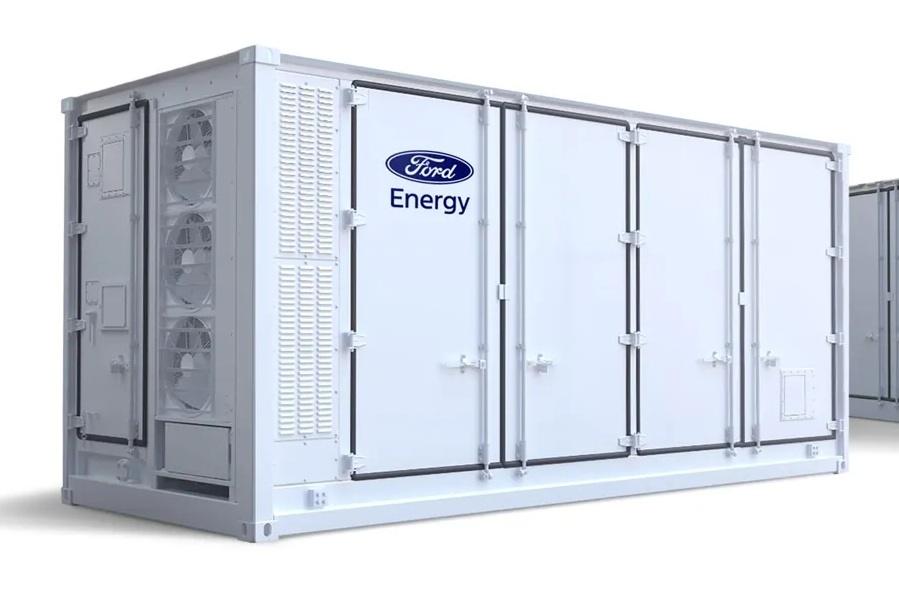
Flagship Product: The Ford Energy DC Block
Ford Energy‘s flagship product will be the “Ford Energy DC Block,” a standardized 20-foot containerized energy storage system designed for large-scale applications.
The system is based on 512 Ah prismatic LFP (lithium iron phosphate) cells, a chemistry increasingly used for its lower cost and greater durability compared to other alternatives.
The company will initially offer two configurations:
- FE-250: designed for two-hour discharge applications.
- FE-450: focused on four-hour energy storage operations.
Both systems integrate highly thermally stable LFP batteries, liquid cooling, and advanced energy management systems, aimed at delivering an estimated 20-year lifespan. Ford highlighted that one of its primary goals is to offer financially reliable solutions for utilities and energy developers seeking bankable and sustainable long-term projects.
“For nearly a year, we have operated quietly to build the foundation of this business. We haven’t just been planning; we have been executing—securing supply chains, preparing our manufacturing sites, and aligning our technology with the enormous demand for domestic energy storage.”
— Lisa Drake, President of Ford Energy
Data Centers, AI, and Renewables
The launch of Ford Energy comes at a time of explosive growth in the U.S. energy storage market. The boom in AI-driven data centers, the rise in renewable generation, and the need for electrical grid resilience are driving surging demand for stable, high-capacity storage solutions.
According to industry projections, the global battery storage market is valued at $40.45 billion in 2026** and is expected to grow to **$161.12 billion by 2034, with a compound annual growth rate of 18.86%.
Ford is confident that there is ample room for new players and that its century-long experience in industrial-scale manufacturing gives it a competitive edge over sector startups.
Furthermore, Ford Energy has already secured its first major customer. The company signed a five-year framework agreement with EDF Power Solutions North America for the supply of up to 20 GWh of storage systems. The agreement contemplates Ford supplying up to 4 GWh annually starting in 2028, providing commercial validation of the strategy and bolstering investor confidence.
Lastly, the announcement of the Ford Energy launch was received with enthusiasm. Morgan Stanley valued the new division at $10 billion** and estimated it could generate approximately **$588 million in annual operating profits at full scale.
Initial customer deliveries are scheduled for the end of 2027, and the company is currently in “full execution mode,” preparing its manufacturing capacity and providing solutions to its customers.
A Year 2026 of Consolidation for Mobility
The Latam Mobility 2026 Tour will continue in Santiago, Chile, on August 25, bringing together experts and strategic players to further strengthen the sustainable mobility ecosystem in the region.
The tour will end in Mexico City on October 12 and 13, alongside the Climate Economy Forum, in a meeting that will bring together sector leaders to continue driving the transition toward more efficient, sustainable, low‑emission transportation systems in Latin America.
The transition is already underway. The Latam Mobility 2026 Tour will be the meeting point to accelerate decisions, connect key players, and collaboratively build sustainable mobility in Latin America.