The Brazilian automotive market is undergoing an unprecedented shift. For the first time, the volume of imported vehicles sold in the country in the year-to-date has surpassed sales of the market’s longtime leader, Fiat.
According to recent data from the National Association of Motor Vehicle Manufacturers (Anfavea), between January and July 2026, 344,100 imported vehicles were registered (including light and heavy vehicles), compared to 320,200 bearing the Fiat badge. In a hypothetical ranking, imports as a whole would sit at the very top of the sales chart.
Imports now account for 22.7% of the market as of July 2026, up from 18.6% in 2025 and 17.7% in 2024. The surge in vehicles produced outside Brazil is striking: in the first seven months of the year, imports jumped 25.7% compared to the same period in 2025. In July alone, 63,500 units were imported—a 40.5% increase over the same month last year.
China is the driving force behind this import wave. From January to July, 180,500 Chinese vehicles were registered in Brazil, representing a staggering 105.4% growth over the same period in 2025. Chinese vehicles now account for 52.4% of total automotive imports for the period.
In contrast, Argentina—historically Brazil’s largest supplier of imported vehicles—recorded a 16.8% drop in its year-to-date shipments, totaling 101,100 units. Mexico , for its part, sent 23,800 vehicles, posting 29.8% growth.
Also of interest | General Motors Accelerates Electrification and Hybrid Strategy in South America with Historic Investment
July Posts the Best Monthly Performance of the Year
The month of July was particularly strong for the sector. Some 279,500 new vehicles were registered, marking the best monthly performance of the year, with 14.9% growth compared to July 2025 and a 2.6% increase over June.
In the first seven months of 2026, the Brazilian market has accumulated 1.7 million registrations—a 17.9% advance over the same period last year.
Domestic production also climbed: automakers manufactured 253,900 vehicles in July, 5.9% more than in the same month of 2025. In the year-to-date, production reached 1.63 million units, with 8.3% growth.
This performance places Brazil second worldwide in production growth, trailing only India (14.5%) and ahead of Japan (2.9%), while the United States and China posted contractions.

Electrified Vehicles Reach Record Market Share
One of the most striking data points in the Anfavea report is the explosive growth of electrified vehicles (hybrids and electrics). In July, these models captured a record 23.5% share of total light vehicle sales. A year ago, that share was below 11%.
In the January-to-July cumulative period, 308,000 light electrified vehicles were registered—a 120.8% jump over the same period last year.
The most telling detail is the composition of this growth: imports of combustion vehicles fell 6.8% , while imports of electrified vehicles surged 78.4% , confirming that the current import boom is directly tied to the market’s technological transformation.
Igor Calvet was blunt in assessing where the industry stands: “While it takes just a few weeks to bring a vehicle produced in another country and put it up for sale here, localizing its production takes more than a year.”
The numbers back up that concern. Of the 121,000 “domestic” electrified vehicles sold in the period, only 53,000 were actually manufactured in the country, while 68,000 came from CKD (Completely Knocked Down) and SKD (Semi-Knocked Down) assembly operations. The other 186,000 electrified vehicles arrived fully built from abroad.
Calvet noted that “this volume of nearly 350,000 imports is greater than the production in the period of most of our members’ factories, which indicates that we could be generating more demand for our factories and suppliers and, therefore, more jobs.”

Imports: Bridge or Threat?
The executive also warned about the potential downside: if manufacturing a complete vehicle in Brazil requires ten workers, CKD and SKD operations require only two to three. A scenario where that becomes widespread could translate into a 70% drop in jobs generated.
The growth of imports isn’t inherently negative. Imports can serve as the first phase of an industrialization process, allowing companies to test the market, build brand recognition, gain scale, and prepare for future investments.
In fact, China is seizing this opportunity like no other country, and several Chinese manufacturers have already announced plans not just to sell vehicles in Brazil but to produce them locally.
The challenge for Brazil, however, is to strike the right balance—one that allows companies to use imports to introduce new technologies and grow the market, but that, as volumes increase, progressively encourages local production.
In contrast to the dynamism of imports, Brazilian vehicle exports continue to face downward pressure. In the first seven months of 2026, 255,900 units were exported—20.8% less than the 323,000 recorded in the same period of 2025. The main culprit is the contraction in Argentine demand, which fell 35.4% year-to-date.
With the exception of Colombia, Brazilian shipments to all other Latin American countries posted declines.
As Igor Calvet pointed out, industrial policy must operate within this window of vulnerability—not by closing the market or blocking competition, but by creating conditions so that Brazil’s extraordinary market growth also translates into productive investment on home soil.
The Ideal Space for Assembly Plants in Latin America
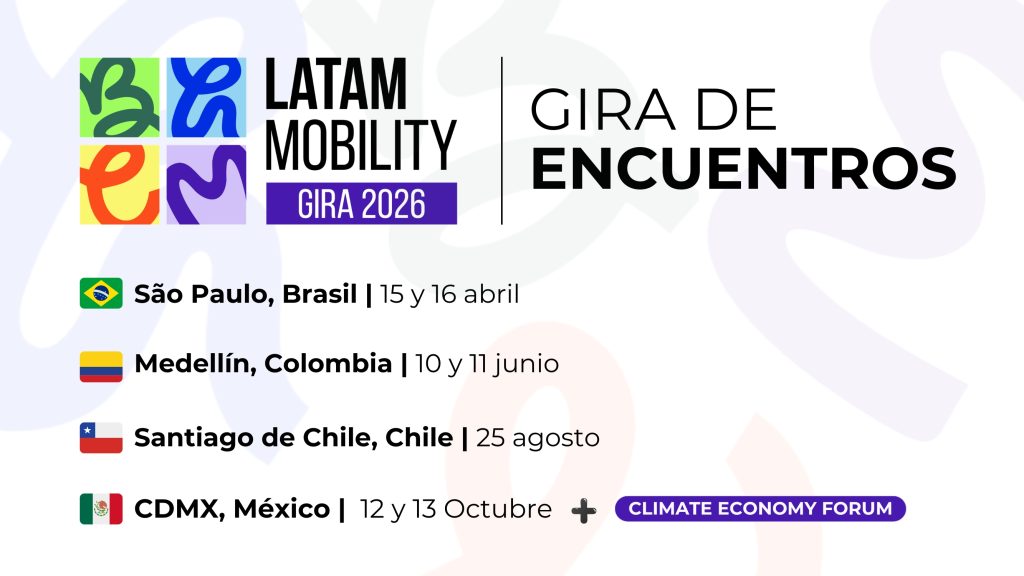
The Latam Mobility 2026 Tour will arrive in Santiago, Chile, on August 25, bringing together experts and strategic players to further strengthen the sustainable mobility ecosystem in the region.
The tour will end in Mexico City on October 12 and 13, alongside the Climate Economy Forum, in a meeting that will bring together sector leaders to continue driving the transition toward more efficient, sustainable, low‑emission transportation systems in Latin America.
The transition is already underway. The Latam Mobility 2026 Tour will be the meeting point to accelerate decisions, connect key players, and collaboratively build sustainable mobility in Latin America.