

At Latam Mobility Cono Sur 2026, Sebastián Díaz—Solution Manager for PV, BESS, and EV Charger at Huawei Digital Power Chile—delivered the keynote “Power On: Igniting the Future of Electromobility.” He laid out the charging infrastructure solutions Huawei is deploying in Chile to accelerate the shift to electric transportation.
The presentation drew a packed auditorium of government officials, executives, and industry experts. It underscored Huawei‘s commitment to digitalization and energy sustainability across Latin America, along with its ability to deliver high-performance technologies tailored to the Chilean and regional markets.
You May Also Be Interested In | Santiago, São Paulo, and Bogotá Concentrate 7,000 Electric Buses and Lead the Transportation Revolution in the Region
Huawei: A Technology Giant With Solid R&D Investment
Sebastián Díaz opened by introducing Huawei as a tech company founded in 1987 that started in telecommunications and later diversified into digital power, cloud, and smart devices—always with a relentless focus on innovation.
“We invest 20% of our sales in R&D,” Díaz highlighted, noting that over 54% of Huawei’s workforce is in development roles. That allows the company to refresh its product lineup every two to three years and stay ahead of the technology curve.
Huawei arrived in Chile in 2003 to drive 2G deployment and has since expanded into new business units, including Digital Power—an area dedicated to renewable generation, energy storage, and EV charging infrastructure.

Charging Solutions for Fleets: Four Key Values
Díaz’s presentation centered on charging infrastructure for electric fleets—ranging from buses and trucks to backhoes and port cranes. He emphasized four core strengths of Huawei‘s solution:
High Resistance to Harsh Environmental Conditions
Huawei‘s chargers are built to perform in extreme environments. Díaz explained that the equipment has a failure rate of less than 0.2% , ensuring near-permanent uptime. The secret is a liquid cooling system with an IP55 protection rating that eliminates fans, drastically cutting failures from dust, corrosion, or high heat.
He cited a mining operation in China where the equipment runs from -40°C to +50°C with 150 autonomous electric vehicles. He also noted that noise levels stay below 55 decibels, making urban installations viable—even along Santiago’s busy Alameda corridor.
Modular Evolution and Scalability
Huawei‘s system allows seamless capacity upgrades. Each power unit can serve up to 12 vehicles simultaneously, scaling from 240 kW to 1.4 MW depending on project needs.
“You have to leave room and plan from the start,” Díaz advised, stressing the importance of a long-term vision in infrastructure design.
Smart Charging and Operational Efficiency
Huawei‘s Split system decouples the power unit from the dispensers (charging guns), enabling intelligent energy distribution. Unlike traditional stand-alone chargers that waste fixed capacity, Huawei‘s solution dynamically allocates power based on each vehicle’s real-time demand.
“We can charge five times as many vehicles with this solution,” Díaz stated, backing it up with a side-by-side video that showed a dramatic jump in throughput (vehicles served per hour) compared to conventional systems.
Integration With Renewable Energy and Storage
Huawei doesn’t just offer chargers—it also provides photovoltaic (PV) systems and battery energy storage (BESS). This integration lets operators generate solar energy during the day, store it, and use it at night, cutting costs and reducing strain on the grid.
Díaz noted that installation is modular and fast, with turnkey timelines shrinking to a week—or even just hours in some cases, as recently demonstrated at a Chilean mining site.

Multiple Applications and Constant Innovation
Díaz detailed that Huawei is actively working on multiple fronts in Chile: public transit bus charging, mining projects, and green corridors connecting cities like Santiago-Concepción and Santiago-Puerto Montt.
“We’re in talks with various transportation companies to deploy high-power solutions, especially in large-scale mining, where the heaviest trucks need shorter charging times and 24/7 operation,” he said.
He also confirmed that Huawei already has all its equipment certified by Chile’s Superintendency of Electricity and Fuels (SEC), with T1, T4, and T6 seals, clearing the way for commercial rollout.
Díaz previewed that Huawei is bringing its Megawatt charger to Chile—a 1.4 MW, 2,400-amp beast designed for heavy-tonnage vehicles. While demand hasn’t reached that level yet, Huawei is already in talks with industry players to evaluate its deployment.
“Our solution is modular, compact, and easy to install. In tech, we’ve learned that simplicity and availability are what matter most,” Díaz concluded.

Next Stop: Latam Mobility México 2026
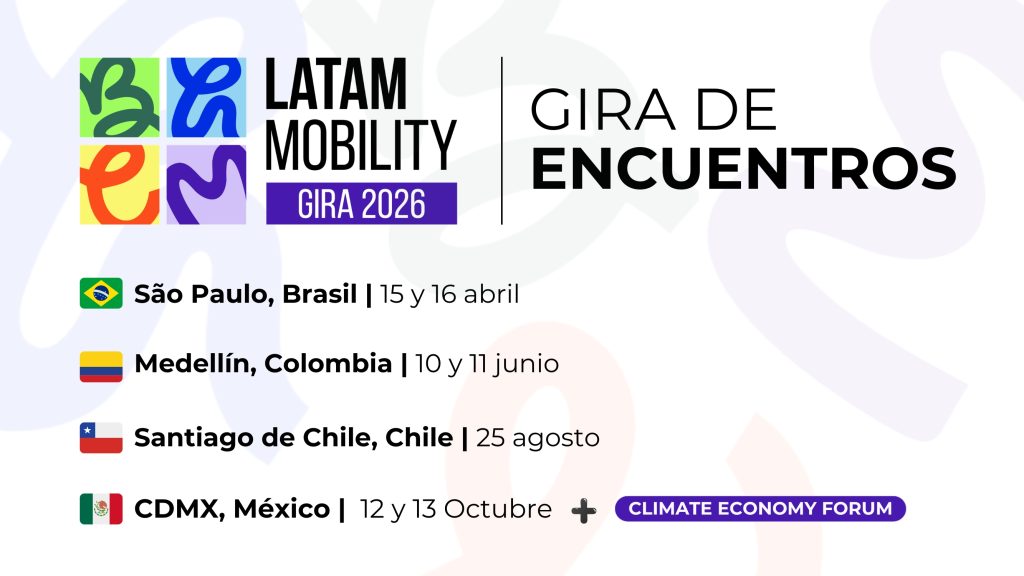
The Latam Mobility 2026 Tour keeps rolling, and the next stop is Mexico City on October 12–13, 2026.
This event is shaping up to be the year’s grand finale for the sector, bringing together public and private leaders from across Latin America to keep driving the shift toward cleaner, more efficient, and sustainable mobility.
The Latam Mobility Mexico 2026 edition will offer a unique platform to deepen partnerships, explore the latest innovations, and map out joint roadmaps that accelerate transportation decarbonization across the region.
There, governments, companies, academia, and civil society will continue weaving the collaborative network that will make sustainable mobility a continental reality. Optimism isn’t naivety—it’s the certainty that by working together, change is absolutely achievable.