During the inauguration of Latam Mobility Cono Sur 2026, Chile’s Undersecretary of Transport, Martín Mackenna, reviewed the country’s sustainable mobility policy. He highlighted key achievements, the consolidation of a management model that has outlasted multiple administrations, and the challenges ahead as the government works to extend its quality and sustainability standards to the entire country.
The summit drew more than 600 attendees and has cemented its status as the region’s premier hub for energy transition and sustainable mobility networking.
In his address, the Undersecretary walked through the major milestones in Chile’s public transport transformation. His core message: the path toward cleaner, more efficient mobility is also the path toward a better-connected country.
You May Also Be Interested In | Porsche Chile Takes an Electric Leap With the “Moon” Charging Ecosystem and Reinforces Its Commitment to Electromobility in the Southern Cone
Chile: A Global Electromobility Leader
Undersecretary Mackenna opened by underscoring Chile’s standing as an undisputed global benchmark in electromobility. “Santiago is the city outside of China with the most electric buses,” he stated, backing the claim with concrete numbers: the Metropolitan Mobility Network currently operates roughly 7,300 buses, more than 4,300 of which are electric—about 60% of the total fleet.
According to the Undersecretary, this achievement is no accident. It is the result of a series of policy decisions made starting in 2018 that have matured into lasting State policies, maintained across different government administrations.
Mackenna was emphatic that sustainability isn’t limited to environmental gains—it also has a social dimension. He noted that the Red brand is about much more than a color or a name; it represents a quality-of-service standard that has positioned Chile as a leader in user satisfaction with public transport.
“The Red Mobility Network and Santiago’s Metro are top citizen brands in terms of positive impact and public approval,” Mackenna said, citing studies that back up that recognition. He pointed out that Red Movilidad made it into the top 10 brands with a positive impact, largely because of its contributions to the economy, people, and the environment—thanks in no small part to citizen approval and the rollout of electric buses.
The Undersecretary also referenced Cadem studies, which rank Santiago’s Metro first in institutional trust with 83%, while Red Movilidad reached 75%—up six points from its previous measurement.
“All of this shows how much public transport matters to the Ministry of Transport and Telecommunications,” he said. “And it’s reflected in citizen approval, in a system that averages more than 5 million daily validations.”

State Policies and a New Management Model
Mackenna stressed that the progress made is the fruit of State policies sustained since 2018, which have solidified a new contractual management model and left the system’s earlier struggles behind. He acknowledged that implementation hasn’t always been easy, but the results speak for themselves.
He highlighted a major shift in industry costs. In 2017, when the first two electric buses arrived, each unit cost more than $500,000. Today—a decade later—prices have been cut in half, to around $250,000.
That reduction, he explained, was made possible by aligning multiple stakeholders, developing new financing structures, creating innovative business models, and coordinating work on charging infrastructure.
The Undersecretary also announced that the Ministry is pushing forward with system modernization, including a new fleet management system. Over the next three years, operations and planning systems will be comprehensively updated to improve the user travel experience and optimize overall performance. He also noted that new payment methods—like QR code payments—are being rolled out, and that the ministry continues to tackle challenges to make public transport increasingly attractive as a real mobility alternative.
Expanding to the Regions
One of the most significant announcements in Mackenna’s address was the commitment to bring Santiago’s advancements to the rest of the country. “Everything we value so much in Santiago, we have the challenge of bringing to the regions,” he stated.
He reported that more than 440 electric buses are already operating in the regions. In early September, a network of 41 electric buses will be inaugurated in the city of Ovalle—a 100% electric fleet. In Copiapó, 121 electric buses are already in circulation.
The Undersecretary previewed that efforts are ongoing to add more buses—both electric and Red-standard—across the country, with new units planned for Greater Valparaíso and Osorno. The Ministry will also continue working with regional governments to extend the quality standard to more areas.
On infrastructure, Mackenna announced that they are working with the Ministry of Housing and Urban Planning on regulatory changes to facilitate electro-terminal installations. He noted that one major benefit, tied to social sustainability, is that electric terminals generate far fewer negative externalities for surrounding communities compared to diesel bus terminals.
“We want this incorporated into urban planning policies and to simplify approvals for electro-terminals,” Mackenna said, emphasizing the need for regulations that support the growth of charging infrastructure.

Trains, Subways, and Other Sustainable Modes
Mackenna made it clear that the sustainable mobility commitment isn’t limited to buses—it covers all modes of transport. He highlighted the development of Metro Santiago’s Line 7, Line 8, and Line 9, as well as Line A of the train.
He also mentioned commuter rail projects, such as the Melipilla Train and the Batuco Train. In the regions, plans include doubling the capacity of the Biotren, extending the Merval in Valparaíso, and developing commuter trains in La Araucanía and Los Lagos.
“These are essential for attracting more people to public transport and enabling multimodal operations with other modes,” he said. He also highlighted the role of taxis, shared taxis, and smaller public transport, which are highly efficient for certain mobility needs in different cities.
Along those lines, he announced that the electric taxi fleet renewal is being boosted through changes to renewal programs—aiming to incorporate more electromobility, modernize the fleet, and address investment needs in charging infrastructure. Subsidy amounts are being increased, and operators are being allowed to partner up to install shared electro-terminals.
The Undersecretary emphasized that sustainable mobility also encompasses freight transport, intercity transport, and private transport. He announced coordinated work with the Ministry of Energy on the Electromobility Strategy, which includes deploying charging infrastructure—such as the high-power route along Route 5—as well as establishing tax incentives and decarbonization tools.
In closing, Martín Mackenna reaffirmed the Ministry of Transport and Telecommunications’ commitment and conviction that the path toward sustainable mobility is also the path toward a better and more connected country.
“What has been achieved in these years is the foundation upon which we will continue working to improve public transport. With a view not only toward Santiago but toward all the regions of the country—so that people can access cleaner, more modern, more comfortable systems that are at the service of the people, which is ultimately our main focus.”
Martín Mackenna
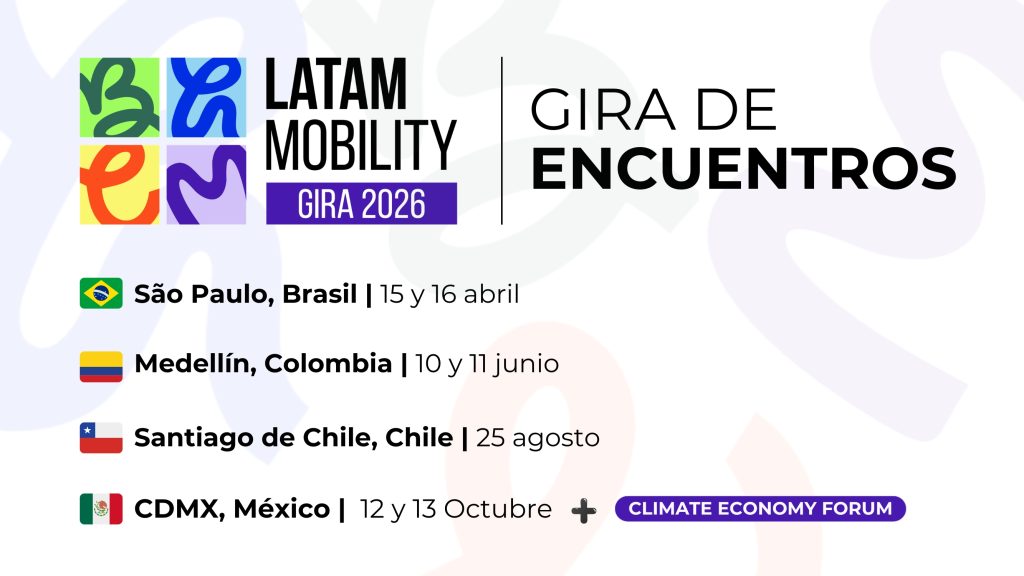
Mexico, the grand finale of the Latam Mobility 2026 Tour
Mexico City is preparing to host the grand finale of the Latam Mobility 2026 Tour, the event that will cap off a journey across the region’s key markets.
On October 12 and 13, the Mexican capital will become the epicenter of dialogue and action for sustainable mobility in Latin America, bringing together the most influential decision-makers from the public and private sectors, along with international experts, investors, and pioneering companies in electromobility.
Latam Mobility México 2026 arrives at a pivotal moment for the country and the entire region. The agenda will tackle the structural challenges of the energy transition in transportation, from the expansion of charging infrastructure and the electrification of public and freight transport, to the regulatory frameworks needed to accelerate the adoption of electric vehicles.
The transition toward cleaner, more efficient mobility is no longer a future promise: it is a reality that is steadily advancing in Mexico and throughout the region. The grand finale of the 2026 Tour in the Aztec capital will be the decisive moment to accelerate decisions, connect key stakeholders, and define the roadmaps that will guide the transformation of transportation in Latin America.
Don’t miss the opportunity to be part of the event that will put the perfect finishing touch on a year of dialogue, innovation, and collective action. We look forward to seeing you in Mexico City to build the future of sustainable mobility together!