


According to an analysis based on an international survey of electric vehicles drivers, an accelerated transition to this type of mobility would avoid up to 5.912 billion tons of CO2 per year, a volume comparable to the annual emissions of economies such as the United States or India.
This data reinforces the strategic role of the transportation sector, which is responsible for nearly a quarter of global greenhouse gas emissions.
For this reason, the electrification of transportation is consolidating its position as one of the most important levers for addressing the global climate crisis.
You may also be interested in | BYD Confirmed as the World’s Largest Electric Vehicle Seller in 2025
User Loyalty Drives Adoption
One of the most striking findings of the Global Electric Vehicle Driver Survey is the high level of satisfaction among those who already use this technology.
Globally, 93% of drivers said they would buy an electric vehicle again if they had to replace their current one. In contrast, only 1% would consider returning to a gasoline or diesel car, while 4% would opt for a plug-in hybrid.
This level of loyalty is significant for a technology that, while advancing rapidly, still faces structural challenges in infrastructure, initial costs, and uneven regulatory frameworks between countries.
On the other hand, the environmental potential of this preference is considerable. Based on a note from Expansión ESG that estimates the total number of vehicles in circulation worldwide at 1.644 billion, and figures from the Global Carbon Budget, the analysis considers that each combustion car emits an average of 3.6 tons of CO2 per year.
Under this scenario, replacing 93% of the global vehicle fleet with electric units would avoid nearly 5.912 billion tons of annual emissions, a magnitude comparable to the total emissions of highly industrialized countries.
These results coincide with warnings from organizations such as the United Nations Environment Programme (UNEP), which has repeatedly pointed out that the electrification of transport is essential for countries to meet their climate commitments and move towards more sustainable urban mobility systems.
Operating Costs and Experience, Decisive Factors
The survey, conducted by the Global Vehicle Alliance (GVA) with support from the ClimateWorks Foundation, shows that the preference for electric vehicles is not solely based on environmental reasons.
For 63% of drivers, the main incentive is the lower cost of energy compared to fossil fuels. Added to this is interest in technological innovation, cited by 31%, as well as care for the environment and lower maintenance costs, mentioned by 21% in both cases.
The ClimateWorks Foundation emphasizes that more and more users perceive electric vehicles to be more economical in the long term than combustion vehicles, even in contexts where public incentives are limited.
This perception is reinforced by a positively rated driving experience, characterized by better acceleration, less noise, and a more comfortable ride.
Confidence Grows with Time
The experience gained behind the wheel also influences the consolidation of this technology. According to the results, 33% of drivers have been using electric vehicles for less than a year, while 15% report two years of experience.
Five percent say they have three years of use and 3% say they already have four years of driving experience, which reinforces confidence as daily exposure to the technology increases.
This behavior suggests that, once the initial barrier to adoption has been overcome, the likelihood of remaining in electromobility is high.
Despite progress, challenges remain. The EY Mobility Consumer analysis agrees that charging infrastructure has become the main obstacle for potential buyers, even above range anxiety.
Globally, 72% of drivers identify the limited coverage of fast chargers as the main disadvantage, while 31% point out that these charging points are often out of service.
Other factors mentioned include the time required for recharging the electric vehicles, cited by 26%, insufficient range for certain uses, with 24%, and the difficulty of an electric vehicle functioning as the only car in the household, mentioned by 23%.
Overcoming these barriers represents both a challenge and an opportunity for manufacturers, infrastructure operators, and public authorities.
A Conviction-driven Transition
Overall, the Global Electric Vehicle Driver Survey shows that adoption of this technology consolidates once the initial phase has been overcome.
The fact that nine out of ten users are willing to repeat the purchase indicates that electromobility is advancing less as a trend and more as a conviction based on experience.
For countries such as Mexico, where penetration is still in its infancy compared to more advanced economies, this level of loyalty sends a clear message: the challenge is no longer to convince those who already drive an electric vehicle, but to create the necessary conditions for more people to access this alternative, thus accelerating the reduction of emissions and the transition to cleaner and more sustainable mobility.
2026 as a Year of Consolidation
Rather than ambitious announcements, 2026 will be a year for measuring results. Electric and low-emission mobility will no longer be evaluated by the number of pilot projects but will be judged by its ability to operate at scale, reduce real emissions, and improve the quality of urban life.
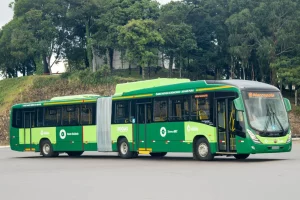
For Latin America, the challenge will be to capitalize on its experience in electric public transportation, close infrastructure gaps, and build stable policies that allow the transition to be not only green but also inclusive and economically viable.
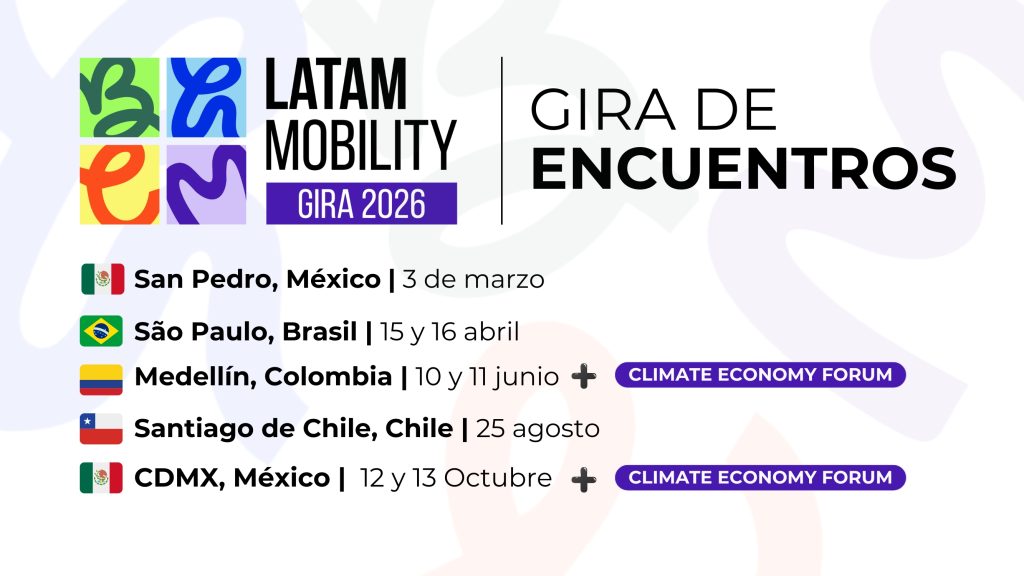
With the 2026 Tour, Latam Mobility reaffirms its commitment to building a regional agenda that connects vision, public policy, innovation, and the market.
Through its stops in Monterrey and Mexico City, Brazil, Colombia, and Chile, the platform will continue to promote a collaborative approach to accelerate the transition to cleaner, more efficient, and more inclusive transportation systems, positioning Latin America as a relevant player in sustainable mobility at the global level.
Be part of the movement that is accelerating Latin America’s energy and urban transformation. If you would like to learn more about how to participate and positioning options, click here.