The energy transition in Latin American public transportation has reached a historic milestone. For the first time, the region has surpassed 10,000 electric buses in operation—a figure that reflects the coordinated effort of 80 cities across 13 countries to accelerate the decarbonization of urban transit.
The announcement came during the Lat.Bus 2026 fair in São Paulo, with data consolidated by E-Bus Radar and presented by C40 Cities and the International Council on Clean Transportation (ICCT) .
This achievement is no coincidence. It is the result of years of ambitious public policies, innovative financing models, and political will that have turned the region into a living laboratory for electromobility.
What was an exception a decade ago is now an expanding public policy that delivers direct benefits for the climate, public health, transit quality, and local economies.
You might also be interested | The Great Energy Transition and Networking Hub Arrives in Santiago de Chile: «Latam Mobility Southern Cone 2026»
The Trio Leading the Electric Revolution
Three cities carry the weight of this transformation. Together, Santiago de Chile, São Paulo, and Bogotá account for more than 7,000 electric buses—representing over 66% of the region’s total fleet.
Santiago remains the city with the largest electric bus fleet outside of China, with 4,379 units in operation that have prevented 5,124 kilotons of CO₂ emissions per year. Its fleet includes 4,038 standard buses, 216 minibuses, 95 articulated buses, and 30 double-decker buses—the latter being the only ones of their kind in all of Latin America.
The brands operating in the Chilean capital include Zhongtong, FOTON, BYD, Scania, Yutong, and King Long. But electromobility is no longer exclusive to the capital: cities such as Copiapó, Valparaíso, Antofagasta, La Serena, and Tiltil have also adopted this technology, raising Chile’s total fleet to 4,882 zero-emission units.

São Paulo is home to the largest electric bus fleet in Brazil and the second largest in Latin America. In June 2026, the capital of São Paulo incorporated 500 new electric buses at once, raising its fleet to 1,759 electric units, including 1,570 battery buses and 189 trolleybuses. The environmental impact is striking: this fleet avoids the emission of approximately 130,000 tons of CO₂ per year and eliminates the consumption of about 57 million liters of diesel annually.
Mayor Ricardo Nunes highlighted that the addition of these 500 buses is equivalent to the environmental impact of planting 3.2 million trees per year. Behind this deployment is an investment program of approximately 6.5 billion reais, combining resources from the National Bank for Economic and Social Development (BNDES), the World Bank, and the Inter-American Development Bank (IDB). This financing scheme has been key to overcoming the economic barriers that traditionally hindered the adoption of clean technologies.

Bogotá has consolidated itself as a fundamental pillar of this electric revolution. The Colombian capital operates 1,583 electric buses—a figure that represents 15% of all zero-emission vehicles in Latin America. The commitment to expansion is firm: the local administration projects adding 631 additional electric buses between 2026 and 2028, with the ambitious goal of reaching 2,297 zero-emission units by 2027.
This growth is supported by a co-financing model between the District and the Nation, which includes an agreement for 1.5 trillion pesos for the acquisition of new units. The impact of this fleet is profound: it is estimated that its operation prevents the emission of more than 10 million tons of CO₂ annually, while reducing noise pollution and improving the quality of life for drivers and passengers.

China’s Advance Puts the Brazilian Industry on Alert
A recurring topic at the fair was the growing concern of the Brazilian industry over the advance of Chinese manufacturers—and the figures speak for themselves. According to data from the National Federation of Motor Vehicle Distribution (Fenabrave), between January and July 2026, China’s BYD occupied the second position among bus brands in Brazil, with 175 units licensed.
In the month of July alone, BYD led the market with 60 units registered. The company already dominates the electric bus segment, with a market share exceeding 44% in some months.
Igor Calvet, president of the National Association of Motor Vehicle Manufacturers (Anfavea), stated: “Brazil needs to reconcile fleet renewal and decarbonization with preserving its engineering expertise and installed productive capacity.” Calvet warned that foreign manufacturers are advancing not only in the Brazilian market but also in neighboring countries that historically bought vehicles produced in Brazil.
He added: “Preserving our engineering and productive capacity in the face of this competition is not resistance to change. It is the defense of skilled jobs and the technical knowledge that manufacturers in Brazil took 70 years to build.”
Rubem Bisi, president of the National Association of Bus Manufacturers (Fabus), also defended the need for consistent and sustainable programs to finance the technological upgrading of collective transportation. He called for creating balanced competitive conditions for an industry that generates jobs, collects taxes, develops low-emission solutions, and exports vehicles and technology.
The underlying message is clear: in the face of Asian competition, local responsiveness and knowledge of the local terrain are the main competitive advantages.
The Ideal Space for Sustainable Mobility in Latin America
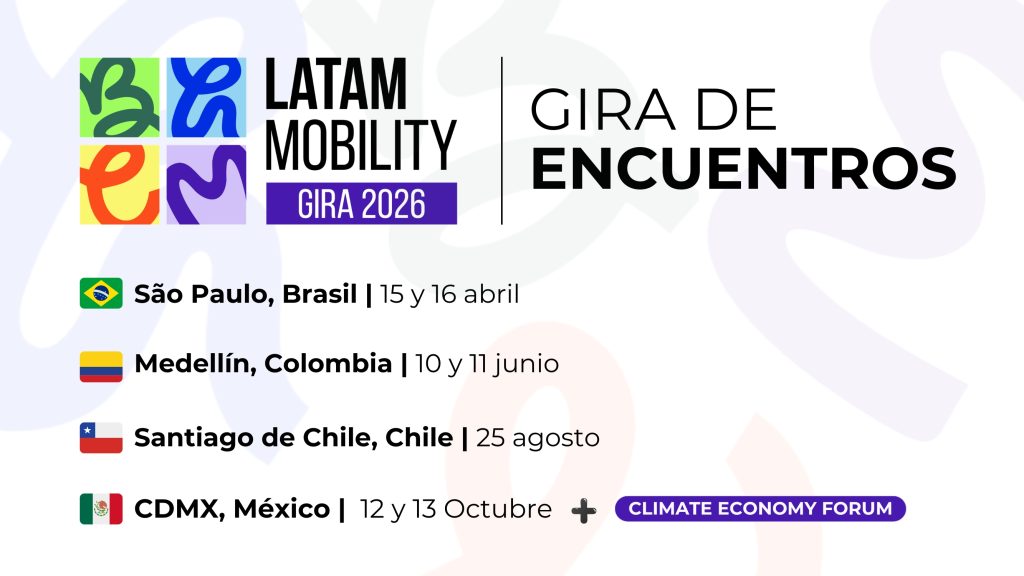
The Latam Mobility 2026 Tour arrives tomorrow, August 25, in Santiago de Chile, bringing together experts and strategic stakeholders to continue strengthening the sustainable mobility ecosystem across the region.
The tour will end in Mexico City on October 12 and 13, alongside the Climate Economy Forum, in a meeting that will bring together sector leaders to continue driving the transition toward more efficient, sustainable, low‑emission transportation systems in Latin America.
The transition is already underway. The Latam Mobility 2026 Tour will be the meeting point to accelerate decisions, connect key players, and collaboratively build sustainable mobility in Latin America.