



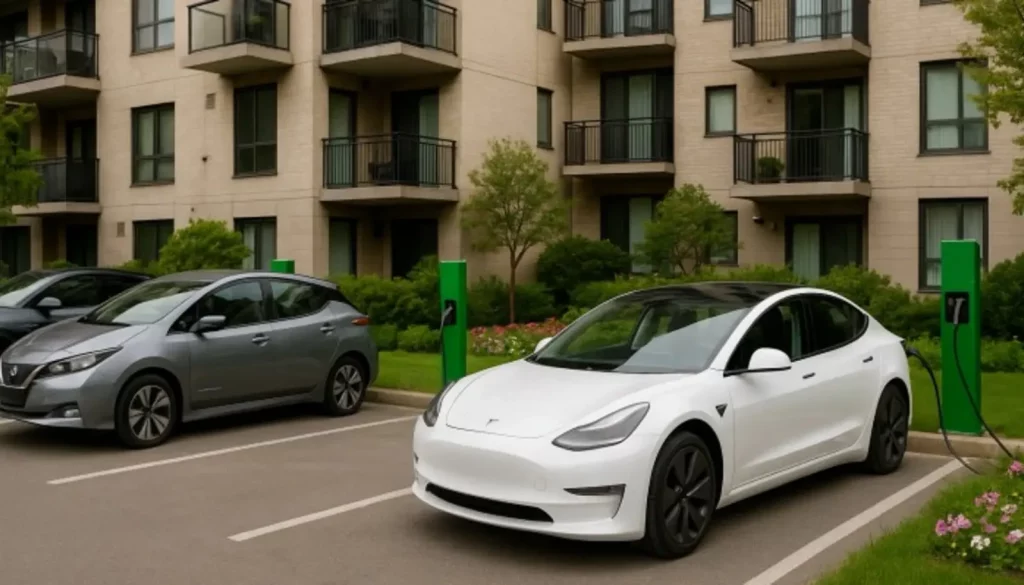
The State of São Paulo has taken a significant step in advancing electric mobility in Brazil. Governor Tarcísio de Freitas signed Law No. 18,403, which ensures the right of condominium owners to install, at their own expense, individual chargers for electric vehicles in their private parking spaces, in both residential and commercial buildings.
The regulation was published last week in the Official State Gazette and is now in effect. This eliminates one of the main obstacles faced by owners of electrified vehicles in large urban centers: the refusal of some condominiums to allow the installation of charging infrastructure in private parking lots.
You might also be interested in | ANAC studies creating a specific pilot category for “flying cars” and opens public consultation in Brazil
Individual Right with Legal Backing
The legal text establishes that “the condominium owner is assured the right to install, at their own expense, an individual charging station for an electric vehicle in their private parking space,” provided that current technical and safety standards are respected.
In practice, the legislation prevents internal regulations or administrative decisions of condominiums from blocking the adoption of charging infrastructure without solid technical grounds.
The condominium association can only deny authorization if it presents a duly substantiated and documented technical or safety justification.
In the event of an unjustified denial, the affected owner can appeal to the competent public bodies, introducing an additional protection mechanism to ensure compliance with the law.
Regulatory Compliance
While the law recognizes the right to install chargers, it also establishes clear conditions to ensure the electrical and structural integrity of the buildings.
The installation must be compatible with the electrical load of the individual unit and comply with the regulations of the local electric power distributor, as well as national technical standards issued by the Brazilian Association of Technical Standards (Associação Brasileira de Normas Técnicas – ABNT).
Notable among these are ABNT NBR 5410 (low-voltage electrical installations), ABNT NBR 17019, and the NBR IEC 61851-1 standard, which regulates conductive charging systems for electric vehicles.
Furthermore, the work must be carried out by a qualified professional, with the issuance of a Technical Responsibility Note or Record (Anotação de Responsabilidade Técnica – ART or Registro de Responsabilidade Técnica – RRT), ensuring traceability and technical accountability.
The condominium owner must also provide formal prior communication to the building’s management before starting the installation of the chargers.
The condominium’s bylaws may regulate aspects such as the communication format, complementary technical standards, and responsibility for potential damages or electricity consumption. However, they cannot prohibit the installation without verifiable technical grounds.
New Projects and Vetoes
The law also introduces a forward-looking obligation for the real estate sector. Developments whose projects are approved after February 19, 2026, must provide in their electrical systems the minimum capacity to support the future installation of charging stations by condominium owners or users.
However, the text itself clarifies that the specific technical regulation for this requirement will be defined by an act of the Executive Branch, following the law’s publication. This implies that the state government will need to detail the technical criteria, required minimum capacity, and potential inspection parameters.
Although the law consolidates the right to install chargers, the governor fully vetoed Article 3 of Bill 425/2025, previously approved by the São Paulo State Legislative Assembly.
This article contemplated public incentive instruments to foster charging infrastructure, such as tax exemptions or credit lines aimed at installing this equipment.
With the veto, the legislation guarantees the legal right of the condominium owner but does not establish mechanisms for economic support or public financing to make the installations viable. Consequently, the costs of acquiring and installing the chargers will fall exclusively on the interested parties, following private initiative logic.
Law No. 18,403 positions the State of São Paulo among the Brazilian jurisdictions that are advancing in regulatory adaptation in the face of the energy transition and the electrification of transport.
While supplementary technical regulation and the development of broader incentive policies are still pending, the rule sets an important precedent regarding the individual right to charging infrastructure in dense urban environments, where condominium governance had, until now, been a point of friction for the expansion of electric mobility.
2026 as a Year of Consolidation
Rather than ambitious announcements, 2026 will be a year for measuring results. Electric and low-emission mobility will no longer be evaluated by the number of pilot projects but will be judged by its ability to operate at scale, reduce real emissions, and improve the quality of urban life.
For Latin America, the challenge will be to capitalize on its experience in electric public transportation, close infrastructure gaps, and build stable policies that allow the transition to be not only green but also inclusive and economically viable.
With the 2026 Tour, Latam Mobility reaffirms its commitment to building a regional agenda that connects vision, public policy, innovation, and the market.
Through its stops in Monterrey and Mexico City, Brazil, Colombia, and Chile, the platform will continue to promote a collaborative approach to accelerate the transition to cleaner, more efficient, and more inclusive transportation systems, positioning Latin America as a relevant player in sustainable mobility at the global level.
Be part of the movement that is accelerating Latin America’s energy and urban transformation. If you would like to learn more about how to participate and positioning options, click here.