

The “China Zorrilla” —the world’s largest fully electric ferry—is now in the final leg of its historic journey from Australia to the Río de la Plata. The vessel, built at the Incat Tasmania shipyard in Hobart, was loaded onto the semi-submersible heavy-transport ship Black Marlin for the more-than-15,000-kilometer voyage to its final destination.
The loading operation—described by Incat as one of the most complex maneuvers ever performed in Tasmania—involved taking on ballast until the Black Marlin sat below the waterline, positioning the “China Zorrilla” over the submerged cargo deck, and then gradually refloating the entire assembly.
Robert Clifford, president of Incat, said that seeing the ship (internally identified as “Hull 096“) loaded onto the Black Marlin represented “a moment of enormous pride” for the entire team. He emphasized that the project “challenged conventional thinking at every stage and reflects the ingenuity, determination, and craftsmanship” of hundreds of shipyard workers.
After formally setting sail from the port of Hobart, the “China Zorrilla” recently completed its transit of the Strait of Magellan—a stretch the company called “one of the great milestones of the entire journey,” given the unpredictable weather and the complexity of navigating with a 130-meter vessel riding on deck.
You may also like | Autel Energy Makes the MaxiCharger DH120 With GB/T Standard Available Across Latin America
A Colossal Aluminum Catamaran With Capacity for 2,100 Passengers
The “China Zorrilla” is a catamaran measuring 130 meters in length and 32 meters in beam, built entirely of marine-grade aluminum, making it the largest 100% electric aluminum vessel ever constructed. Its maximum capacity is 2,100 passengers and 225 vehicles—double the size of its predecessor, the “Francisco.”
The electric propulsion system features eight motors and an energy storage system exceeding 40 MWh, fed by more than 5,000 batteries weighing roughly 260 tons. Once in service, the ferry will cruise at 25 knots and make six daily crossings between Puerto Madero in Buenos Aires and Colonia del Sacramento in Uruguay.

The all-electric drivetrain will enable zero direct emissions during navigation, whisper-quiet operation, and significantly reduced vibrations compared to conventional vessels. To support this, Buquebus will install 15 MW high-power chargers at the ports of Buenos Aires and Colonia, which will recharge the ferry in about 80 minutes—aligning perfectly with passenger boarding and disembarkation.
The main deck will feature nearly 2,300 square meters of commercial space, while the upper deck will concentrate dining areas, common areas, and the three travel classes: Tourist, Business, and First. In total, the ferry will offer 3,000 square meters of recreational space, accommodate 150 crew members, and provide satellite connectivity.

The World’s First ‘Blue Operation’
The “China Zorrilla” project represents a total investment of $170 million, which includes the charging and electrical transmission infrastructure essential for its operation.
The financing was structured through a loan from Banco Santander Uruguay for US$107 million and a partial credit guarantee of US$67 million from the International Finance Corporation (IFC) , a member of the World Bank Group.
This alliance made possible the first “blue operation” in Uruguay and the first in the maritime and electric transport sector worldwide. The ‘blue loan’ designation—a subset of green financing—is used by the IFC for investments in water management, plastic pollution reduction, marine ecosystem restoration, sustainable shipping, eco-tourism, and marine renewable energy.
Juan Carlos Lopez Mena, president of Buquebus, stated: “At Buquebus, we believe that the future is only possible if it is sustainable and efficient. That is why reducing energy consumption, incorporating innovation, and strengthening social action are part of our business strategy. Our main environmental objective is to reduce greenhouse gas emissions through cutting-edge technologies.”
Alfonso Garcia Mora, vice president for Europe, Latin America, and the Caribbean at IFC, noted: “Investing in electric transport is essential to reduce millions of tons of greenhouse gas emissions each year, in a sector that accounts for roughly 25% of global emissions.” The project is expected to cut emissions by the equivalent of 37,545 tons of CO₂ annually.

Arrival in Uruguay and Commissioning
According to the maritime tracking site VesselFinder, the Black Marlin is scheduled to arrive at the port of Nueva Palmira, Uruguay, on September 12, 2026. The freight cost for the transfer from Tasmania is estimated at around $8 million.
Once there, the transport ship will submerge again to release the “China Zorrilla,” which will then undergo final tests before entering commercial service. Because the vessel is designed for short-haul trips—covering the Colonia–Buenos Aires run in about 90 minutes multiple times daily—it couldn’t make the transoceanic journey under its own power.
Once all certifications are secured, the ferry is set to begin regular service on the Colonia (Uruguay) to Buenos Aires (Argentina) route in early January 2027.
Buquebus calls the ship “a new chapter in transport innovation and decarbonization” and notes that it will allow Argentina and Uruguay to host the first regular service of the world’s largest 100% electric ferry. The ferry’s name honors actress China Zorrilla, an iconic figure of Río de la Plata culture.
Beyond its cultural weight, the vessel marks a concrete step toward a cleaner, more sustainable future—where technology and environmental stewardship sail side by side toward a greener horizon.

Next Stop: Latam Mobility México 2026
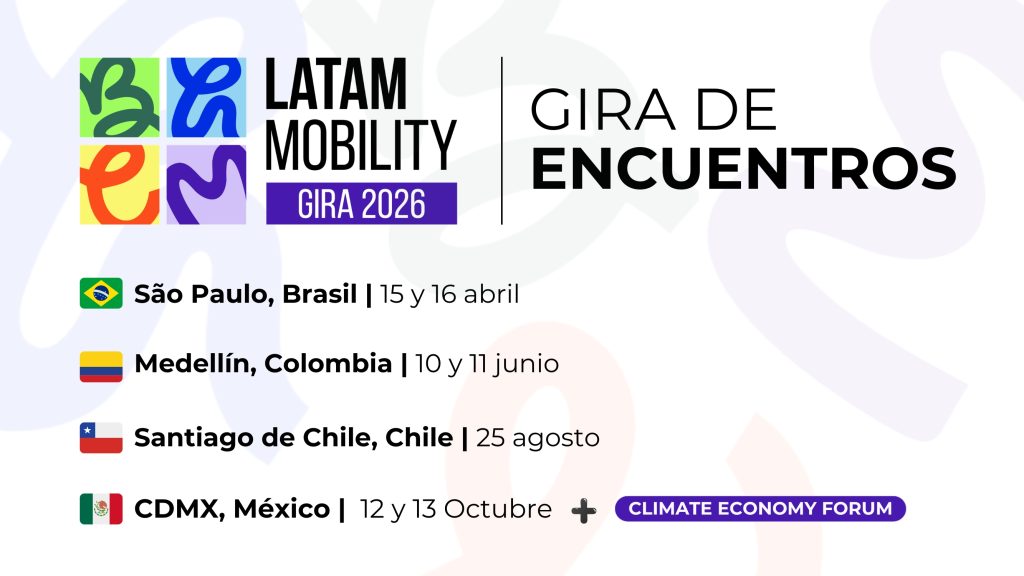
The Latam Mobility 2026 Tour will continue its journey across the region, with the next stop in Mexico City on October 12–13, 2026.
This event is shaping up as the year’s grand finale for the sector, bringing together public, private, academic, and civil society leaders from across Latin America to keep driving the transition toward cleaner, more efficient, and sustainable mobility.
Latam Mobility México 2026 will offer a unique platform to strengthen partnerships, explore the latest innovations, and map out joint roadmaps that accelerate transportation decarbonization across the region.
Latam Mobility thus reaffirms its commitment to being the region’s premier hub for energy transition and networking—connecting the ideas, projects, and people who are transforming the way we move.