


Within the framework of the webinar “LATAM: 2026 Roadmap for Mobility and Energy,” organized by Latam Mobility, a high-level panel brought together prominent sector leaders to analyze the present and future of electromobility in Brazil and its impact on the region.
The discussion was moderated by Daniela Garcia, Country Lead Brazil at Invest In Latam, who guided a conversation spanning technological innovation, regulatory challenges, and industrialization.
The session featured Rodrigo Vicentini (Managing Director Brazil at CharIN), Ana Luiza Berti (Head of Commercial Brazil & Latam at VoltBras), and André Jannini (Vice President of IBMS and representative of FIESP).
The experts agreed that Brazil is positioning itself as the undisputed leader of the energy transition in Latin America, though it still faces structural challenges to consolidate its global leadership.
You may also be interested in | São Paulo to Host “Latam Mobility & Net Zero Brasil 2026,” the Premier Regional Gathering for Sustainable Mobility
A Market in Motion
The conversation opened with a focus on understanding Brazil’s role in the sustainable mobility ecosystem. Daniela Garcia noted that Brazil is one of the largest markets in the world, but emphasized that sustainable mobility goes beyond vehicles—it encompasses a complex web of technology, energy, and infrastructure.
Ana Luiza Berti shared her perspective from VoltBras, a company specializing in software for charging networks with a presence in 10 countries across the region. “Brazil has become a benchmark for Latin America,” she said. “What we develop here we take to other countries, especially in interoperability technologies, advanced payments, and financial reconciliation for complex charging networks.”
Berti noted that the rapid adoption of app-based fleets and the surge in solar energy usage have created unprecedented pressure on infrastructure, generating both opportunities and a pressing need for greater legal certainty.
Rodrigo Vicentini, for his part, emphasized interoperability as a fundamental pillar. From CharIN—a global association promoting standards like ISO 15118—he explained that the future of mobility depends on standardization.
“We cannot repeat the experience of the ‘90s with cell phones, where each operator functioned in isolation,” Vicentini said. “We need drivers to be able to charge at any point, regardless of the provider, with a seamless and transparent experience.” He also highlighted Brazil’s competitive edge in renewable energy and the urgent need to advance in neo-industrialization.

The Formula for Scalability
The panel delved into the paradoxical contrasts of the Brazilian market: a country with an enviable energy matrix and a vibrant startup ecosystem, but weighed down by a tax burden and bureaucracy that hinder industrial development.
André Jannini contributed the perspective from industry and entrepreneurship. As Vice President of IBMS and now focused on FIESP, he announced the creation of a new sustainable mobility hub within the industrial federation.
“Brazil has the potential to be a global reference in hybrid mobility, combining biofuels with electrification,” Jannini stated. “But we need to reindustrialize. That means correcting tax distortions and, above all, distributing incentive resources more fairly.”
Jannini offered a pointed critique: large multinationals easily access development funds, while innovative startups that create national solutions are left behind. “We are a startup developing the first biomethane-electric hybrid vehicle designed in Brazil,” he said.
“Competing for resources against giants that don’t need that money is an uneven fight.” He insisted that the key to boosting the national industry lies in reducing the tax burden and creating regulatory certainty.
Interoperability and a Vision for the Future
As the debate turned toward prospects for 2026 and 2027, the panelists agreed that the technological challenges are largely solved—the real hurdles are commercial, regulatory, and collaborative.
Ana Luiza Berti pointed out that other countries in the region—Colombia, Mexico, Argentina—are beginning to experience the same mass adoption that Brazil saw two years ago.
“The opportunity is enormous, but we must act as a unified sector,” she said. “The end-user cannot suffer from the lack of agreements between players. We need collaboration so that interoperability is not just a technical concept, but a commercial reality.”
Along those lines, Rodrigo Vicentini outlined the technical roadmap for the coming years, mentioning upcoming regulatory frameworks from INMETRO, discussions on bidirectional charging (V2G) at ANEEL, and the arrival of new technologies like Plug&Charge.
“We expect significant progress in legal metrology and the standardization of bidirectional charging—both critical for the stability of the electrical system,” he said. “Brazil has the opportunity not only to import technology but also to create its own component development hubs for the global market.”
Conclusions: The Ecosystem Symphony
To close, the experts left clear messages on what’s needed to consolidate Brazilian leadership:
- André Jannini summed it up: Brazil has the clean energy matrix, the market scale, and a unique integration with biofuels. The missing link is “the cement that binds everything together: interoperable, governed, certified, and intelligently compensated connectivity—along with a reduction in the tax burden.”
- Ana Luiza Berti urged the sector to unite and solve the remaining commercial and regulatory challenges, emphasizing that the opportunity exists, but a lack of coordination could slow progress.
- Rodrigo Vicentini projected a future where roaming between charging operators is transparent for the user—similar to the evolution of mobile telephony—and where Brazil actively participates in the global supply chain, manufacturing components rather than just assembling imported products.
Daniela Garcia closed the panel by thanking the participants and reminding them that the true value of these spaces lies in the joint construction of the ecosystem. “Those who see electromobility only as a vehicle don’t understand the energy and geopolitical revolution we’re experiencing,” she concluded. “Brazil has unique strengths, and synergy with Latin America will be key to scaling solutions.”
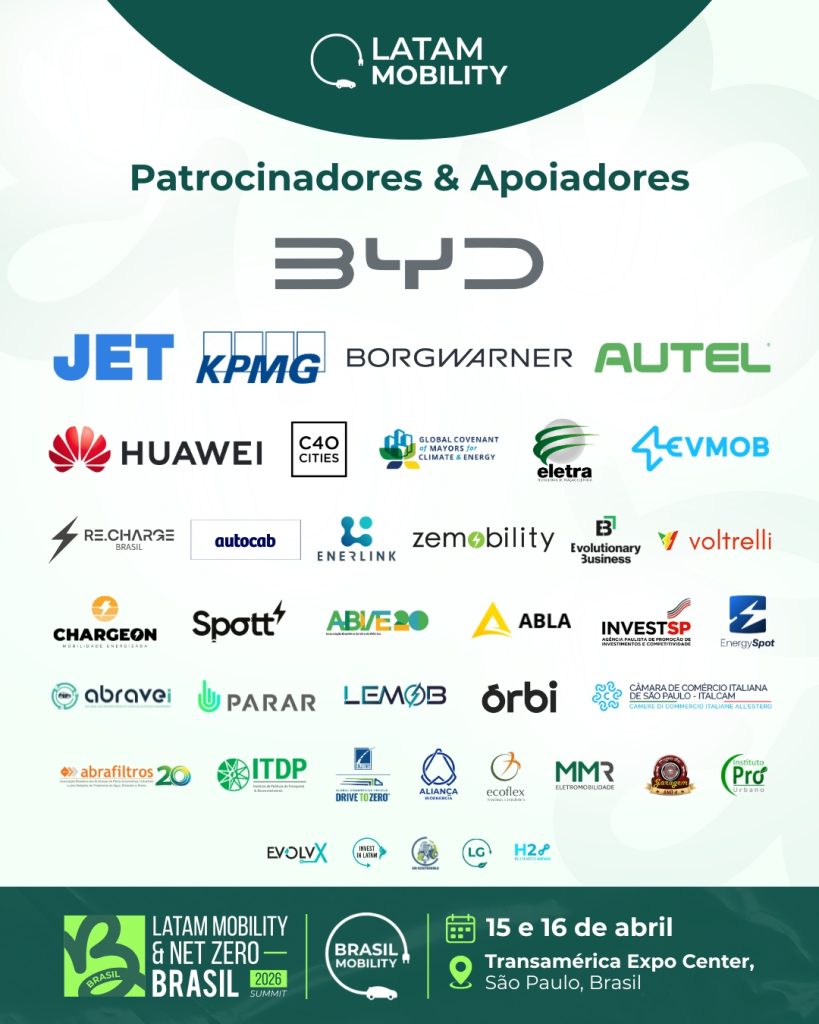
The webinar served as a prelude to the upcoming in-person event “Latam Mobility & Net Zero Brasil,” taking place on April 15 and 16 in São Paulo, where these debates on the future of sustainable mobility in the region will continue.
If you wish to purchase tickets for the event, click here. For more information, visit our WhatsApp channel.