



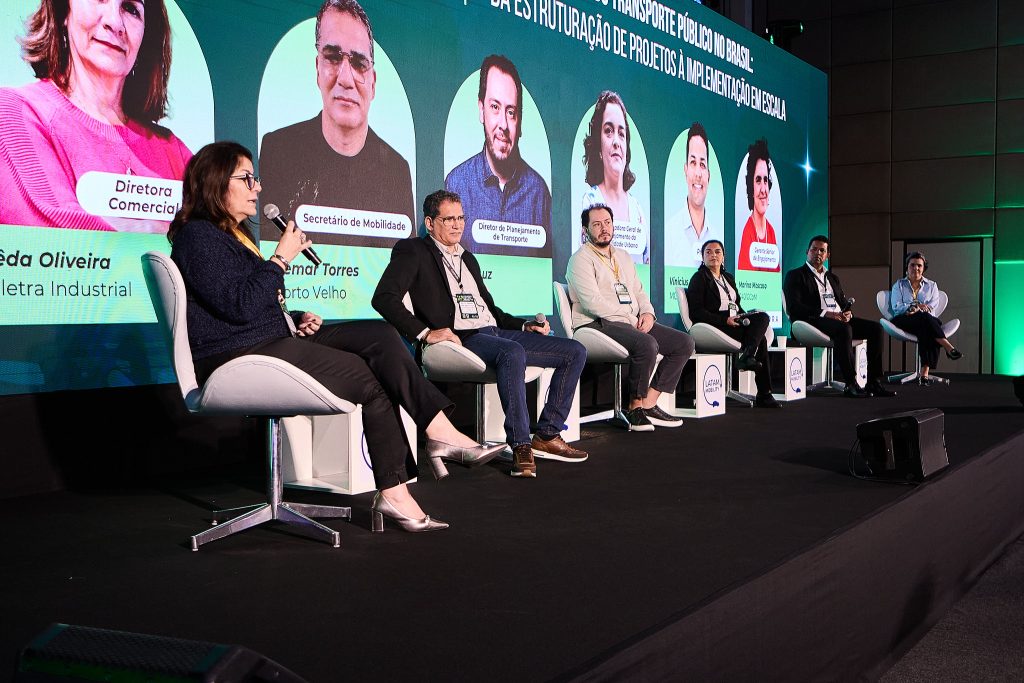
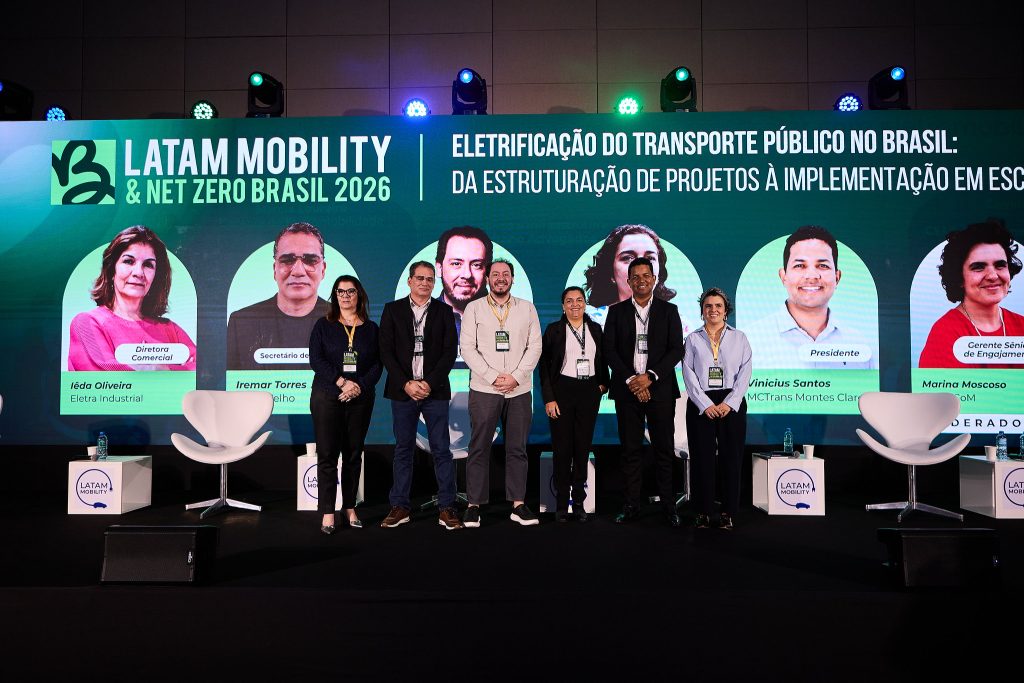
Within the framework of Latam Mobility & Net Zero Brazil 2026, a panel titled “Electrification of Public Transport in Brazil: Structuring Projects for Scalable Implementation” brought together representatives from national and municipal governments, industry, and international organizations to analyze the challenges and opportunities of electric mobility in the country’s collective transit systems.
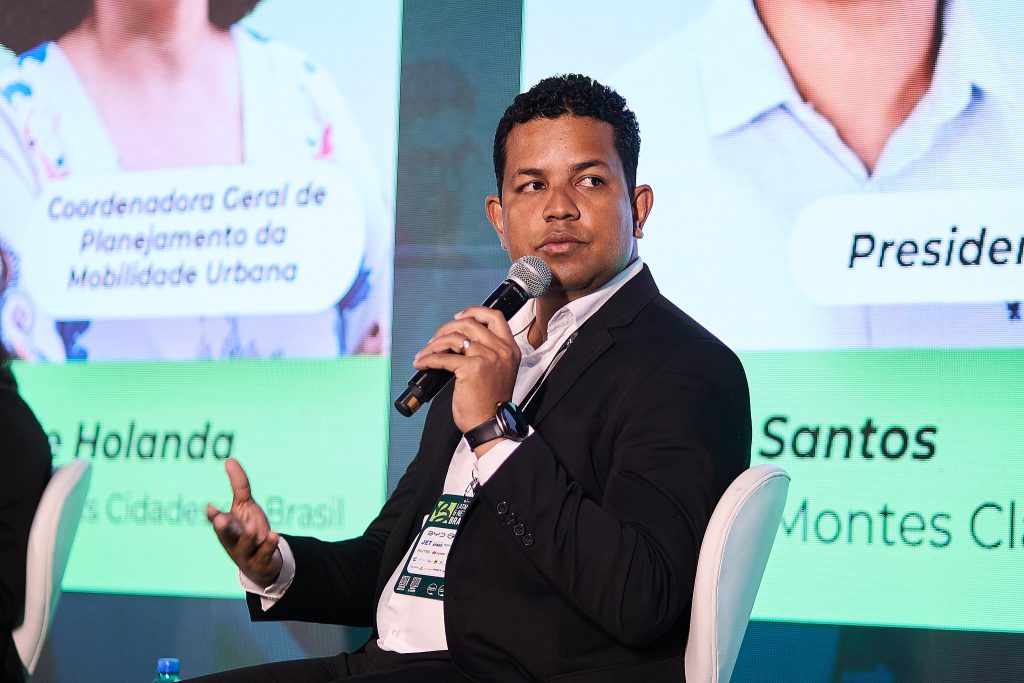
Moderated by Marina Moscoso, Senior Engagement Manager at C40/GCoM, the panel featured Caio Luz, Transport Planning Director at SPTrans; Daniele Holanda, General Coordinator of Urban Mobility Planning at Brazil’s Ministry of Cities; Iêda Oliveira, Commercial Director at Eletra Industrial; Iremar Torres, Mobility Secretary of Porto Velho; and Vinicius Santos, President of MCTrans Montes Claros.
During the panel, participants discussed how to structure viable electric mobility projects, exploring the role of multi-level coordination among governments, as well as pathways to mass public transit electrification — including infrastructure, financing, tenders, and risk management.
Also of interest | Brazil: Salvador and Belém lead active mobility projects with nature‑based solutions
São Paulo: a public policy turning point
Caio Luz from SPTrans opened the debate with a powerful statement: “As of 2022, under Mayor Ricardo Nunes’s determination, we no longer allowed diesel buses to be added to our system. That was the decision that accelerated everything. ”
Luz explained that São Paulo’s fleet has 13,000 vehicles operating daily — a number unmatched in the country. Initially, only 18 units were electric. However, between January 2025 and April 2026 alone, more than 800 electric buses were delivered, bringing the total to 1,259 units in operation.
The director noted that the mayor’s plan aims for 2,200 electric vehicles by the end of 2028, and he confirmed that the first third of that target has already been surpassed. Still, he acknowledged that recharging infrastructure remains the big challenge: “We need to discuss alternatives like high‑voltage systems or intermediate storage.”
A relevant fact: of the 32 lots that divide bus operations in the city, 30 already include electric units — demonstrating that the periphery is also being served.
“This is a public policy with deep social and environmental impact, ” Caio Luz concluded, offering São Paulo’s experience to other municipalities.
Montes Claros electrifies its fleet
Vinicius Santos, president of MCTrans, presented the experience of Montes Claros, a city of about 500,000 inhabitants in the interior of Minas Gerais.
They currently have 100 buses in their fleet and have already tendered 22 electric units, with a new tender underway to add more than 27 vehicles. The goal is to electrify 50% of the fleet in 2026.
Santos emphasized that the main challenge is power grid governance — an obstacle common to all cities. But he warned: “Electrification alone will not bring passengers back. We must also think about new technologies to attract the users we lost after the pandemic.”
He thanked the support of the Mutirão program for bringing large and medium‑sized cities together to facilitate the transition.
Porto Velho: Amazonian City not Waiting for the Future
Iremar Torres, Mobility Secretary of Porto Velho, offered a unique perspective from the Amazon. His city, with 125 buses and 1.1 million passengers per month, has a social fare of R$ 3 (half‑fare for students) heavily subsidized by the municipality. “Eighty percent of our users have no other transportation option,” he explained.
But Porto Velho has a privileged energy profile: it boasts two gigantic hydroelectric plants (Santo Antônio and Jirau) on the Madeira River, a very high density of private electric vehicles (proportionally one of the highest in Brazil), and public charging stations already exist — so‑called “electrolineras”.
“We see electrification not only as an environmental issue but as an opportunity for reliable and stable infrastructure. Diesel is volatile; electricity is cheaper and more predictable,” Torres stated.
“Porto Velho wants to be the future of the North. We want to become a model case for medium‑sized cities.” He acknowledged that without the technical support of the Mutirão program, advancing complex tender processes would not have been possible.
National industry: Competition, knowledge, and history
Iêda Oliveira, Commercial Director at Eletra Industrial — a company with over 25 years of experience in electric bus traction technology (from trolleybuses to hybrids and pure electrics with 100% Brazilian technology) — strongly defended the role of the domestic private sector.
“Everything starts with public policy. It’s impossible to drive an electrification project without that,” she stated. She also recalled that when the city of São Paulo announced it would no longer purchase diesel buses, “the pressure from the conventional sector was enormous — it took them a while to understand that electrification is here to stay.”
Oliveira highlighted that passengers notice the difference: the electric bus is quieter, more comfortable, and there are already drivers who prefer to wait for the electric rather than board a diesel bus. She also mentioned the revolution in garages: maintenance teams are seeking training, and drivers have lost their fear thanks to onboard technology that protects the vehicle.
“Brazil has the third largest urban bus fleet in the world. We cannot remain technologically behind,” she warned. And she delivered a message: “The national industry is ready. We have 13 electric bus models developed in Brazil, with partners like WEG (motors, inverters, batteries), Mercedes‑Benz (chassis), and Caio (bodywork). We need public policies to look at us too, because we compete with heavily subsidized Asian products. ”
Federal Government: Technical Assistance, Financing, and Clear Goals
Daniele Holanda from the Ministry of Cities outlined the federal government’s progress. She noted that the Climate Plan sets a target of 30% of the fleet being zero‑emission by 2035. Since 2023, the Growth Acceleration Program (PAC) has opened financing lines for fleet renewal, receiving requests for more than 2,000 electric buses in its first call.
Holanda detailed that the government has worked on two fronts: investment in infrastructure and fleet renewal, and technical assistance to municipalities. She mentioned initiatives such as the Mutirão Brasil program (supporting 13 cities), the Acoplare project with the Ministry of Mines and Energy, the Zebra Alliance with C40, as well as partnerships with KfW and GIZ to publish technical and operational guidelines for standardizing electric bus specifications.
“We are even working on an aggregated purchasing process to reduce vehicle costs and facilitate tenders,” she announced. She concluded: “Electrification is an opportunity to improve service, digitalize the system, and bring passengers back, with a just transition that also reaches peripheral territories.”
Final messages: Cooperation, Scale, and Social Justice
At the panel’s close, speakers agreed on several key points. Caio Luz highlighted that electrification also improves worker health (drivers and maintenance staff) and offers thermal and acoustic comfort.
Iremar Torres insisted that Porto Velho is already ready: “We have a manager passionate about the city who wants to turn it into a smart city. Electric is not just environmental — it’s economic viability.” Vinicius Santos stressed that attracting the passenger who has other options is the major challenge for medium‑sized cities.
Iêda Oliveira closed with a call to expand public policies that value national content and generate jobs and development in Brazil.
Daniele Holanda reminded that the PAC includes local content rules, and together with GIZ they are working on a just transition project to include women and vulnerable communities in the production chain.
Moderator Marina Moscoso thanked the richness of the debate and highlighted that the experiences of São Paulo, Montes Claros, and Porto Velho demonstrate that progress at different scales is possible — provided there is multi‑level coordination, adequate financing, and political will.
A Year of Consolidation for Mobility
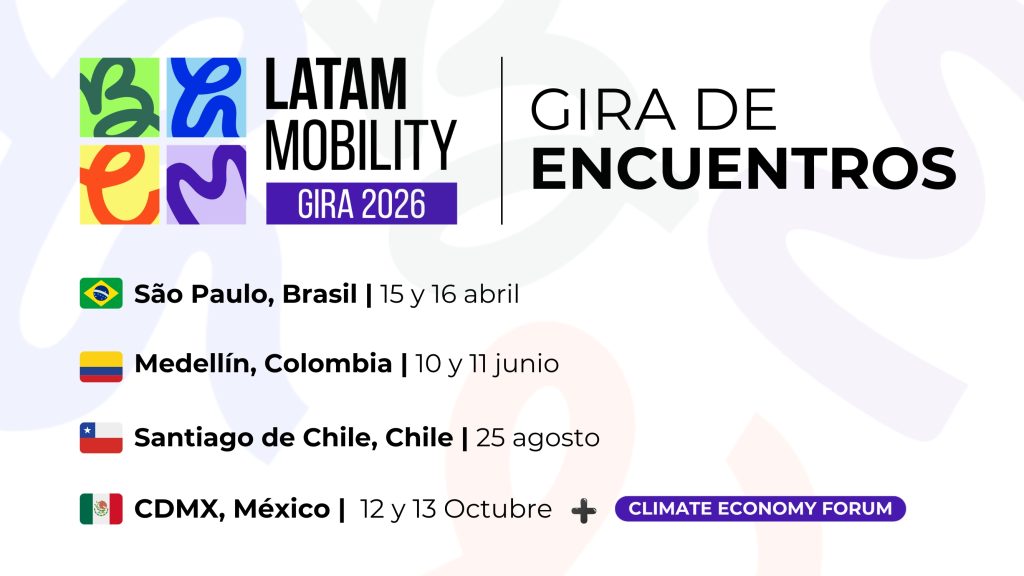
The Latam Mobility 2026 Tour continues its journey across the region. The next gathering will take place in Medellín, Colombia, on June 10–11, and later will arrive in Santiago, Chile, on August 25, bringing together experts and strategic players to further strengthen the sustainable mobility ecosystem in the region.
The tour will conclude in Mexico City on October 12–13, alongside the Climate Economy Forum, in an event that will bring together leading figures from the sector to continue driving the transition toward more efficient, sustainable, and low‑emission transportation systems in Latin America.
The transition is already underway. The Latam Mobility 2026 Tour will be the meeting point to accelerate decisions, connect key players, and collaboratively build sustainable mobility for Latin America.