


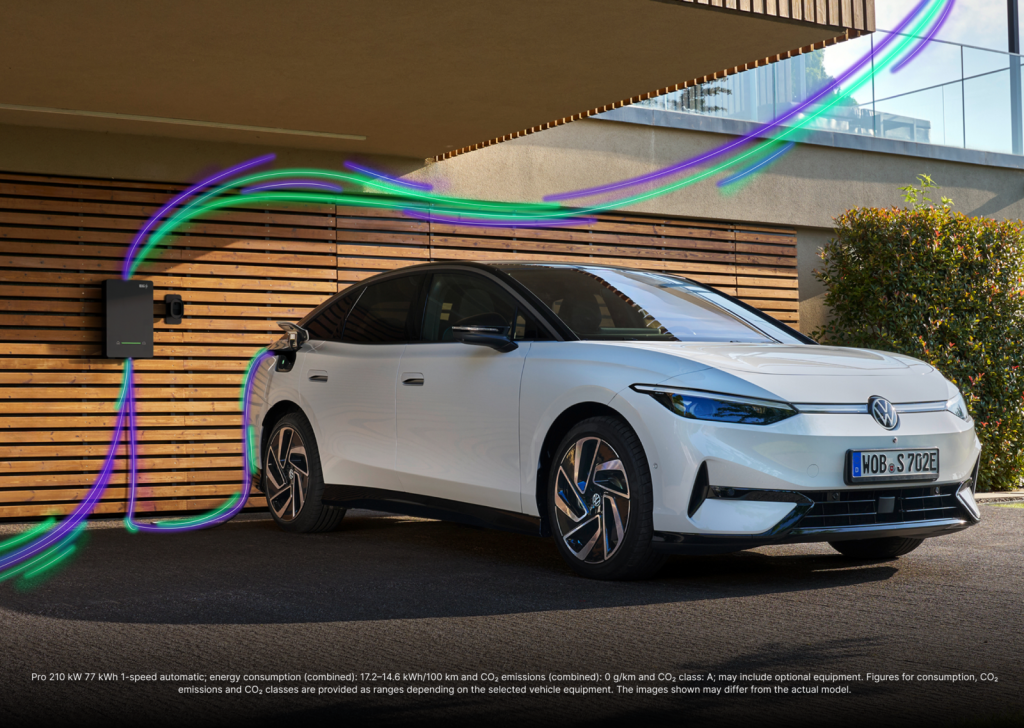
Together with Elli (the energy and mobility brand of the Volkswagen Group), Volkswagen is preparing to launch a fully integrated Vehicle-to-Grid (V2G) offering for private customers in Germany.
Starting in the fourth quarter of 2026, Volkswagen customers will not only be able to charge their electric vehicles but also actively integrate them into the energy system and generate additional income.
Pre-registration for this offer will open in June of this year, with other European countries to follow. With this initiative, Volkswagen is systematically developing its existing charging and home energy ecosystem: Vehicle-to-Grid is not a standalone product — it’s the next step in building a comprehensive energy offering around the electric vehicle.
“Electric mobility can only realize its full potential if it is also economically convincing for our customers,” said Martin Sander, member of the Executive Committee of Volkswagen Passenger Cars responsible for Sales, Marketing and After Sales.
“With Vehicle-to-Grid we achieve exactly that: significantly lower home charging costs and, in the long term, near-cost-free charging. As pioneers in bidirectional charging, our entire ID. family has been ‘bidi-ready’ since 2023. In this way, we are taking V2G from innovation to everyday life and making this technology accessible to the general public. That is the ambition of the Volkswagen brand,” added.
You might also be interested in | Canal Solar bets on BESS storage as a solution for vehicle charging
Turnkey Solution with Vertical Integration
The V2G offering is a turnkey solution that systematically integrates an electric vehicle, a dynamic electricity tariff, a bidirectional direct current (DC) charger, a smart meter, a digital application for managing energy flow, and corresponding installation services.
With this approach, Volkswagen and Elli offer an ecosystem managed from a single source — the customer doesn’t have to worry about the complex interaction between components. Elli acts as the link between the electric vehicle, the customer, and the energy market.
The new V2G offering allows customers to actively manage their mobility costs: electric vehicles could become a source of income in the future. By making their vehicle’s battery capacity available and offering flexibility in charging behavior, customers can achieve savings and, in the future, generate income.
Market estimates point to a potential of between 700 and 900 euros per year in the best-case scenario. In an initial phase, customers will receive a fixed payment for making their battery available to the energy market — regardless of trading performance, fully transparent, and based on the level of flexibility the customer chooses.
The goal is to gradually reduce the total cost of mobility, moving toward practically cost-neutral charging. In this way, electric mobility evolves from being a pure cost factor to becoming an active component of the energy market.
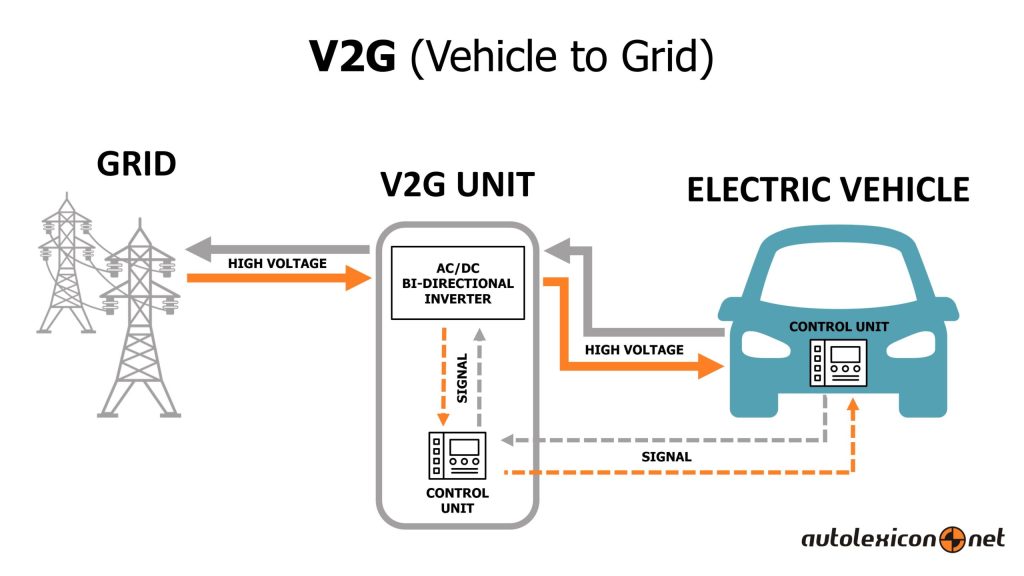
V2G as Part of an Integrated Energy System
In the future, electric vehicles will take on a dual role: they will not only serve as a means of transportation but also function as flexible energy storage units.
Excess energy — especially from renewable sources — can be stored in the vehicle and fed back into the grid when needed, making the integration of mobility and energy a central component of the Volkswagen Group‘s strategy.
In addition to individual benefits, Vehicle-to-Grid offers significant macroeconomic potential: various studies indicate that by 2040, up to 22 billion euros could be saved annually in Europe in system costs.
In Germany alone, about 9,500 GWh of renewable energy have recently gone unused due to excess — enough to power about three million electric vehicles for an entire year.
The technological foundation is the Modular Electric Drive Matrix (MEB). About one million vehicles in Europe are already technically ready for bidirectional charging: the entire ID. family has been technically prepared for this since 2023.
With the upcoming ID. Software 6 update, the functionality will be extended to more battery sizes, making it accessible to an even broader customer base, including future volume models. At the same time, Volkswagen guarantees through its high-voltage batteries and protection systems that bidirectional charging does not significantly affect battery lifespan.
“Today we have the technological and operational capabilities to scale an integrated offering for millions of vehicles and across all brands. Now we are taking the next step: we connect the batteries, unlock new value potentials through aggregation, and for the first time make our vision of a ‘Managed Battery Network’ a reality.”
— Giovanni Palazzo, CEO of Elli and SVP of Charging and Energy at Volkswagen Group Components
A Year of Consolidation for Mobility
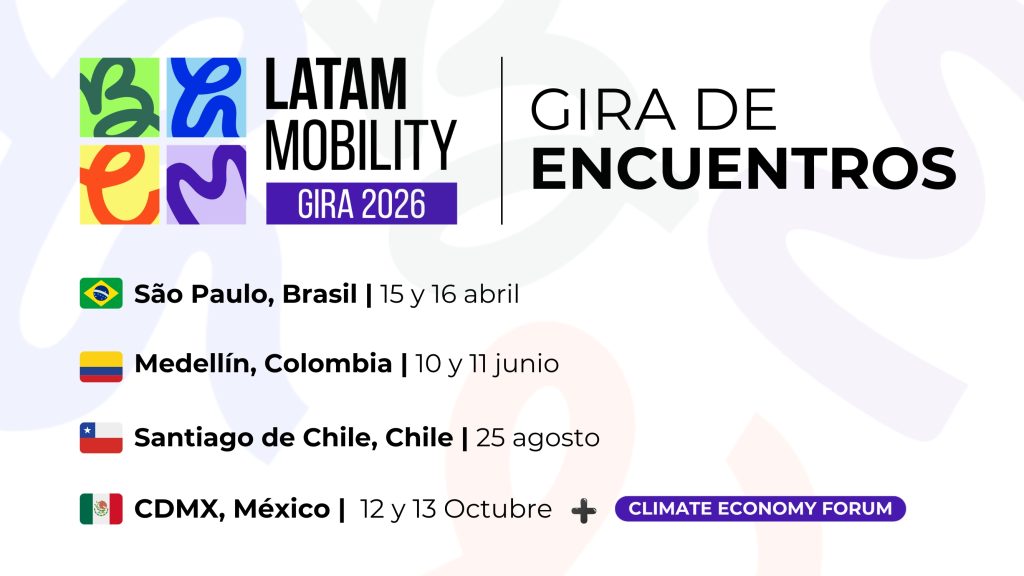
The Latam Mobility 2026 Tour will continue in Medellín, Colombia, on June 10–11, and will later arrive in Santiago, Chile, on August 25, bringing together experts and strategic players to further strengthen the sustainable mobility ecosystem in the region.
The tour will conclude in Mexico City on October 12–13, alongside the Climate Economy Forum, in an event that will bring together leading figures from the sector to continue driving the transition toward more efficient, sustainable, and low‑emission transportation systems in Latin America.
The transition is already underway. The Latam Mobility 2026 Tour will be the meeting point to accelerate decisions, connect key players, and collaboratively build sustainable mobility for Latin America.
colaborativa, la movilidad sostenible de América Latina.