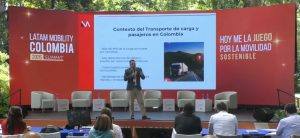


During the sixth edition of “Latam Mobility Colombia 2026,” held at the Orquideorama of the Medellín Botanical Garden, the panel “Automotive Ecosystem and Regional Challenges: Innovation and Adoption for Sustainable and Connected Mobility” took place, moderated by Andrés García, Director of Mobility at Invest In Latam.
The panel consisted of Carlos Rodríguez Ariza, Commercial and After‑Sales Director of Auteco Blue; Julio Calderón, Chief Compliance Officer of Automotores Toyota Colombia; María Cristina Castro, General Manager of Autovardí (representative of Chery in Colombia); Nicolás Muñoz, Brand Manager of Xpeng; and Rosmary Morales, Sustainability Lead of Inchcape (importer of brands such as Xpeng, GWM, Mercedes‑Benz, Suzuki, Jeep, among others).
They all agreed that the Colombian new energy vehicle market has experienced exponential growth, but warned that structural challenges still exist that require joint action between the private sector, government, and academia.
You may also be interested in | Report | Fleets in Colombia: Renewal, Electrification, and New Rules Setting the Course in 2026
Accelerated Growth and Technology Diversification
Rosmary Morales opened the conversation by noting that Inchcape, as the largest multi‑brand importer and distributor in the world, grew more than 60% in the representation of hybrid and electric vehicles between 2025 and 2026.
“Having that multi‑brand perspective allows us to adapt to consumer needs,” she said, and explained that while some customers opt for a 100% electric vehicle, others find in hybrids the best gateway to the transition.
María Cristina Castro supported this vision and added that 50% of the new vehicle fleet sold in Colombia already corresponds to new energies (hybrids at all levels, plug‑ins, and electric vehicles).
She also highlighted that Colombia has surpassed countries like Costa Rica in electric vehicle penetration, reaching figures above 20% for some brands, and is approaching Uruguay which has 30% . “When the market sells more than half of its vehicles in new energies, we really have to talk about new mobility in the country,” she stated.
Software and Artificial Intelligence as Differentiators
Nicolás Muñoz presented Xpeng’s vision – a company that goes beyond car manufacturing: it is an artificial intelligence (AI) company that also develops drones, manned flights, and humanoids.
He explained that today customers no longer look only for range and price, but for added value through software. Xpeng offers over‑the‑air (OTA) updates that allow the vehicle to evolve with the market and learn from global AI. “We are selling software and everything it means to make people’s lives easier,” he stated.
He also highlighted the importance of after‑sales service as a trust builder: Xpeng is certifying high‑voltage technicians and equipping workshops with the highest standards, aware that fear of an accident or technical failure is one of the main barriers to adoption.
Toyota: 60 Years in Colombia and a Multi‑Technology Strategy
Julio Calderón recalled that Toyota has completed 60 years of uninterrupted presence in Colombia, during which time it has learned that the country is 90% rural. Therefore, the brand rejects over‑reliance on a single technology and bets on a range of solutions ranging from full hybrid to battery electric vehicle and, in the future, hydrogen.
“There is no single technology, just as there is no single solution for all problems,” he emphasized. Calderón presented the concept of “peace of mind” as Toyota’s hallmark, backed by a value chain that includes always‑available spare parts, effective after‑sales, and the development of Kinto, a mobility‑as‑a‑service platform.
He also warned about a troubling fact: if Colombia wants to reach the goal of 600,000 electric vehicles by 2030, it will need the equivalent of 1.5 times the capacity of the Ituango hydroelectric project to supply the required energy. “Is Colombia prepared for that level of investment? It is an uncomfortable question, but we must answer it,” he raised.
Auteco Blue: B2B Learnings and Technical Training
Carlos Rodríguez Ariza shared the experience of Auteco Blue, a company specialized in electric mobility since 2019, focused mainly on the business sector (B2B).
He noted that the company’s evolution has been based on data collected from real operations in different productive sectors of the country. Thanks to its six years of experience, the company has developed specific telemetry for electromobility and has become a service station in Colombia for two of the world’s leading battery manufacturers: CATL and Gotion.
Rodríguez highlighted the importance of technical training as a barrier not yet resolved: “Technical institutions must prepare their academic curricula to train the workforce required by the new field of electromobility.”
Legal Stability and State Policies, Not Government Policies
One of the most recurrent themes was the need for clear and lasting rules. Julio Calderón was emphatic: “The mobility game is not played alone. Customer, government, dealerships and importers must be aligned.”
He also noted that legal instability in Colombia – such as sudden changes in driving restrictions for hybrids or the discussion on technical standards equivalent to those of the United States – generates uncertainty and hinders investment.
“We need state policies, not government policies,” he stated. “A country with a 0.2% share of the global market should not be debating whether U.S. federal safety standards are equivalent for Colombia. That makes no sense.”
Nicolás Muñoz supported this vision: “Inchcape and Xpeng do not make decisions for 1 or 2 years, but for 5 or 10 years. If tax or tariff conditions change, business plans are destroyed and investors will not bring more brands.” He added that legal stability would also allow financing for charging networks and infrastructure.
Barriers: Trust, Depreciation and Insurability
Andrés García asked what the main barriers still holding back adoption are despite the growth. The answers were emphatic.
María Cristina Castro identified three major brakes: the consumer confidence index in the entire ecosystem (financing, rates, insurability, spare parts availability), the lack of specialized technicians, and the age of the Colombian vehicle fleet.
Castro revealed that Colombia has only between 143 and 150 vehicles per 1,000 inhabitants – well below the Latin American average (250‑280) – which implies an aging fleet with high costs in public health and accident rates. “We need to define clear goals for fleet renewal and access to technology for the base of the pyramid,” she stated.
Nicolás Muñoz added a little‑discussed barrier: depreciation or buyback of electric vehicles. He noted that if a customer buys an EV and a year later is offered 40% or 50% less than a combustion vehicle, they will not buy an electric one again. “Manufacturers must be responsible for maintaining the market price so that the buyback is not so penalized. Even if it’s not profitable, it’s our responsibility.”
Rosmary Morales agreed that trust is the most relevant asset and highlighted the need for multi‑stakeholder coordination. She mentioned Inchcape’s “Motors of Change” study, which revealed that Colombia is the Latin American country most open to new mobility technologies. However, resistance persists due to fear of not finding charging infrastructure or losing range. “We need a roadmap with long‑term predictability,” she underscored.
Coordinated Actions Are Needed
The panel made clear that Colombia is now a reference in sustainable mobility in Latin America, with a market that adopts new technologies faster than many of its neighbors.
But consumer trust, legal stability, technical training, charging infrastructure, and electric vehicle depreciation remain barriers that require coordinated action between the private sector, government, and academia.
The final message was optimistic but realistic: continuing to grow is possible, but it requires long‑term state policies and effective coordination of the entire ecosystem.
Finally, moderator Andrés García thanked the panelists and highlighted that the world we live in today is not that of last year, and that conversations and challenges are evolving rapidly.
A Year 2026 of Consolidation for Mobility
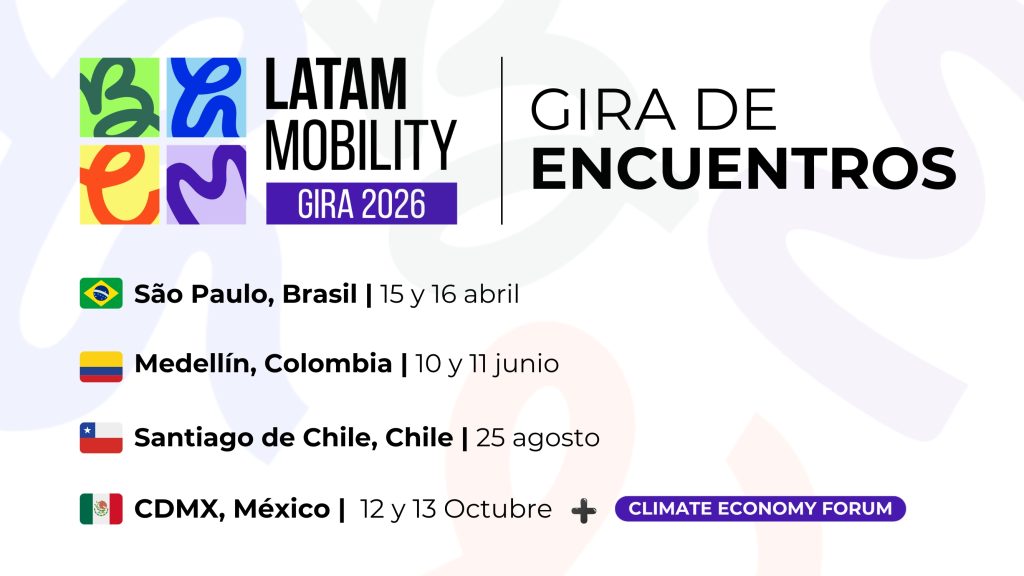
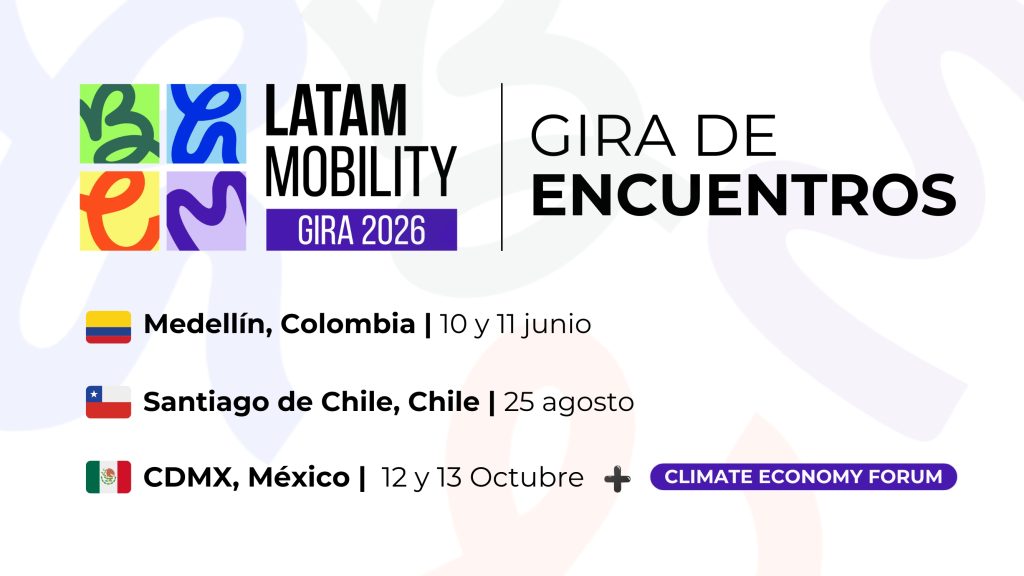
The Latam Mobility 2026 Tour will arrive in Santiago, Chile, on August 25, bringing together experts and strategic players to further strengthen the sustainable mobility ecosystem in the region.
The tour will end in Mexico City on October 12 and 13, alongside the Climate Economy Forum, in a meeting that will bring together sector leaders to continue driving the transition toward more efficient, sustainable, low‑emission transportation systems in Latin America.
The transition is already underway. The Latam Mobility 2026 Tour will be the meeting point to accelerate decisions, connect key players, and collaboratively build sustainable mobility in Latin America.