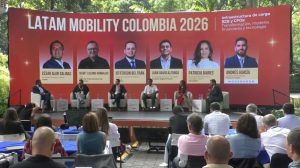



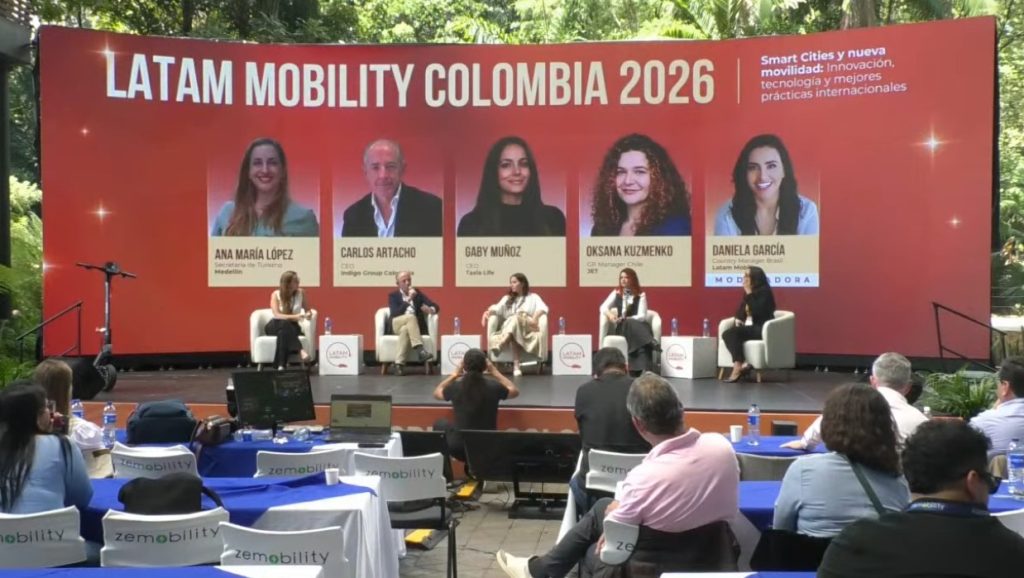
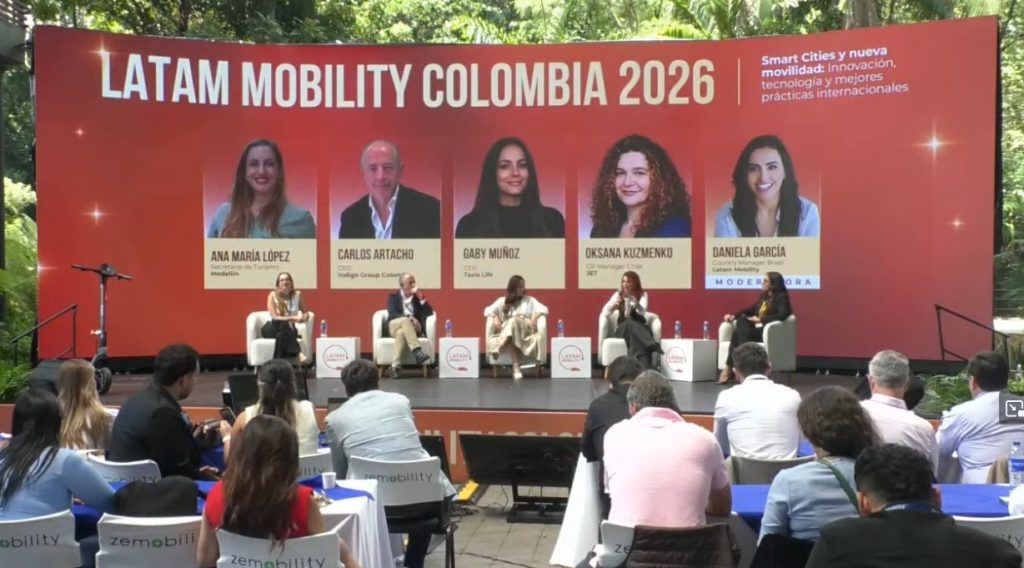
Within the framework of “Latam Mobility Colombia 2026,” held in the city of Medellín, the panel “Smart Cities and new mobility: Innovation, technology and international best practices” took place, moderated by Daniela García, Brazil Country Manager for Latam Mobility.
The session brought together leaders of the urban mobility ecosystem to analyze the challenges and opportunities the region faces in building smarter, more sustainable and inclusive cities.
You may also be interested in | Toyota Presents Technological Diversification Strategy at Latam Mobility Colombia 2026: ‘A Path for Every Destination’
Defining New Mobility: Beyond the Concept
Daniela García opened the conversation by highlighting the need to understand the concept of new mobility as a complementary and indispensable pillar of Smart Cities. From their respective roles, each panelist presented concrete projects that exemplify this vision.
Carlos Artacho, CEO of Indigo Group Colombia, emphasized that his company, a French multinational with over 60 years of experience, is dedicated to parking operations and recently unified Citi Parking and Central Parking in the country under the Indigo brand.
In his speech, he underlined a central idea: “It’s not just about developing new infrastructure, but using what we have well.” He warned about problems such as the invasion of public space and the underutilization of existing infrastructure, and stressed that sustainable mobility must be environmentally, financially, and socially sustainable. “It’s important to know where those vehicles end up and how we use public space,” he stated.
For her part, Oksana Kuzmenko, Chile GR Manager at JET, presented her company’s vision, which focuses on shared micromobility via scooters and electric bikes, present in nine countries with plans to launch soon in Colombia.
She explained that their approach is based on three principles: on‑demand service, shared mobility, and electric green micromobility. “I don’t need to own my own scooter; I can solve my mobility needs in any city where this infrastructure exists,” she said. She also highlighted that this model is built in collaboration with the public sector.
Gaby Muñoz, CEO of Taxia Life, a software development company from Manizales, placed emphasis on social impact and the importance of understanding local cultures. She mentioned that their most popular product, integrated with WhatsApp, has grown 600% organically because “people love that channel.”
She noted that they have worked intensively on programs for female drivers and for transporting elderly people, which led the World Health Organization to recognize Manizales as a city that understands the mobility of older adults. “Technology should be something fast, easy and cool for the user,” she summarized.
Finally, Ana María López, Secretary of Tourism of Medellín, highlighted the city’s mobility system, which includes a tram, metrocable, bike lanes, and an integrated network that has become a tourist attraction in itself.
“Anyone who comes to Medellín has to ride the metro, the tram, the metrocable. It’s a very satisfying experience,” she assured. She emphasized that the city, known as a hub of science, technology and innovation, has a tourism and entertainment intelligence system that allows measuring how visitors move and making data‑driven decisions.
Conditions for Scaling up: Institutional Frameworks, Data and Collaboration
The second segment of the panel addressed a recurring challenge in the region: how to move from successful pilots to sustainable city‑wide solutions.
Ana María López listed three fundamental elements: a shared and aligned vision around a common purpose, a solid institutional framework that transcends government terms, and above all, data as a central axis. “It allows us to understand opportunities, challenges and where to evolve,” she stated.
Gaby Muñoz explained that her model places the driver as the backbone, not the user, which changes the entire logic of benefit generation. “We need a process of awareness, of understanding why we are doing this,” she argued, adding that they have built this path over 13 years, now achieving parity and overcoming barriers.
For her part, Oksana Kuzmenko offered a practical perspective: the pilot should not be a mere demonstration but a tool to collect key data that allows designing scalability. “From the pilot phase we have to think about growth. Not just a launch to show off, but to gather information that serves the transit department and planning,” she indicated. She cited JET‘s experience in Santiago, Chile, where a limited pilot generated information that led to a larger‑scale tender.
Carlos Artacho shared Indigo‘s experience: “The pilot has to be profitable. We need a regulatory framework that makes these projects feasible,” he demanded. He acknowledged that public‑private partnership (PPP) laws require adjustments, as they are very capital‑intensive investments in countries that demand long amortization periods. “We are happy to do pilots and replicate them, but we want to be profitable,” he concluded.
Urban Data: Balancing Innovation and Privacy
The third theme revolved around how urban data analytics can optimize mobility, safety and tourism without violating citizen privacy.
Oksana Kuzmenko was clear: while JET collects information from each trip, it does so anonymously and in aggregated form (start and end points, times, preferred routes), without needing access to sensitive data like names. She highlighted that countries like Chile and Brazil have already advanced their data protection laws, forcing companies to constantly update their regulatory compliance.
Ana María López reaffirmed the importance of data as the “central pillar of the entire tourism strategy.” She explained that Medellín uses primary sources (Migración Colombia, DANE) and secondary sources (partnerships with trade associations and private companies) to understand not only how citizens move, but also what profiles of tourists arrive, what interests them, how they spend and how they behave. All of this, she said, enables valuable decision‑making and future planning.
Carlos Artacho revealed a striking fact: in large cities, 40% of traffic jams are due to people looking for parking. For Indigo, data management is essential not only to improve user experience, but also to design public control and enforcement policies. “All policies without control and enforcement will not work,” he warned. He noted that artificial intelligence offers enormous opportunities but also cybersecurity risks, so data protection must be a priority.
Gaby Muñoz closed this block by reminding that technology must serve people. Through data, Taxia Life has been able to better understand its drivers and users, allowing them to have an impact with specific social projects. “It’s about creating micro service agents to improve 24/7 attention, while protecting people’s privacy,” she stated.
A Message of Hope and Collective Commitment
In their closing words, the panelists left a unanimous message of collaboration and optimism.
Ana María López thanked the attendees for offering intelligent solutions and underscored the challenge of making cities suitable both for tourists and citizens, ensuring that the local population feels comfortable.
Carlos Artacho called for creating comfortable spaces and changing habits: “We demand public solutions, but we leave our car double‑parked and get angry if we get a ticket. That we have to change.” He stressed the need to adapt to new models such as last‑mile logistics and to invest in education and institutional control.
Gaby Muñoz summarized her purpose: “Create a better world with technology,” connecting with what happens on the street to solve real conflicts.
Finally, Oksana Kuzmenko expressed her gratitude for the space and recalled that the ultimate goal of building Smart Cities is to generate more pleasant, inclusive cities with options for everyone. “So that each user can find what suits them,” she concluded.
The panel ended with an official photo of the participants and a renewed commitment to continue promoting sustainable and intelligent mobility in Latin America.
2026: A Year of Consolidation for Mobility
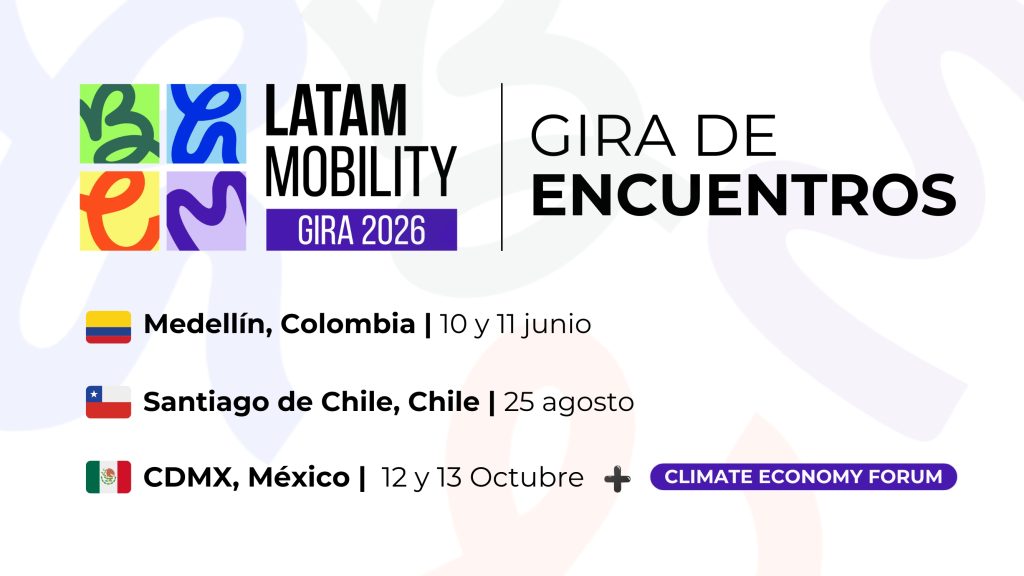
The Latam Mobility 2026 Tour will continue in Santiago, Chile on August 25, bringing together experts and strategic players to further strengthen the sustainable mobility ecosystem in the region.
The tour will end in Mexico City on October 12 and 13, alongside the Climate Economy Forum, in a meeting that will bring together industry leaders to continue driving the transition toward more efficient, sustainable and low‑emission transportation systems in Latin America.
The transition is already underway. The Latam Mobility 2026 Tour will be the meeting point to accelerate decisions, connect key players and collaboratively build sustainable mobility in Latin America.