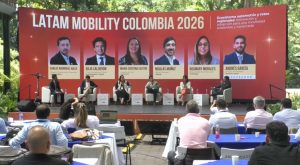


During the eighth edition of “Latam Mobility Colombia 2026,” held in Medellín, Deibit Lozano Grimaldo, CEO of CIEN by Internacional de Eléctricos (IE) , delivered a keynote titled “Electric mobility goes to CIEN: the model Colombia was waiting for.”
Lozano began his presentation with figures reflecting the current state of electric mobility in Colombia: 80,000 electric vehicles on the road and 520 charging points available, of which 30% are not working properly. Faced with this reality, he asked a provocative question: “Would we call that a network?”
For CIEN’s CEO, the problem is not the vehicle, nor the lack of demand, nor the absence of incentives. “We know there are many incentives and they are excellent,” he said. The real challenge lies in infrastructure and, above all, the user experience.
“A network that doesn’t focus on the user experience is the problem. The call is to focus on user experience and impact,” he stated.
You might also be interested in | Toyota presents its technology diversification strategy at Latam Mobility Colombia 2026: “One path for every destination”
CIEN By IE: Convergence Of Energy, Communications And Automation
Lozano explained that CIEN was born under a unique ecosystem, integrating multiple business units that converge on the user experience. On one hand, energy: to bring electrification to the vehicle network, substations, transmission cells, transformation, and protection systems are required. On the other hand, telecommunications: “A network without proper telecommunications is an intermittent network that fails to generate trust.”
In addition, lighting plays a central role: all the charging stations CIEN is installing are user experience spaces, not simple pedestals. Each charging point includes a connection hotspot to solve the recurring problem of lack of data signal on national highways or remote areas. “The problem is not infrastructure or software, but the system,” he emphasized.
Industry and automation are another fundamental pillar. To manage OPEX and make projects viable, the stations feature automation and remote control that allow asset management from a distance and optimization of operating costs.
Lozano backed his proposal with Internacional de Eléctricos’ track record: more than 30 years in the market, over $100 million in sales, 120 million software transactions, and 40% market share in toll software in Colombia, with presence also in Mexico and Paraguay.
Trust As A Core Value
“We don’t just charge vehicles; we charge trust,” Lozano said. To achieve this, CIEN has developed a mobile app with unique features that value the user’s time.
Charger reservation is one of the key innovations. Faced with high demand and risk of saturation, the app allows users to reserve a charger for the same day or the next day, with a 15-minute window to arrive. If not used, the connector is released at minute 16 and the absent user receives a penalty.
“When you reserve, you organize your time, you plan your time. You know that when you arrive, the charger will be available for you,” he explained.
Another recurring problem is charger hogging: vehicles that finish charging and remain connected for hours. CIEN implemented an inactivity fee to educate the market. “Human beings, unfortunately, have to be educated through their wallets. When you tell them that the car preventing others from accessing the service will cost them, they will automatically move it,” he noted.
Personalized billing is another differentiating feature. The user decides how to pay and who to bill: if on a company assignment, the charge can be invoiced to the company, not the individual.
“You have the ease of deciding with which payment and billing profile. Like when you’re at a gas station and they ask you who you want the invoice in the name of,” Lozano compared.
Six Principles To Operate The Network
Lozano emphasized that infrastructure is just the beginning; the most important thing is how the network is operated. CIEN is governed by six principles:
Speed at 100 (don’t delay responding to the customer), simplicity (avoid unnecessary technicalities), resolution (solve problems honestly and explain what cannot be solved), empathy (put yourself in the shoes of those who don’t know electromobility), honesty (tell it like it is), and mutual respect (demand respect and also respect the user).
“Volume scales, but commitment does not. Commitment remains super strong. We don’t lie. I didn’t come to tell you what we are going to do; I came to tell you what we are doing,” he stressed.
As proof of the effectiveness of their model, Lozano presented a success story: in just four months, in an intermediate city, CIEN achieved 2,200 users, 4,500 charging sessions, 80,000 kWh supplied, and 99.8% uptime at its stations.
CIEN also announced a development plan with an investment of more than 20 billion Colombian pesos over the next 18 months. By June 2026, the company projects having more than 100 charging stations and more than 500 connectors deployed in the country.
Direct Communication
Finally, Deibit Lozano explained that CIEN opted for WhatsApp as the main communication channel. “We communicate to the user how their charge is going, when it finishes, and even when it will enter the inactivity period.” This strategy generates empathy and keeps the user informed without relying on intrusive cell phone notifications.
Additionally, CIEN’s representative said memberships bring simplicity. For vehicle fleets (for example, from platforms like Uber), there is no need for each driver to top up a wallet or register a credit card. The company offers kilowatt packages with biweekly or monthly billing to the corporate entity, simplifying management for the driver.
Payment freedom is guaranteed through a gateway developed and integrated with Bancolombia and Wompi, offering security and flexibility with all available payment methods.
Lozano concluded by stating, “At CIEN we work to ensure that there are more and more charging options along the road. Our stations are beginning to connect destinations and facilitate the journeys of those who choose this form of mobility.”
A Year 2026 of Consolidation for Mobility
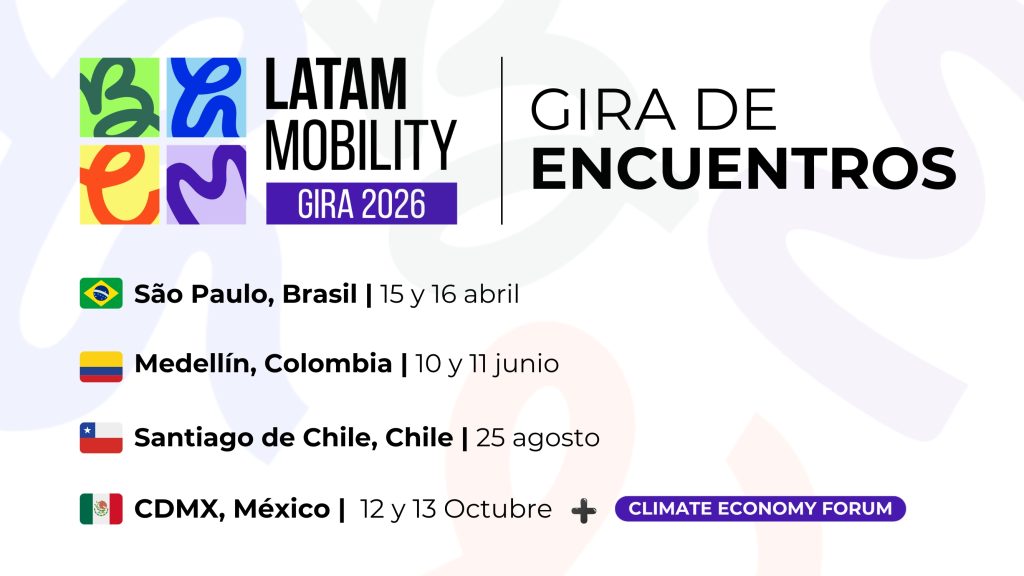
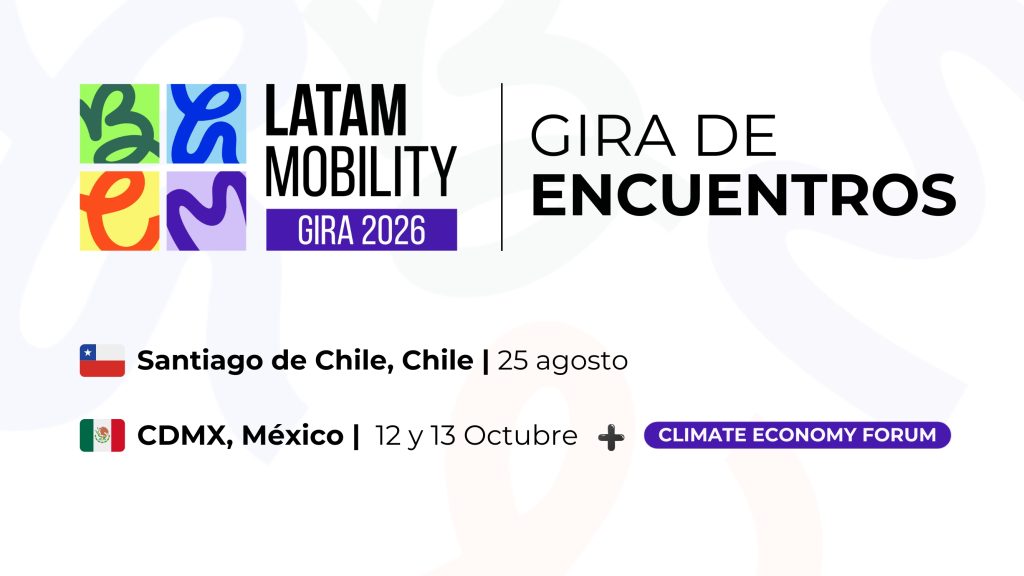
The Latam Mobility 2026 Tour will continue in Santiago, Chile on August 25, bringing together experts and strategic players to further strengthen the sustainable mobility ecosystem in the region.
The tour will conclude in Mexico City on October 12–13, alongside the Climate Economy Forum, in an event that will bring together leading figures from the sector to continue driving the transition toward more efficient, sustainable, and low‑emission transportation systems in Latin America.
The transition is already underway. The Latam Mobility 2026 Tour will be the meeting point to accelerate decisions, connect key players, and collaboratively build sustainable mobility for Latin America.