

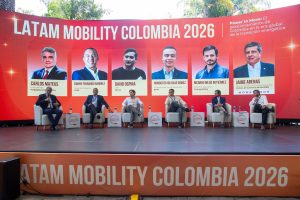

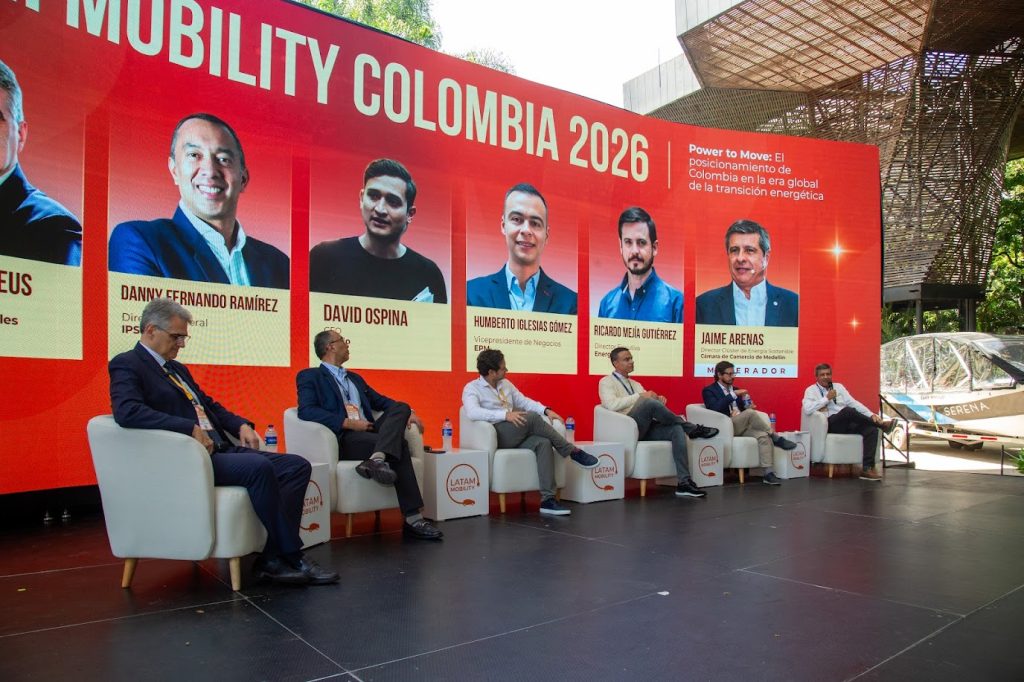
As part of the Latam Mobility Colombia 2026 meeting, held at the Orquideorama inside the Medellín Botanical Garden, the panel “Power to Move: Colombia’s Positioning in the Global Era of Energy Transition” took place. This was a dialogue space that brought together prominent representatives from the energy industry, electric mobility, and biofuels.
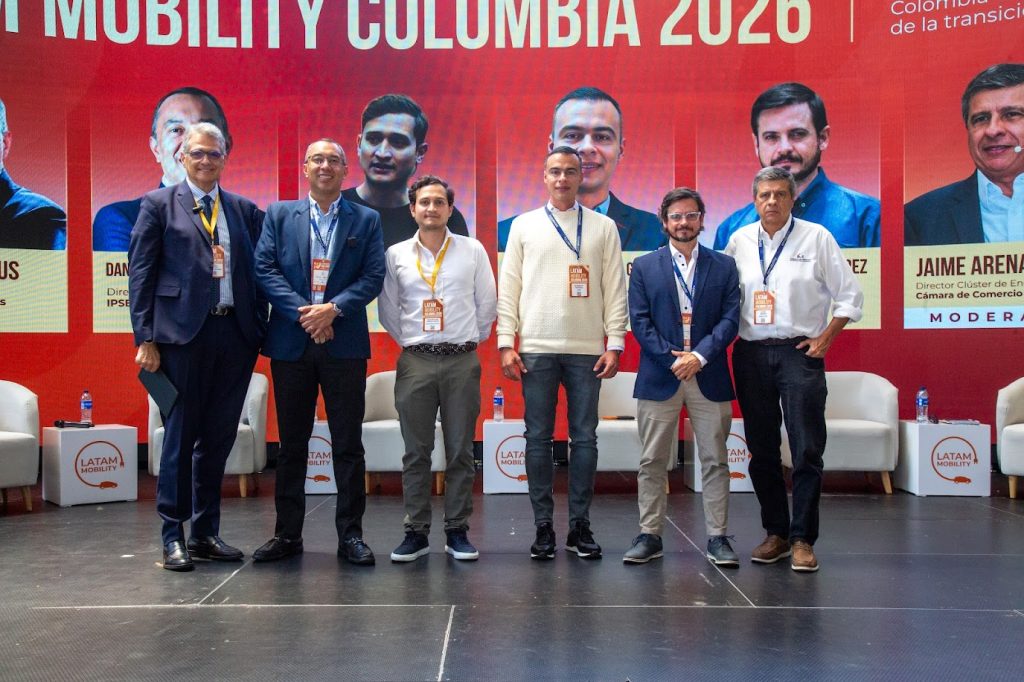
The conversation was moderated by Jaime Arenas, Director of the Sustainable Energy Cluster at the Medellín Chamber of Commerce, and featured Carlos Mateus (President of Fedebiocombustibles), Danny Fernando Ramírez (General Director of IPSE), David Ospina (CFO of Dielco), Humberto Iglesias Gómez (Vice President of Business at EPM), and Ricardo Mejía Gutiérrez (Executive Director of Energy Valley).
Throughout the session, the panelists agreed on a common diagnosis: Colombia has unique competitive advantages in the region, but faces structural challenges that require a clear roadmap, public-private coordination, and a profound cultural shift.
You May Also Be Interested In | Toyota bets on multi-technology and Xpeng on AI: Auteco Blue, Autovardí and Inchcape join the debate on innovation in the Colombian automotive ecosystem
Colombia: A Benchmark in Regulation and Energy Matrix
One of the panel’s initial points of consensus was that the country has a solid regulatory framework, recognized even globally. David Ospina from Dielco highlighted that “Colombia’s regulations are an example not only for Latin America but can also be compared to European standards.” However, he warned that the current major challenge is not a lack of rules but the capacity for technical and infrastructure execution.
Carlos Mateus from Fedebiocombustibles recalled that Colombia is part of the “ABC” of biofuels in the region, alongside Argentina and Brazil. He noted that the sector has been reducing emissions for over 20 years – nearly 4 million tons of greenhouse gases per year and 900 tons of particulate matter.
He also highlighted progress in Sustainable Aviation Fuels (SAF) and the integration of biodiesel into marine diesel, positioning the country as a leader in transport decarbonization.
Meanwhile, Ricardo Mejía from Energy Valley focused on Colombia’s energy matrix, ranked as the sixth cleanest in the world. “An electric vehicle in Colombia is much more environmentally friendly than the same vehicle in other grids that depend on fossil fuels,” he stated. Nevertheless, he called attention to the need to educate users about the entire emissions chain – beyond just the tailpipe.
Charging Infrastructure and Non-Interconnected Zones: Challenges and Opportunities
Humberto Iglesias from EPM addressed one of the most critical issues for the mass adoption of electric vehicles: confidence in charging infrastructure. He revealed that in areas like El Poblado and Laureles, transformers are collapsing due to high simultaneous charging demand.
To tackle this, EPM will invest 250 billion pesos in a new substation in the Colombia neighborhood, benefiting districts 14, 15, and 11. “The adoption of electric vehicles depends on the confidence that infrastructure generates,” he emphasized.
Danny Fernando Ramírez from IPSE broadened the view to the Non-Interconnected Zones (ZNI), which represent 52% of the national territory. There, mobility largely depends on motorized tricycles and motorcycles powered by fossil fuels, whose supply is irregular and expensive.
“We see a great opportunity to promote electric mobility in these regions,” he stated, mentioning successful pilot projects in Isla Grande, Puerto Carreño, and Guainía. He also highlighted the unexplored potential of geothermal energy as a reliable source not dependent on weather.
Civic Culture as a Forgotten Pillar
One of the most striking analyses came from Ricardo Mejía, who introduced the concept of “charging savagery.” He explained that many users use uncertified connectors or block charging stations for long periods, which has led respected companies to abandon the public charging business.
“There are already companies that have left the business because maintenance is more expensive than operation – due to a lack of civic-mindedness,” he warned.
Mejía proposed a national campaign for a sustainable mobility culture, inspired by the success of the Medellín Metro, where the community adopted the system as its own. He also advocated for intelligent charging management systems – with app-based reservations and multiple connectors per point – to optimize the use of existing infrastructure.
Towards a Comprehensive Roadmap
At the panel’s close, the speakers agreed on the urgent need for a national roadmap that combines energy security, decarbonization, and clear signals for foreign investment.
Carlos Mateus announced that Fedebiocombustibles has commissioned a study from an international firm to identify the sector’s bottlenecks. “We need a roadmap that understands demand, supply, and available raw materials, with progressive blending mandates and regulatory stability,” he explained. He estimated that investments close to $2.6 billion are needed in new plants, plantations, and biomass utilization.
David Ospina closed with a call to prepare for emerging technologies such as V2G (Vehicle to Grid) and large-scale storage, which will transform consumers into energy-active agents.
Finally, Humberto Iglesias issued a timely warning: the El Niño phenomenon will reach a 95% probability in July, with a 63% chance of being severe. “Reservoirs are below expected levels. We call for awareness in the efficient use of energy in every home and workplace,” he concluded.
A Year 2026 of Consolidation for Mobility
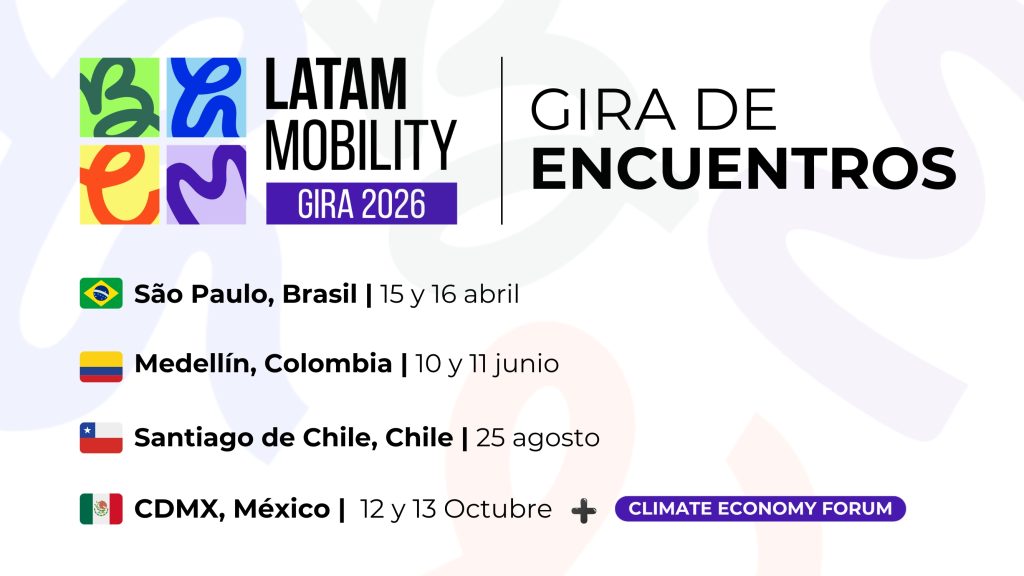
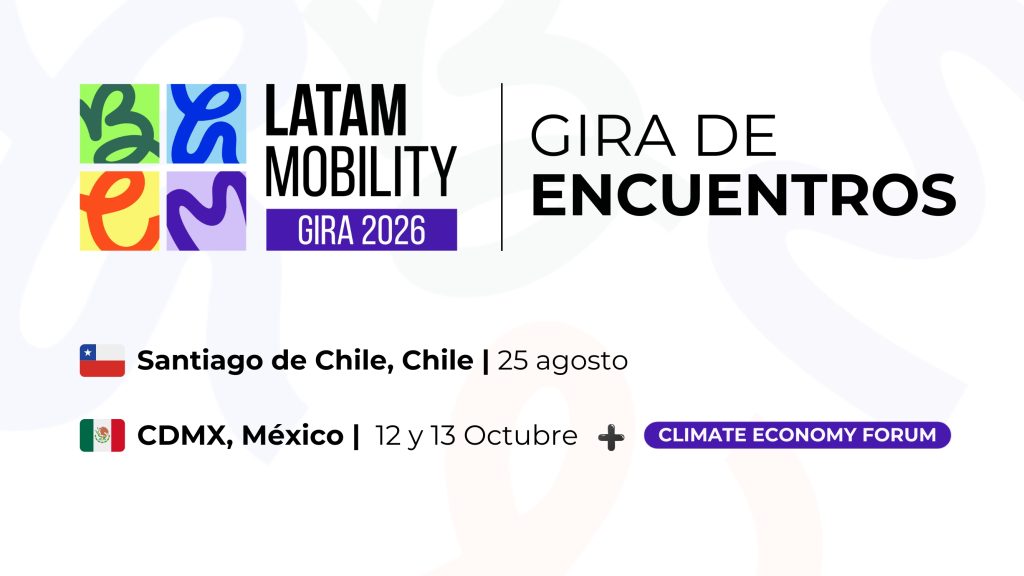
The Latam Mobility 2026 Tour will arrive in Santiago, Chile, on August 25, bringing together experts and strategic players to further strengthen the sustainable mobility ecosystem in the region.
The tour will end in Mexico City on October 12 and 13, alongside the Climate Economy Forum, in a meeting that will bring together sector leaders to continue driving the transition toward more efficient, sustainable, low‑emission transportation systems in Latin America.
The transition is already underway. The Latam Mobility 2026 Tour will be the meeting point to accelerate decisions, connect key players, and collaboratively build sustainable mobility in Latin America.