



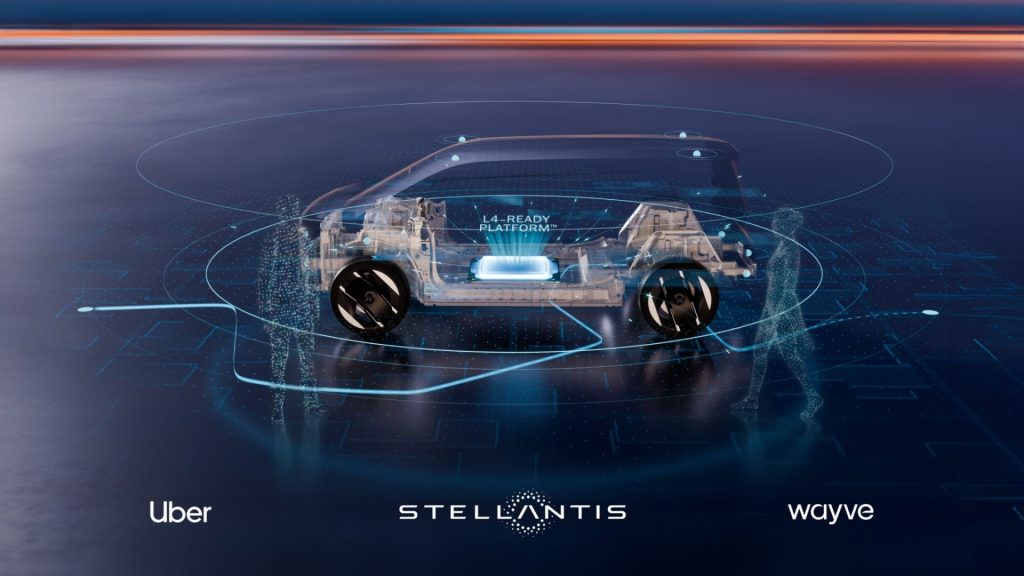
Stellantis, Wayve, and Uber have announced a strategic partnership to develop and deploy Level 4 (fully autonomous, driverless) robotaxis on a global scale. The announcement, made simultaneously from Amsterdam, London, and San Francisco, formalizes the signing of a non-binding Memorandum of Understanding (MoU) among the three companies.
This collaboration brings together the complementary strengths of each player: Stellantis‘ vehicles and platforms, Wayve‘s AI-powered autonomous driving software, and Uber‘s massive global mobility network.
The alliance builds on existing ties between the companies. Stellantis and Wayve recently inked a deal to develop L2++ supervised automated driving tech. Wayve and Uber, meanwhile, already have a partnership to roll out autonomous driving services in London, Tokyo, and ten other cities worldwide starting this year.
Stellantis‘ entry into this alliance represents a major leap forward , bringing large-scale vehicle manufacturing and platforms purpose-built for autonomous operations.
You might also be interested in | Gildemeister Takes Over GAC Motor Representation in Chile and Targets 2% of the Market in Three Years
Three Strengths for Commercializing Autonomy
This new initiative is designed to combine the three essential pieces needed to make autonomy a commercial reality: vehicles, technology, and a ride-hailing platform.
On the vehicle and integration side, Stellantis will design, develop, and mass-produce vehicles built on its advanced L4-Ready™ platforms. These platforms come with integrated sensor suites and are engineered to meet the operational, safety, and redundancy demands of high-utilization autonomous driving. The company already has platforms that can handle Level 4 autonomy, complete with the safety and redundancy systems required for public-road approval.
In the AI tech arena, Wayve brings its artificial intelligence-based driving software, which lets vehicles understand and navigate complex real-world environments all on their own. Built on Wayve’s end-to-end AI approach, the tech is designed to adapt to different regions and driving conditions without relying on city-by-city mapping or costly re-engineering—making scaling faster and more affordable.
Wayve uses a “map-less” AI system that learns to drive by watching how humans drive around it. The company has had test vehicles operating on London’s streets since 2018.
On the mobility platform front, Uber will deploy these autonomous vehicles across its global network, connecting riders with autonomous trips through the Uber app and helping scale operations across different markets. This lets customers tap into the benefits of self-driving tech in vehicles and a marketplace they already know and trust.
Global Expansion and Next Phase
As part of this collaboration, the companies plan to work together on vehicle integration, testing, validation, and deployment, with the goal of bringing safe, reliable, and scalable autonomous mobility services to cities in Europe, North America, and beyond. The initial rollout will focus on urban centers in Europe and North America.
This alliance marks a serious step forward for commercial robotaxi services at scale and reinforces the ecosystem approach needed to bring autonomous vehicle technology to the masses—potentially reaching millions of vehicles and users worldwide.
Stellantis now joins a growing list of automakers that have teamed up with Uber on robotaxi development, including Lucid, Rivian, Volkswagen, and Nissan.
While the companies haven’t shared a detailed commercialization timeline or the exact size of the planned fleets, the Stellantis-Wayve-Uber alliance brings together three global heavyweights in vehicle manufacturing, artificial intelligence, and mobility platforms, positioning this partnership as a major player in the global race for autonomous mobility.
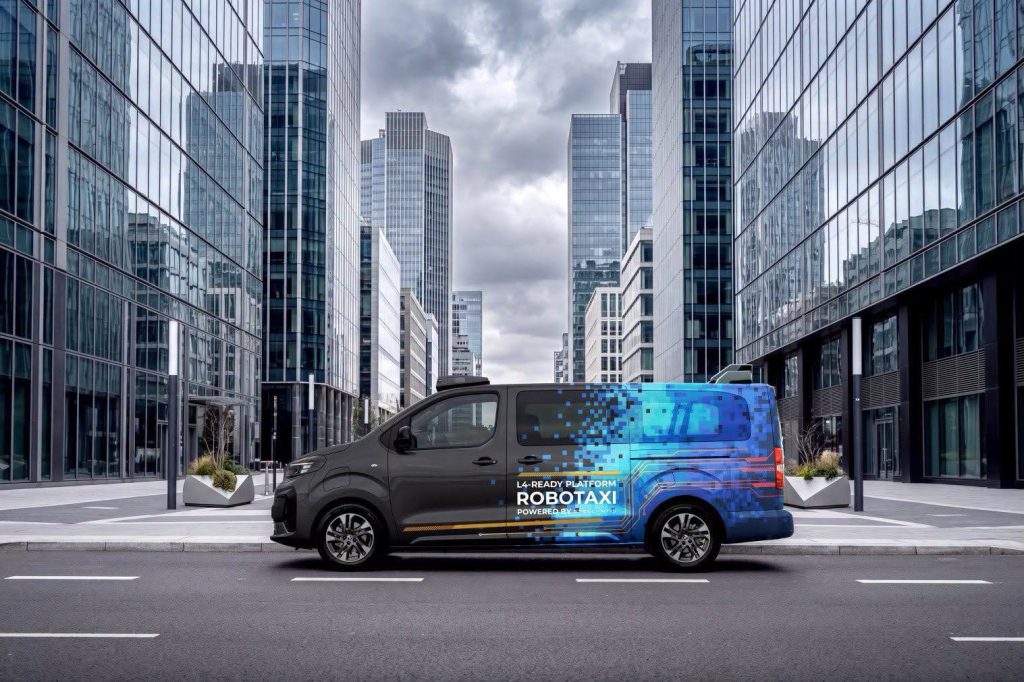
“By combining our L4-Ready™ platforms, designed from the ground up for safe and efficient autonomous operation, with Wayve’s adaptive AI and Uber’s global network, we are accelerating the deployment of autonomous vehicles that meet real customer needs and enable seamless mobility at scale in everyday life.”
Ned Curic (Chief Engineering and Technology Officer of Stellantis)
A Year 2026 of Consolidation for Mobility
The Latam Mobility 2026 Tour will arrive in Santiago, Chile, on August 25, bringing together experts and strategic players to further strengthen the sustainable mobility ecosystem in the region.
The tour will end in Mexico City on October 12 and 13, alongside the Climate Economy Forum, in a meeting that will bring together sector leaders to continue driving the transition toward more efficient, sustainable, low‑emission transportation systems in Latin America.
The transition is already underway. The Latam Mobility 2026 Tour will be the meeting point to accelerate decisions, connect key players, and collaboratively build sustainable mobility in Latin America.