

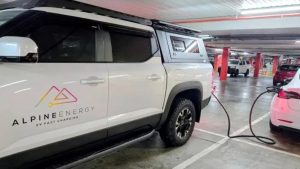

Alpine Energy , a Melbourne-based Australian company, has officially unveiled the MGEN M40 , a DC fast-charging vehicle-to-vehicle (V2V) system that’s poised to change the game when it comes to emergency roadside assistance for electric vehicles.
The device—billed as the first of its kind anywhere—was designed and built entirely in Australia and tackles one of the biggest headaches for mass EV adoption: what to do when you run out of juice in the middle of nowhere with no charger in sight.
The MGEN M40 flips the old model on its head. Until now, charging an EV meant dragging the car to a fixed charging post. With this innovation, the script is totally reversed: the charger comes to the vehicle , delivering power wherever it’s needed, with no grid hookup, no construction permits, and no prior infrastructure required.
You might also be interested in | CATL Unveils TENER Sodium : The First GWh-Scale Commercial Storage Solution With Sodium-Ion Batteries
Technical Specifications and Charging Capacity
The current prototype of the MGEN M40 cranks out up to 40 kW of DC output power , which translates to roughly 65 kilometers of range for every 15 minutes of charging on compatible models.
That’s an 88% jump over existing mobile assistance systems in the Australian market—like the ones NRMA runs in Sydney and Canberra, which pack 4.8 kWh batteries and deliver just 9.6 kW.
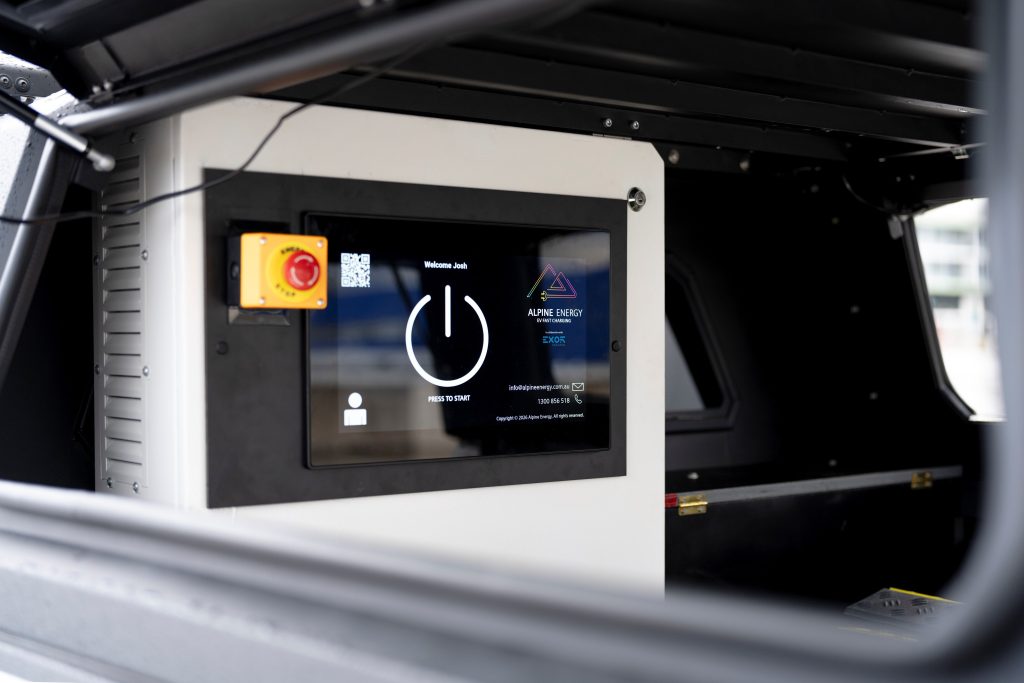
The system comes with standard Australian CCS2 connectors, plus a CHAdeMO port for older vehicles, and features 4G and satellite connectivity to keep it humming even in the most remote spots.
On top of that, the MGEN M40 is built to the OCPP (Open Charge Point Protocol) for telemetry, so it plays nice with the most advanced charge management platforms out there.
Strategic Applications: Roadside Rescue, Mining, and Emergency Response
The MGEN M40’s versatility makes it a go-to tool for three priority sectors. First up is roadside rescue —when an EV is stranded dozens of miles from the nearest charger. Second is mobile automotive services , where you need to bring the juice to the car instead of hauling the car to a plug. And third is mining and other off-grid industries , where power is scarce or nonexistent and EV fleets need portable, self-contained charging that can go anywhere.
The system also packs serious potential for emergency situations —think floods, wildfires, or cyclones—where the grid might be down and rescue vehicles and gear need to stay operational. The ability to run without a grid connection and deploy quickly on any terrain makes the MGEN M40 a natural fit for disaster response.
“Until today, charging an EV meant taking the vehicle to the infrastructure. The MGEN M40 is designed to do the opposite: bring fast charging to the vehicle, wherever it is,” said Mark Wexler, Founder and Managing Director of Alpine Energy.
“The cases driving us are the toughest ones: getting a stranded driver back on the road when there’s no charger for miles around, and keeping entire fleets running where the grid simply doesn’t reach,” added.

Strategic Partnerships
The MGEN M40‘s development got a boost from two key tech partners. On one side, EXOR Oceania —a Perth-based industrial automation firm—is helping crack the mining sector and supporting platform deployment.
On the other, Alpine Energy adapted the battery-coupled DC-DC charging tech from Bulgarian manufacturer Ampernext to fit the needs of the Australian market.
The MGEN M40 officially launched in late May this year, and Alpine Energy is calling it a tech milestone that could accelerate EV adoption in Australia and other sprawling markets with spotty charging networks.
By breaking free from fixed infrastructure, this solution opens up fresh possibilities for electromobility in rural, remote, and hard-to-reach areas, as well as for fleet operations in critical industries like mining.
As Mark Wexler put it: “There’s still significant field validation work ahead. But a mobile vehicle-to-vehicle approach points to a genuinely new way of delivering energy where it’s most needed.”
A Year 2026 of Consolidation for Mobility
The Latam Mobility 2026 Tour will arrive in Santiago, Chile, on August 25, bringing together experts and strategic players to further strengthen the sustainable mobility ecosystem in the region.
The tour will end in Mexico City on October 12 and 13, alongside the Climate Economy Forum, in a meeting that will bring together sector leaders to continue driving the transition toward more efficient, sustainable, low‑emission transportation systems in Latin America.
The transition is already underway. The Latam Mobility 2026 Tour will be the meeting point to accelerate decisions, connect key players, and collaboratively build sustainable mobility in Latin America.