


Chile has solidified its position as the most advanced electromobility market in Latin America, according to the Electric Mobility Monitor for Latin America and the Caribbean prepared by the Latin American and Caribbean Energy Organization (OLACDE) , with data updated through the first quarter of 2026.
The South American nation boasts 2,159 public charging stations , representing a density of 8.04 chargers per 100 electrified vehicles – the highest ratio in the region.
Although Brazil has the largest total number of public stations in absolute terms, Chile leads the key metric that relates available infrastructure to the size of the electrified fleet, surpassing both Panama and Brazil itself.
This figure is particularly relevant in a scenario where the consolidation of electromobility no longer depends solely on fleet growth, but on the ability to deploy charging points in a timely, balanced, and sufficient manner to keep pace with demand.
The gap with other countries in the region remains wide: while Chile exceeds eight chargers per hundred vehicles, Mexico and Colombia barely surpass one, and Uruguay remains below 1%. In terms of absolute public charging infrastructure numbers, Chile ranks second regionally, behind Brazil and ahead of Mexico, Colombia, and Uruguay.
Also of Interest | The Great Energy Transition and Networking Hub Arrives in Santiago, Chile: Latam Mobility Cono Sur 2026
Growing Vehicle Fleet
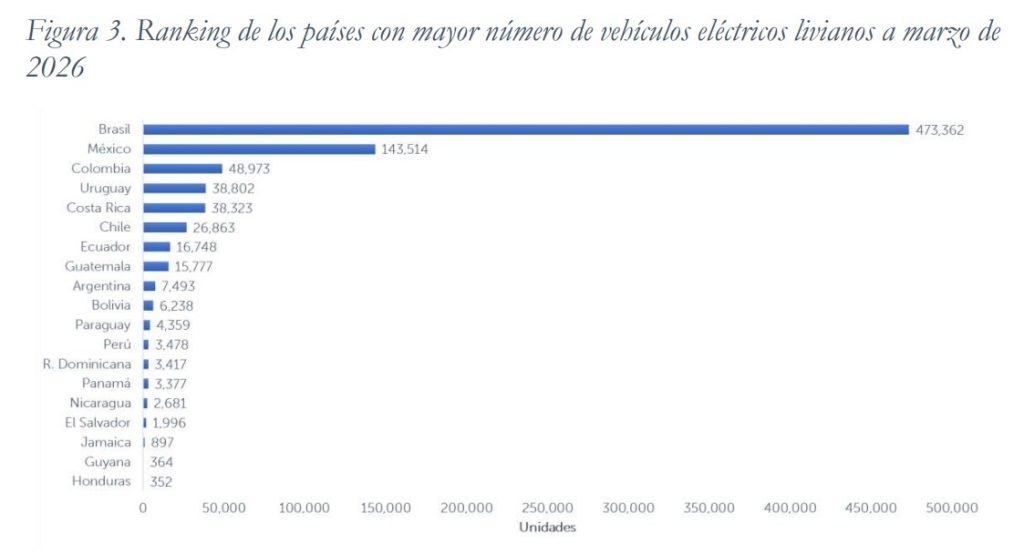
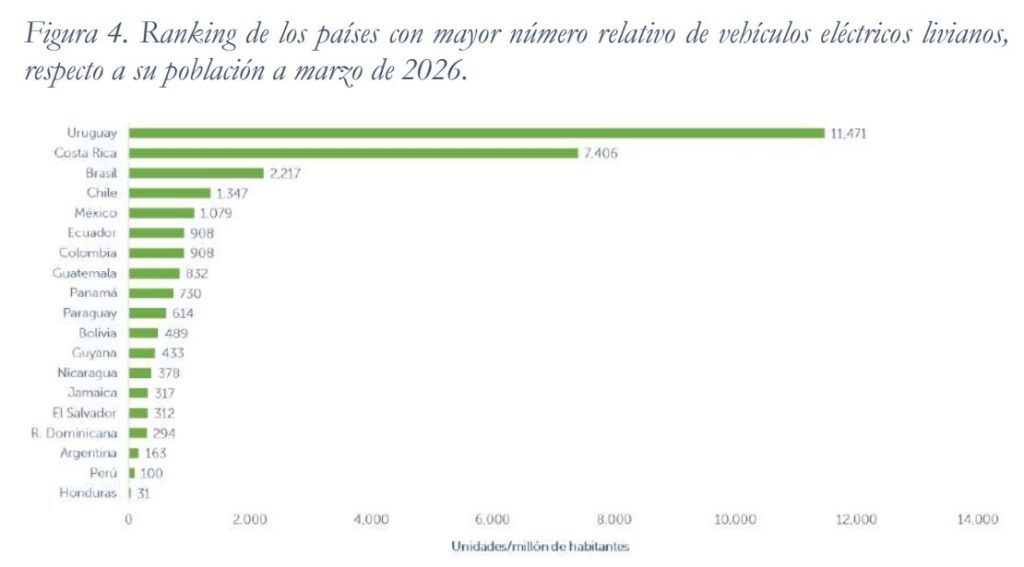
As of March 2026, Chile had 26,863 light electric vehicles in circulation, maintaining its position among the leading markets in Latin America on a per capita basis.
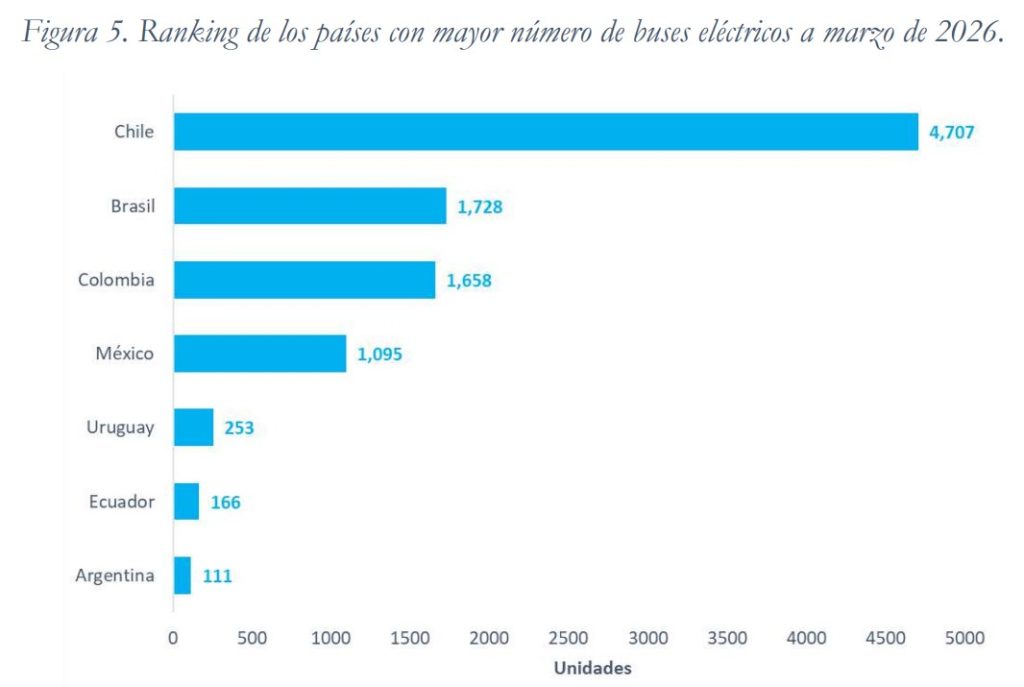
The country also leads the regional fleet of electric buses with 4,707 units , consolidating its strong position in both public transportation and the development of infrastructure tied to electric mobility, according to OLACDE.
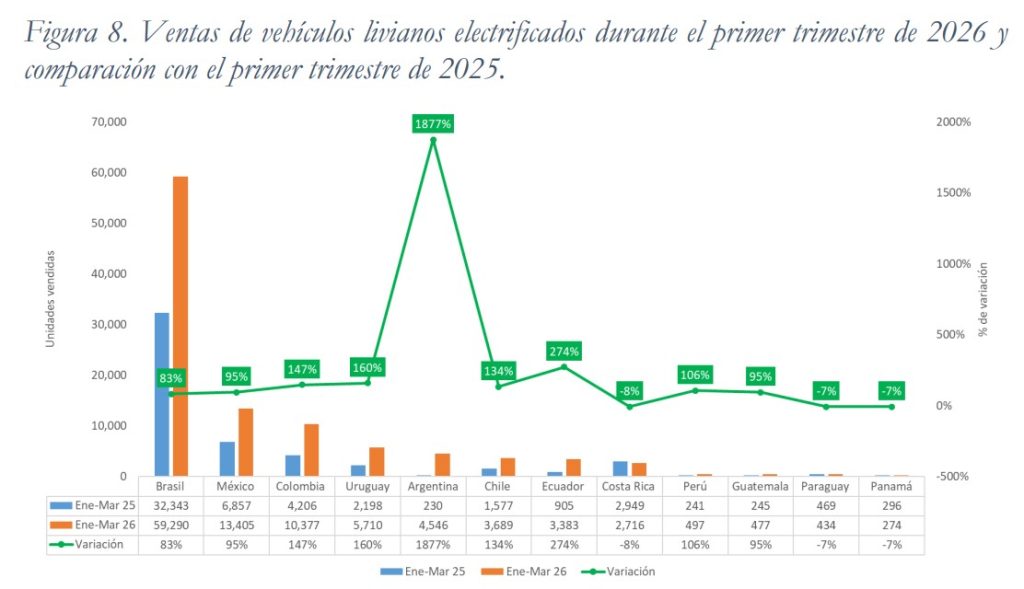
The region’s total light electrified vehicle fleet reached 837,014 units by the end of the first quarter of 2026, following quarterly sales of 106,765 vehicles. If that pace holds, Latin America and the Caribbean could close 2026 with more than one million units in circulation – which raises the strategic importance of having sufficient infrastructure to support that expansion.
Andrés Rebolledo , Executive Secretary of OLACDE , highlighted that charging infrastructure development will be decisive in sustaining future electromobility growth. “The data from the OLACDE Monitor show that Chile has not only advanced in the adoption of electromobility, but also in a decisive aspect for its sustainability: charging infrastructure ,” he noted.
Rebolledo added that the challenge going forward will be to sustain and expand this network to allow for further growth of electric mobility across private, corporate, and logistics segments.
The development of a denser public network also opens up opportunities for charging operators, electric utilities, equipment manufacturers, investors, and mobility service companies , according to OLACDE.
The ‘Green License Plate’ Goes Into Effect
This month, Decree 114/2025 went into effect, implementing visual identification for electric and plug-in hybrid vehicles through the so-called “green license plate.” This measure, promoted by Chile’s Ministry of Transportation and Telecommunications, represents a key advancement in integrating electromobility into the Chilean road system.
The new plates feature a green background with black characters , maintaining the current identification structure: four letters and two numbers for four-wheel vehicles.
The use of the green plate is mandatory for all pure electric and plug-in hybrid vehicles that are commercially sold and registered with the Civil Registry starting from the effective date of the decree. Owners of current electric vehicles may voluntarily choose to make the switch.
The implementation of the green plate facilitates the recognition of benefits for users of electrified vehicles, streamlines inspection by allowing officers to immediately identify vehicles exempt from environmental restrictions in urban traffic, and improves safety in emergencies by alerting first responders to the presence of high voltage.
In the event of an emergency, the green color will instantly alert firefighters and rescue teams to the presence of high voltage so that specific safety protocols can be applied. This standardized visual identification system allows for the quick and clear detection of electric and hybrid vehicles – which is especially relevant for Chile’s Fire Department when responding to emergencies.
The measure will also facilitate the identification of these vehicles on the road or in parking lots should special benefits for electromobility be introduced. For the automotive industry, it is a sign of maturity that confirms the consolidation of clean technologies in the daily life of cities.
A Year 2026 of Consolidation for Mobility
The Latam Mobility 2026 Tour will arrive in Santiago, Chile, on August 25, bringing together experts and strategic players to further strengthen the sustainable mobility ecosystem in the region.
The tour will end in Mexico City on October 12 and 13, alongside the Climate Economy Forum, in a meeting that will bring together sector leaders to continue driving the transition toward more efficient, sustainable, low‑emission transportation systems in Latin America.
The transition is already underway. The Latam Mobility 2026 Tour will be the meeting point to accelerate decisions, connect key players, and collaboratively build sustainable mobility in Latin America.