



As part of Latam Mobility & Net Zero Brasil 2026, a panel titled “Multi-energy axis for the decarbonization of heavy transport: renewable energies, biofuels, and hydrogen” took place.
The session brought together experts from the public, private, and innovation sectors to discuss solutions that combine different energy sources for logistics applications and transport corridors. The unanimous conclusion: there is no single solution or “silver bullet.” Instead, the path to Net Zero requires a mix of technologies tailored to each specific situation.
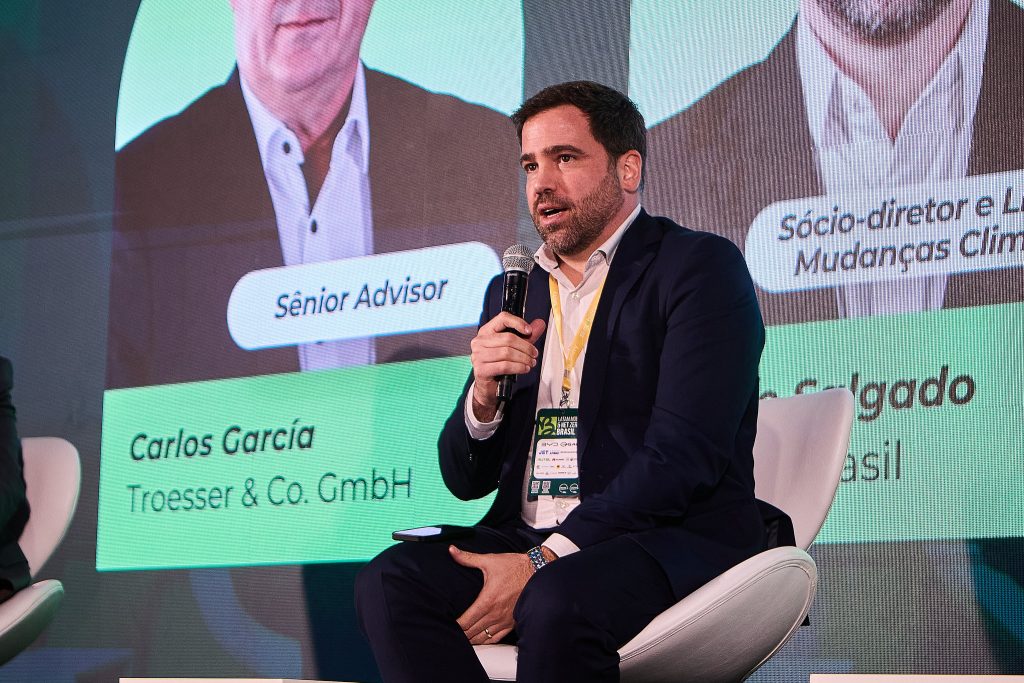
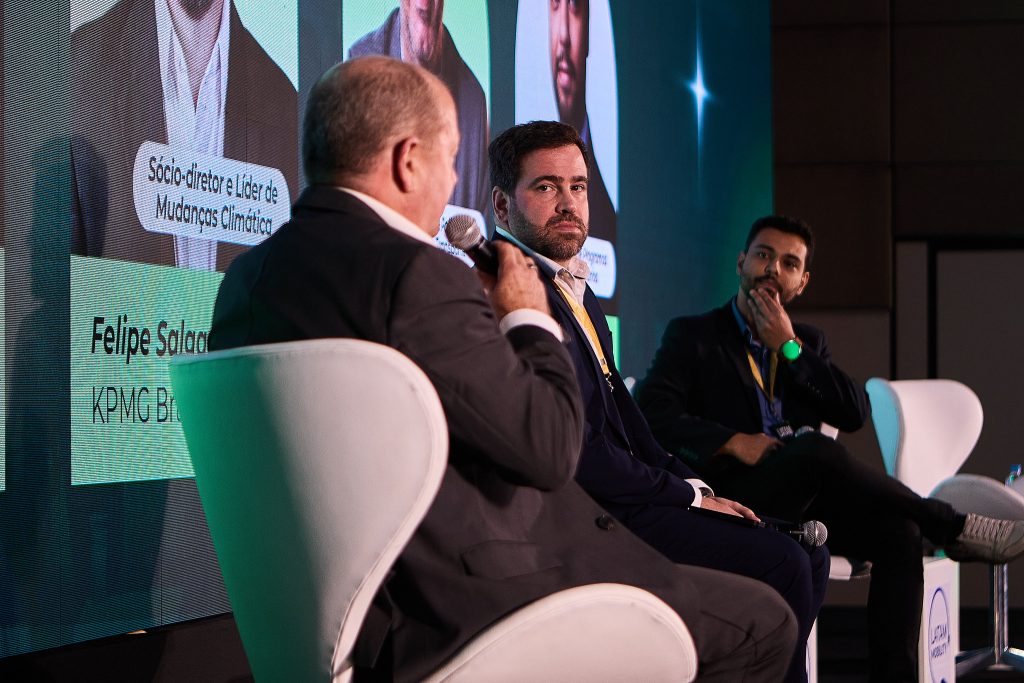
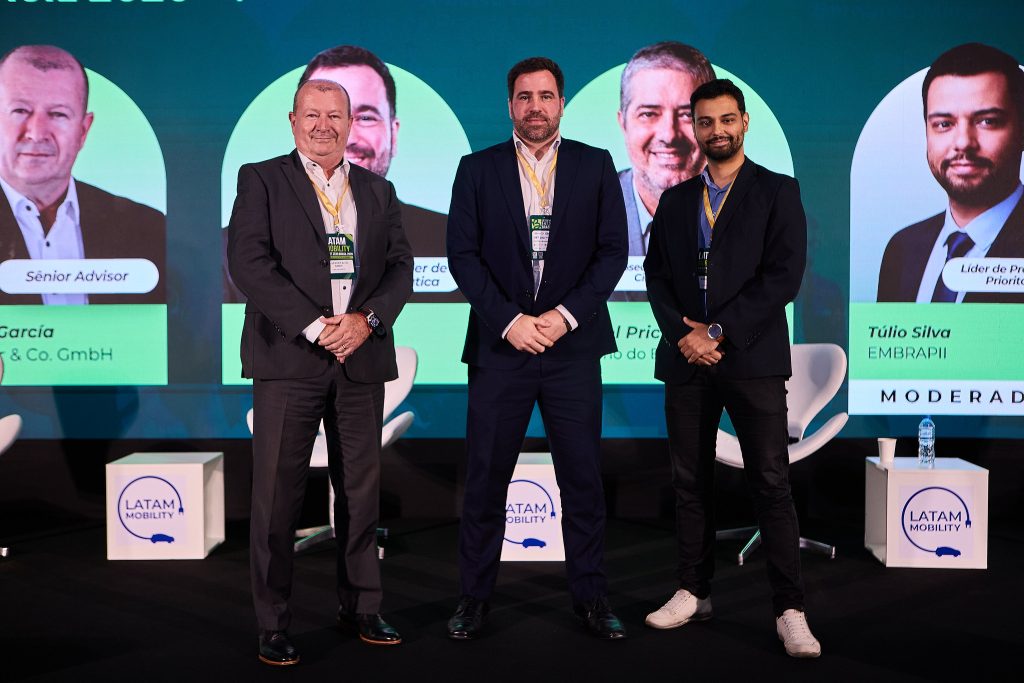
The panel featured Carlos García from Troesser & Co. GmbH, and Felipe Salgado from KPMG Brasil. The discussion was moderated by Túlio Silva from EMBRAPII, who kicked things off by asking a central question: does the solution lie in scaling up already available technologies, or in constant innovation to find new alternatives?
You may also be interested in | KPMG Brazil Warns that the Biggest Challenge for a Vehicle’s Carbon Footprint is Getting Primary Data from Suppliers
The Future is an Orchestra of Technologies
Túlio Silva began by noting that there is no one-size-fits-all answer for logistics and transport decarbonization. “We don’t have a silver bullet,” said the moderator, who emphasized that the real challenge is to orchestrate the best available options: vehicle electrification, renewable energy, biofuels, and hydrogen. Each alternative has its place depending on the region, technical feasibility, and type of fleet or vehicle.
Carlos García supported this view and shared a phrase that sums up the debate: “In cars, the future is electric. In heavy vehicles, the future is electric, but electricity is a component, not the sole solution.”
García explained that while in the consumer segment the cost of transition is spread across millions of buyers, with heavy fleets the investor must buy hundreds of trucks at once. That concentrates the risk and demands much greater support.
Tax Security, Legal Security, and Predictability
One of the points Carlos García stressed the most was the need to guarantee three basic conditions for logistics operators to make the energy transition happen: tax security, legal security, and predictability.
Without these pillars, any investment in clean technologies becomes unviable, and the extra cost ends up hitting freight rates, contaminating the entire supply chain.
“You can’t leave all the responsibility on the operator,” García argued. He added, “There has to be some kind of support.”
Along those lines, he noted that simply improving the average age of the Brazilian fleet—currently 20 years, with Euro 0 vehicles still on the road—would already generate a significant reduction in emissions, regardless of the fuel used.
Externalities Enter the Equation
Felipe Salgado introduced a key concept for rethinking the viability of different technologies: we have to include externalities in the calculation.
It’s not enough to calculate fuel or maintenance costs. You also have to consider impacts on public health, greenhouse gas emissions, and noise pollution.
“The math has to work, yes, but with all externalities included,” Salgado stated. For the KPMG Brasil executive, the right solution for each mode will naturally emerge when you look at the whole picture.
For example, electric buses make sense in urban environments not only for cutting emissions but also for the acoustic comfort of passengers and communities. On the other hand, for long-haul freight, the cost of electric charging infrastructure could throw off freight rates, opening the door for biofuels or hydrogen.
Logistics Optimization and Maintenance
When asked by Túlio Silva what the first step should be for fleet managers starting their decarbonization journey, Felipe Salgado was blunt: “It may sound basic, but analyze your routes and evaluate logistics optimization. There’s money on the table.”
Reducing fuel consumption through better route planning, proper tire inflation, and driver training for more efficient driving are actions that generate immediate impact with little investment.
“That’s ‘class 1’ for many companies, but that’s Brazil’s reality,” Salgado admitted, urging the audience not to underestimate these measures.
Once you get past that level, the next step is fleet modernization, for which financing lines and capital access mechanisms already exist. “It’s a decarbonization journey, with a maturity that must be followed step by step,” he explained.
Looking ahead, García projected that in urban environments and last-mile applications, electrification will dominate. He gave the example of passenger transport from airports to car rental agencies, with daily routes of only 60 kilometers.
However, he warned that prices are not yet fully benchmarked, and in many cases, someone has to subsidize part of the equation to make the numbers work.
From Government Plans to State Policies
One of the most repeated messages among panelists was the need for Brazil to move from government plans to state policies on transport decarbonization.
Carlos García recalled that São Paulo was only able to renew its bus fleet because SPTrans decided in 2022 that no more diesel vehicles would be allowed. Regulation, he said, is a fundamental driver. “If there is no regulation, technology doesn’t matter,” he stated.
Felipe Salgado agreed: “We need clarity and security so that capital can flow. Investors are willing to invest, but they need medium- and long-term plans, not four-year plans.” Along those lines, he proposed defining specific logistics corridors to develop technologies like hydrogen, granting incentives and guarantees that allow solutions to scale.
Carlos García added a variable often left out of the energy debate: the state of Brazilian roads. With a telling anecdote, he explained that while in Dubai his vehicles needed a shock absorber change every 160,000 kilometers, in Brazil they needed to change three over the same distance. “My calculation isn’t wrong; it’s your country,” they told him.
García stated that improving roads or shifting to rail could increase Brazilian agricultural production by 15% to 20% simply by reducing grain waste that currently falls off trucks on poor roads. “Someone is paying that bill,” he warned.
Regarding fuels, Carlos García acknowledged that biodiesel will continue to be a relevant option for long distances, despite nitrogen oxide emission problems. However, he contrasted investment costs: while a biodiesel plant requires between 20 and 30 million reais, an HVO (high-quality renewable diesel) plant demands 600 million. The final decision, he said, will depend on what society is willing to finance.
Final messages
At the close of the panel, Túlio Silva invited panelists to leave a final message for the audience.
Carlos García spoke first: “There is no silver bullet. We need to widen the aperture: a portfolio of fuels, technologies, and financing. Everything has to work together.” And he threw out a challenge to attendees: “Brazil has everything it needs to be a protagonist. If you only want to be a passenger, you don’t get to define the destination. You have to be the driver.”
Felipe Salgado insisted on the need to look at the complete equation, incorporating long-term externalities. He proposed using electric vehicles for last-mile, biofuels for long distances, and defining specific corridors where hydrogen can be developed with clear incentives. “The technology exists, capital is willing. Now it’s about solving,” he concluded.
Finally, Túlio Silva thanked the panelists and the event organizers, and reminded attendees to take advantage of the Brazilian innovation ecosystem, with entities like EMBRAPII, FINEP, and BNDES offering resources and support for the energy transition. “The basics can already be done today, at low cost. What matters is having clarity and starting,” the moderator concluded.
A Year of Consolidation for Mobility
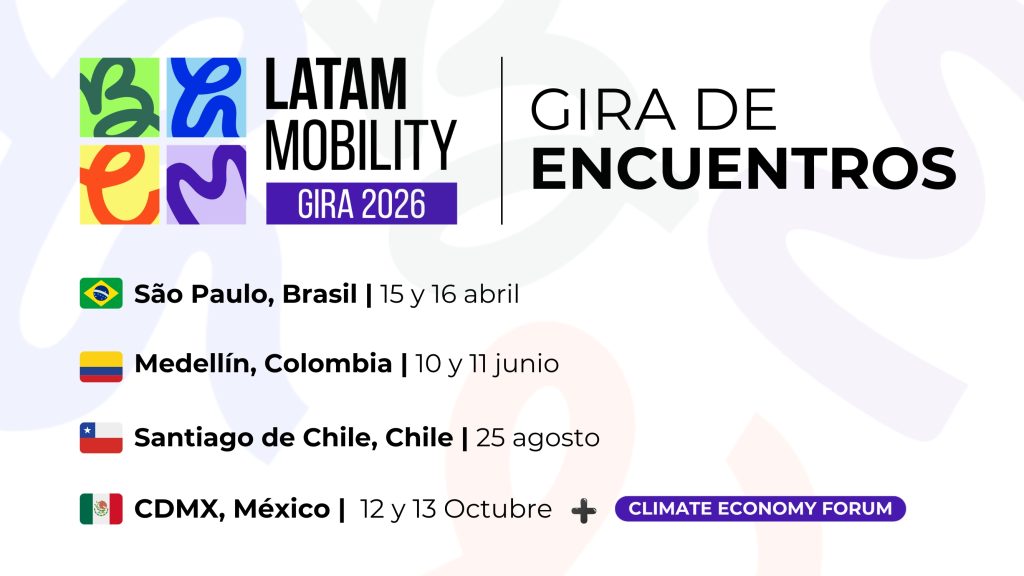
The Latam Mobility 2026 Tour continues its journey in Medellín, Colombia, on June 10–11, and will later arrive in Santiago, Chile, on August 25, bringing together experts and strategic players to further strengthen the sustainable mobility ecosystem in the region.
The tour will conclude in Mexico City on October 12–13, alongside the Climate Economy Forum, in an event that will bring together leading figures from the sector to continue driving the transition toward more efficient, sustainable, and low-emission transportation systems in Latin America.
The transition is already underway. The Latam Mobility 2026 Tour will be the meeting point to accelerate decisions, connect key players, and collaboratively build sustainable mobility for Latin America.