


At the Orquideorama of the Medellín Botanical Garden, Miguel Zamudio, Product Manager at Magma Automotive, presented the technical, economic, and environmental arguments that position natural gas vehicle fuel as the strategic bridge for cargo and passenger fleets in Colombia to move toward zero-emission mobility.
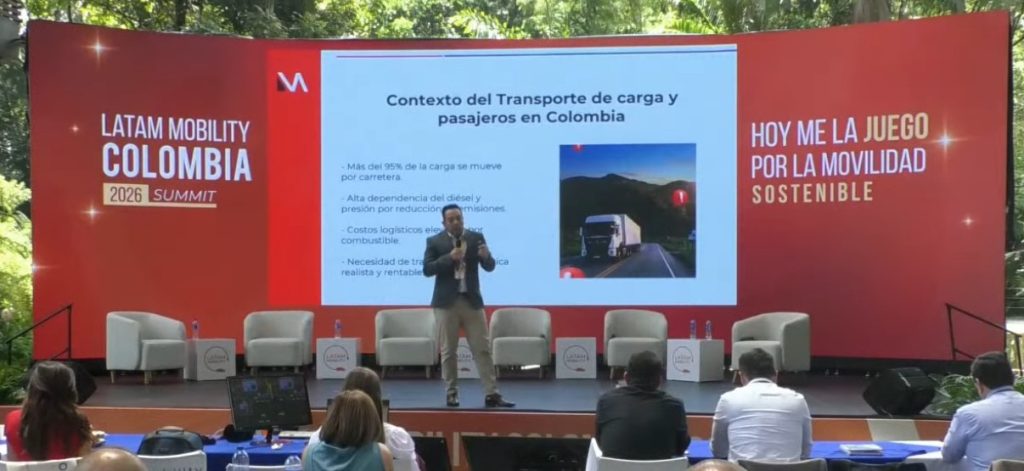
During the sixth edition of Latam Mobility Colombia 2026, held at the Orquideorama of the Medellín Botanical Garden, Miguel Zamudio, Product Manager at Magma Automotive, delivered the keynote “The Natural Step Toward Electrification,” where he presented the company’s commitment to natural gas vehicle (NGV) fuel as a realistic and profitable solution for the commercial vehicle sector in the country.
Zamudio began by presenting Magma Automotive as the representative of the DFAC Dongfeng brand in Colombia and revealed a compelling fact: the company is now the third best-selling commercial vehicle brand in the country. Much of this success, he explained, is due to the commitment to a different technology: natural gas vehicle fuel.
“For us, it has always been a different strategy to arrive with a clean fuel that we believe is the previous step to reach electrification, especially in commercial vehicle operations that have great difficulty with charging,” he stated. Hence his central concept: NGV is the natural step toward electrification and the logical transition for cargo and passenger transport in Colombia.
You may also like | Critical Gap in Colombia: One Charging Point for Every 337 Electric Vehicles and 8-month Infrastructure Delay
Market Data: Low Penetration but an Unavoidable Reality
The executive shared precise figures to assess the current scenario. At the close of 2025, 640 dedicated natural gas vehicles were registered in Colombia, representing only 0.25% of the market. He acknowledged that the number is still low compared to hybrid or electric vehicles, but underscored a fundamental difference: those customers who chose NGV would not have been able to access an electric vehicle – either due to high upfront capital costs (CapEx) or the difficulty of charging in their daily operations.
Given this reality, Magma Automotive has taken a different approach, and that strategy has been successful in the commercial vehicle market.
Zamudio laid out the situation of cargo and passenger transport in Colombia: more than 95% of commercial vehicles on the road depend on fossil fuels, mainly diesel. This dependence generates high operating costs and pushes companies to seek a realistic and profitable energy transition.
Why not immediate electrification? The Product Manager listed the barriers that still prevent a direct leap to electricity in the commercial segment: limited charging infrastructure for commercial vehicles, high initial costs of electric vehicles, restricted capacity of EV charging networks nationwide, and the existence of long-distance operations that require immediate solutions that current electric technology cannot meet.
NGV as a Strategic Bridge
Given this panorama, Zamudio presented natural gas vehicle fuel as a strategic bridge. He explained that compared to a traditional diesel vehicle, NGV reduces CO2 emissions by up to 50% , reduces particulate matter by up to 99% (the main cause of respiratory diseases), and reduces nitrogen oxides (NOx) by up to 75% .
He also highlighted that NGV is already a mature technology, has existing and expanding infrastructure, and allows a gradual transition toward zero emissions in a coherent manner.
One of the strongest arguments of the presentation was economic. Zamudio stated that the cost per kilometer with natural gas is 35% lower than with diesel or gasoline. Added to this is the possibility of negotiating supply contracts with differential prices according to the operating zone, which provides stability and predictability for fleets.
The total cost of ownership (TCO) of NGV vehicles is 35% lower than that of their diesel equivalents, which translates into a much faster return on investment. Likewise, maintenance costs are lower, and the vehicles are factory-dedicated (not conversions), so there is no loss of power or operational strength.
Environmental Benefits and ESG Goal Compliance
The executive highlighted the concrete environmental benefits: lower carbon footprint, significant reduction of polluting particles, better air quality in cities, and compliance with environmental, social, and governance (ESG) objectives. NGV, he added, facilitates companies’ future decarbonization goals and contributes to achieving carbon neutrality targets.
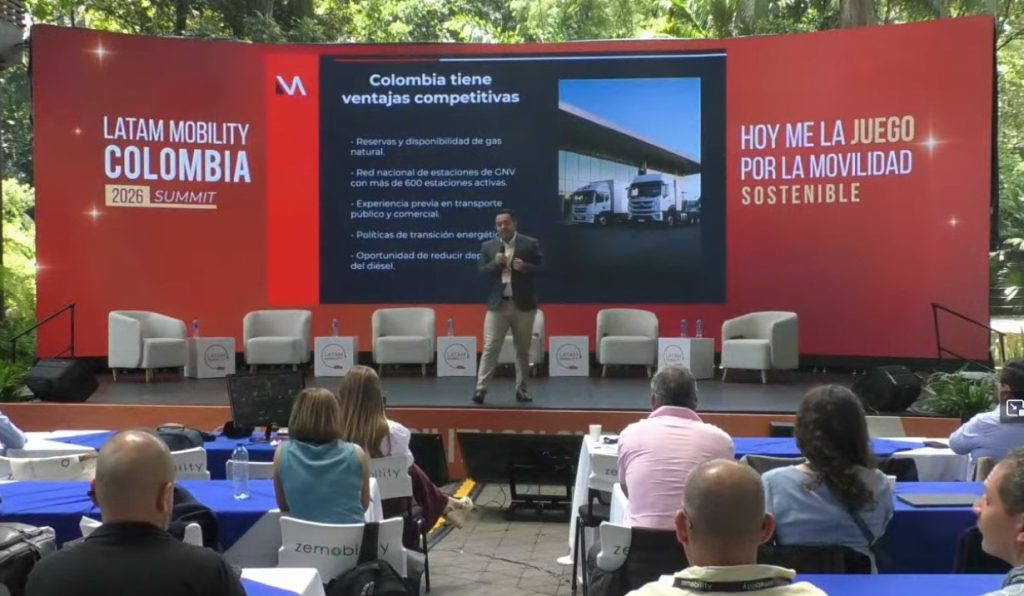
Zamudio emphasized that Colombia has important competitive advantages for this transition: natural gas reserves and availability – although he acknowledged that political factors have limited exploration, and expressed hope that with a new government they could be expanded. He also mentioned a national network of more than 600 active and expanding natural gas stations, as well as previous successful experience in public and cargo transport in various areas of the country.
Energy transition policies in Colombia are very similar to those that benefit hybrid and electric vehicles, so any operator – whether a legal entity or an individual – can access those benefits when acquiring NGV vehicles.
A Progressive Roadmap Toward the Electric Future
The Product Manager presented Magma Automotive‘s vision of the energy transition: a step before hybridization and electric vehicles. The proposed route begins with NGV vehicles, then natural gas hybrid vehicles, then extended-range vehicles, and finally 100% electric or hydrogen vehicles.
“The transition must be progressive and sustainable,” he stated. And he added: “Natural gas accelerates emission reduction today and also allows electric infrastructure and technology to mature.”
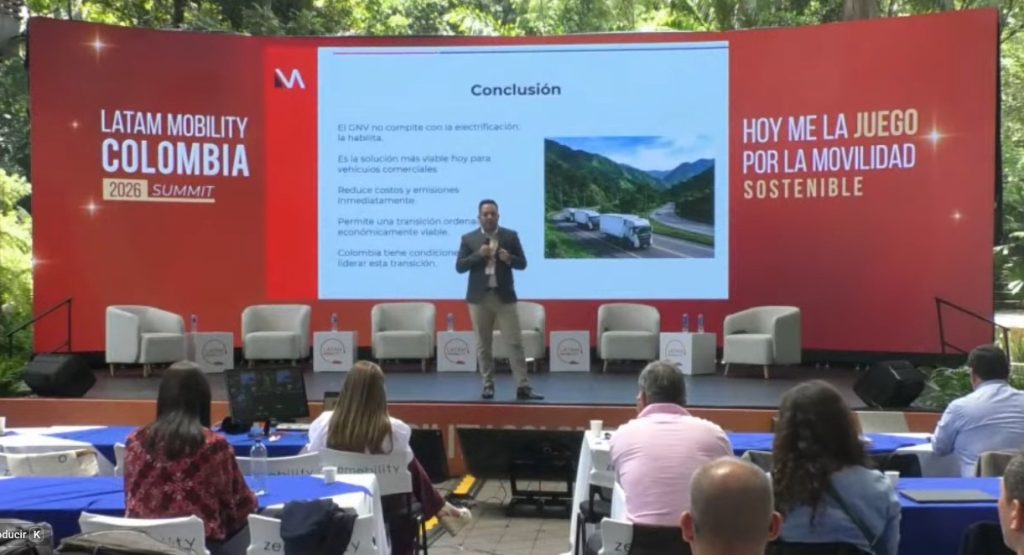
The keynote closed emphatically: “Natural gas does not compete with electrification – it enables it.” Zamudio argued that NGV is the most viable solution today for commercial vehicles because it reduces costs and emissions immediately and allows an orderly and economically viable transition.
“Colombia has ideal conditions to lead this transition,” he stated. “That is why today at Magma Automotive we tell you that we are moving toward the future – the future is to reach 100% electrification, but we are taking the previous steps to get there.”
With this intervention, Magma Automotive reaffirmed its commitment to sustainable mobility that does not ignore the realities of Colombian commercial transport and proposes a gradual, profitable, and effective path toward decarbonization of the sector.
The Conversation Continues
Through its stops in Mexico City, Colombia, and Chile,Latam Mobility will continue to promote a collaborative approach to accelerate the transition to cleaner, more efficient, and more inclusive transportation systems, positioning Latin America as a relevant player in sustainable mobility at the global level.
Be part of the movement that is accelerating Latin America’s energy and urban transformation. If you would like to learn more about how to participate and positioning options, click here.