



Colombia faces a decisive moment in its transition toward sustainable mobility. While sales of electric and hybrid vehicles continue to break records month after month, public charging infrastructure is advancing at a pace the sector considers insufficient and out of sync.
According to the most recent industry figures, this imbalance not only generates long lines at the few available points but also threatens to undermine consumer confidence and the viability of large-scale electromobility.
In this context, companies such as Electrolineras de Colombia have spoken out to warn about the serious consequences of this paradox and to propose concrete solutions.
You may also be interested in | Colombia to Launch First Heavy-duty Electric Corridor: Connecting Bogotá with Barranquilla and Cartagena over 1,200 km
Unfavorable Ratio
The National Unique Transit Registry (RUNT) reported, as of May 21, 2026, a fleet of 77,215 registered electric vehicles in the country.
However, this figure contrasts alarmingly with barely 520 active charging points, resulting in a ratio of one charging point for every 148 electric vehicles — one of the most unfavorable proportions in the region.
If we take the total number of charging stations (each station groups several points), the outlook is even more critical: barely 229 charging stations distributed across the national territory, which equates to one charging point for every 337 electric vehicles.
The deployment of this infrastructure is marked by strong concentration. Of the 520 existing charging points:
- Enel leads the market with a network of 412 chargers, concentrated mainly in Bogotá.
- Terpel has 60 points distributed across 13 departments, of which 16 are in the capital.
- EPM has 48 points installed in Antioquia, the Coffee Axis, and the Santander region.
This uneven distribution shows that infrastructure remains a privilege of a few cities, leaving vast regions of the country without access to public charging.
Industry Warns: A Delay of Up to Eight Months
Electrolineras de Colombia has been one of the most outspoken voices regarding the pace of expansion of the charging network. In a recent analysis, the company argues that the growth of the electric market far exceeds the speed of charger installation, which has created a significant backlog.
“With the current sales pace, Colombia should be installing between 40 and 60 fast DC chargers and several hundred AC points every month to maintain a reasonable balance,” said Pedro Castaño in an interview with Mobility Portal.
“The reality is that deployment is still far below that need, and we estimate a delay of nearly eight months, with a tendency to widen if implementation is not accelerated,” he added.
This operational delay is no small issue, as it directly impacts user experience and confidence in the technology. The company warns that, without immediate acceleration, the gap could deepen in the coming months, especially affecting large cities.
Bogotá, The Epicenter of the Deficit
Bogotá and its metropolitan area concentrate nearly 50% of the country’s electric vehicle fleet, making it the region with the highest demand and, paradoxically, the one where infrastructure shortcomings are most evident.
The situation is aggravated by a structural factor: the difficulty of installing chargers in buildings and residential complexes.
“There is a particular situation there: many users live in buildings and residential complexes where installing charging solutions is still complex. Solving that point is essential to sustain market growth,” said Pedro Castaño.
The issue of condominiums and multi-family buildings has become one of the most relevant challenges for the Colombian electromobility ecosystem.
The lack of electrical capacity in many buildings, delays in approvals by owners’ associations, and the absence of clear rules on who assumes the costs of adapting existing infrastructure are barriers that hinder home charging, forcing users to rely on an already saturated public network.
Outlook and Solutions on the Horizon
Given this diagnosis, industry players agree that the only way out is a public-private partnership that accelerates permits, standardizes processes, and massifies charger installation.
Electrolineras de Colombia is betting on a model of modular, rapidly deployable charging stations. The company projects reaching 1,000 charging points by 2028, for which it has developed standardized processes and operational automation that allow stations to be installed “in weeks, not years.”
“We want more players to be part of the growth of this industry, because the challenge is too great for a single company to take on,” concluded Pedro Castaño.
For its part, the Ministry of Mines and Energy has estimated that, to meet projected demand by 2030, the country will require around 20,000 charging points, which would imply investments of between $255 million and $390 million.
Electric vehicle sales so far in 2026 have already reached 14,541 units, a 207% growth compared to 2025, while hybrids total 27,238 units, an increase of 73.4%.
These numbers confirm that the energy transition is already an unstoppable reality, but also that the time to act is now. The question is not whether Colombia will become an electric mobility country, but whether its infrastructure will be up to the challenge.
The Next Big Gathering in Medellín
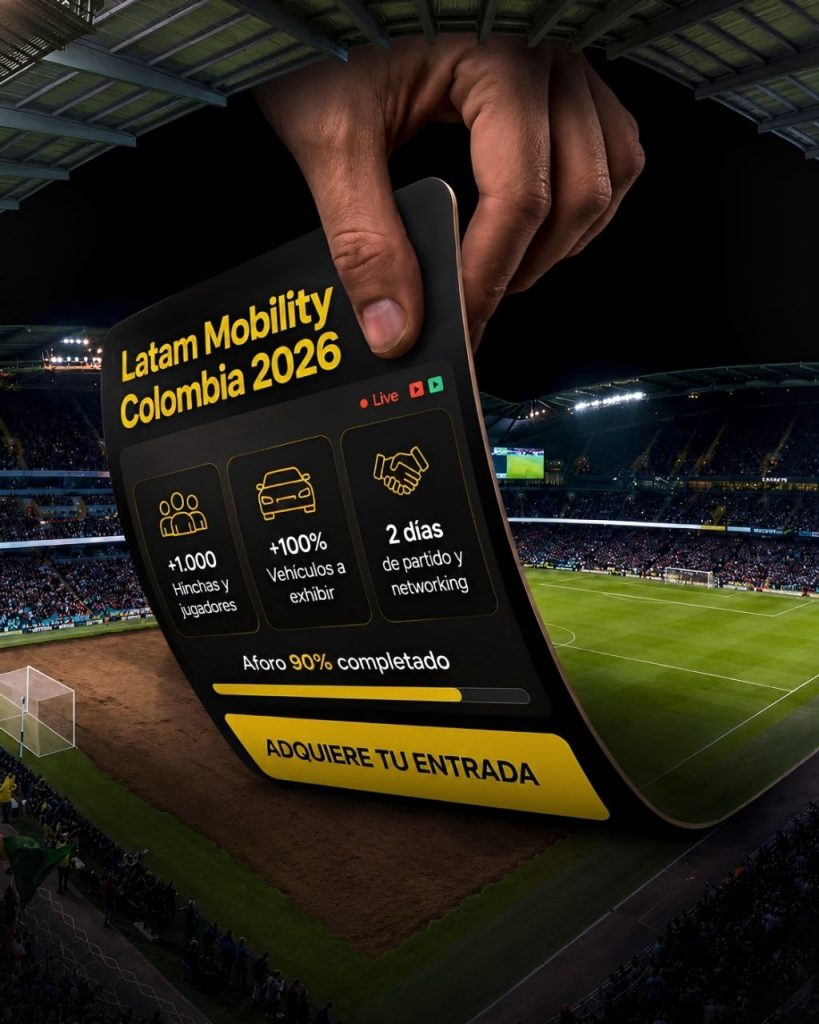
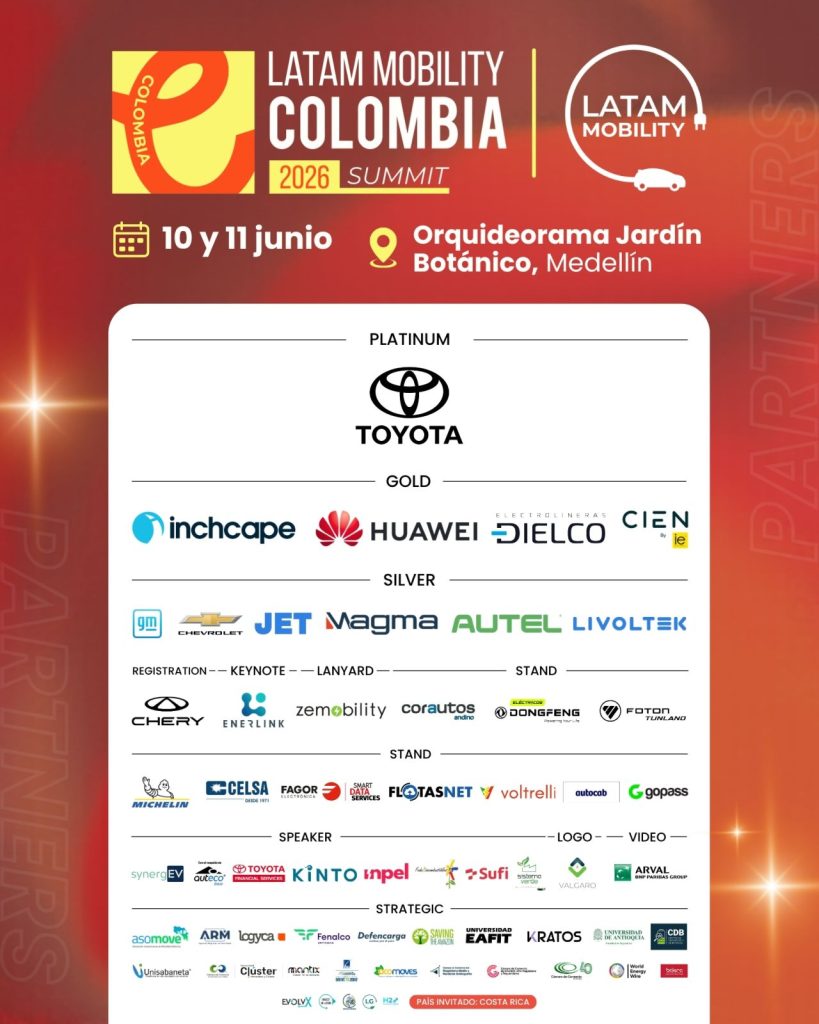
Latam Mobility Colombia 2026 is the most important sustainable mobility event in the region. The meeting will take place on June 10 and 11 at the Orquideorama of Medellín’s Botanical Garden — a natural and iconic venue that will host two intensive days of panels, workshops, networking, and presentations on the latest innovations in electric mobility, hydrogen, biofuels, and charging infrastructure.
The invitation is open to all ecosystem players: companies, fleets, condominium administrators, dealerships, network operators, energy generators, and citizens interested in being part of the change.
Latam Mobility expects to turn Medellin into the epicenter of sustainable mobility in the region, proving that Colombia is ready to win the game of future mobility.