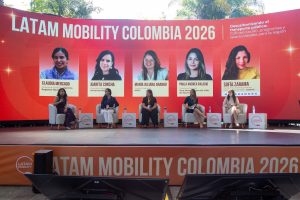



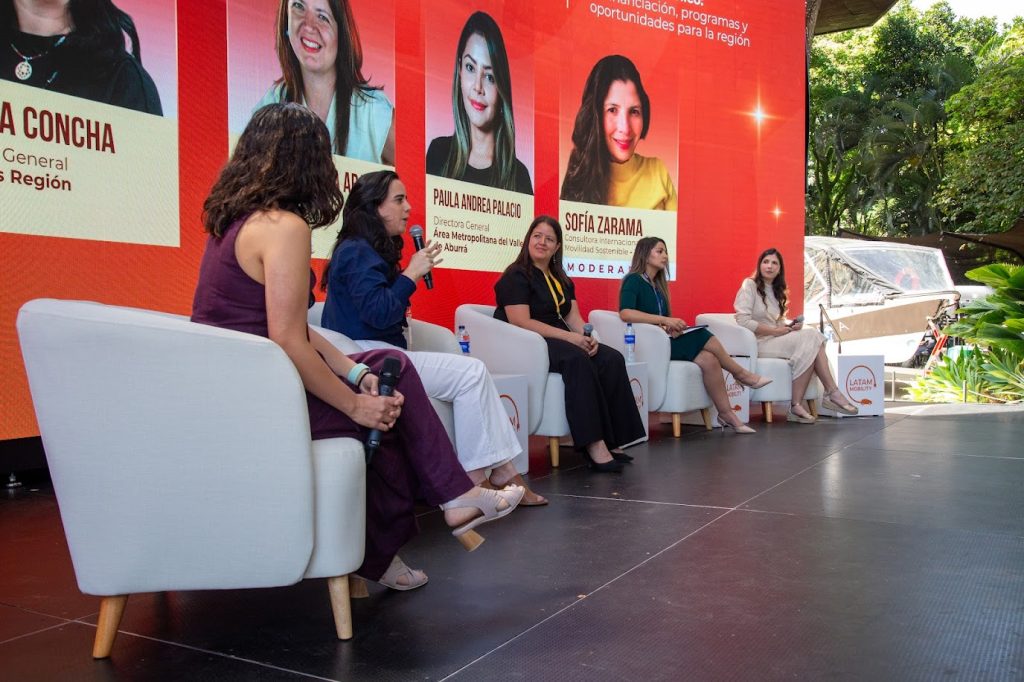
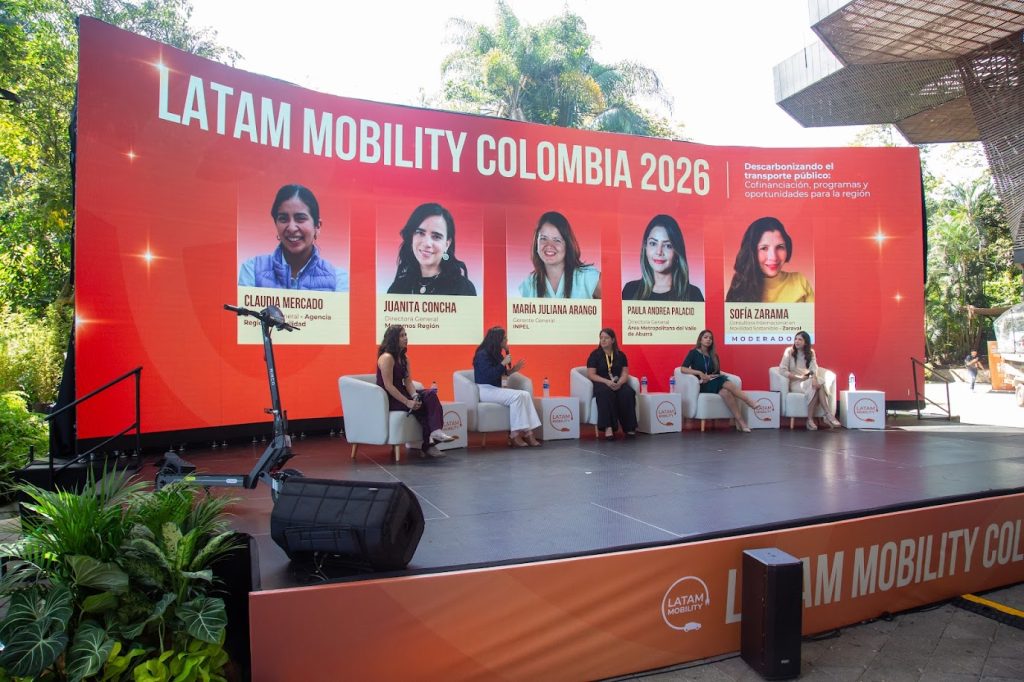
The second day of «Latam Mobility Colombia 2026» kicked off with a high-level panel titled “Decarbonizing Public Transport: Co-Financing, Programs, And Opportunities For The Region,” moderated by Sofía Zarama, international consultant in Sustainable Mobility at Zaraval.
The meeting brought together four prominent leaders from the public and private sectors who, from their respective entities, provided a clear diagnosis of the progress, setbacks, and challenges Colombia faces in achieving clean, efficient, and inclusive public transport.
You might also be interested in | Toyota presents its technology diversification strategy at Latam Mobility Colombia 2026: “One path for every destination”
Participants and Institutional Context
Moderator Sofía Zarama opened the panel by highlighting the importance of having a city-region vision that transcends traditional administrative boundaries. She then invited each panelist to present their organizations and their contribution to decarbonization.
Claudia Mercado, Director General of the Regional Mobility Agency (ARM) , explained that this entity was created just over four years ago when Bogotá and Cundinamarca decided to consolidate a metropolitan region. ARM manages, plans, and co-finances comprehensive mobility projects and also acts as a transport authority for the municipalities that join the metropolitan region.
Juanita Concha, Director General of Movamos Región —the regional transport authority for the southwest— explained that the entity is made up of Cali, Jamundí, Yumbo, Palmira, and the department of Valle del Cauca, and has three main roles: a regional vision and perspective on mobility, a data-based advisory and consulting function, and serving as the transport authority for the Valle commuter train and associated modes.
For her part, María Juliana Arango, General Manager of INPEL, noted that her organization has been the back office for many energy companies in their first steps in electric mobility. They manage 38 charging stations nationwide and developed their own management software to monetize stations. “Last year we supplied more than 92 charging points, both semi-fast and fast. Today we are the ones managing the stations in Cali,” she stated.
Paula Andrea Palacio, Director General of the Aburrá Valley Metropolitan Area (AMVA) , detailed that her entity brings together the ten municipalities of the region, from Caldas to Barbosa, with Medellín as the core city. She highlighted three fundamental roles: being the transport authority for the Aburrá Valley Integrated Transport System (which includes the metro, tram, TPC, and bicycle system); being an environmental authority; and being an articulator of land-use planning.
“That allows us to combine planning from an environmental, strategic perspective, and how projects must advance,” she explained.
Territorial Planning with a Transport-Oriented Development Approach
Sofía Zarama posed the central question: how do you face the challenge of environmental sustainability from a regional vision that includes multiple municipalities with diverse needs?
Claudia Mercado (ARM) responded that the entity was created precisely to facilitate the conception of projects without geographic barriers. They are currently envisioning the Safe and Sustainable Master Plan for 17 municipalities around Bogotá. They are already materializing projects such as:
- The third metro line (the first regional rail line that will reach Soacha);
- The extension of Transmilenio to the region (Cali Avenue, feeding the first metro line), which will benefit more than 500,000 users in Ciudad Verde;
- The Tiranica bike bridge to decongest the Autosur, ready by 2027.
Juanita Concha (Movamos Región) emphasized articulating land-use planning with the regional mobility vision, and highlighted that between last year and this year, the four POTs (Land-Use Plans) in her region were under review and now include an emphasis on sustainable mobility. “We have changed the approach to a much more comprehensive one with a regional vision. That is an important step to later implement more sustainable projects,” she argued.
Paula Palacio (AMVA) agreed that transport-oriented development is the key concept in the review of the POTs of Medellín and other municipalities, and mentioned three mobilizing projects that are articulated with the integrated system: the Metro de la 80, the structuring of the river train (a rail project connecting to Caldas), and the new Metrocable to San Antonio de Prado, already announced and in the bidding process.
Meanwhile, María Juliana Arango (INPEL) explained that from the private sector, they work supporting territorial entities. She indicated their work with the Fleet Technology Upgrade Fund (FOPAT) , helping taxi drivers apply for benefits such as 90% of the value of the electric vehicle and 90% of the investment in charging infrastructure. They have also helped structure bus parks and improve energy efficiency through reactive energy compensation. Additionally, she announced a partnership to install about 400 fast charging points nationwide over the next two years.
Projects Ready, But Stalled
The moderator introduced the topic of financing and co-financing, an instrument through which the national government contributes up to 70% and territorial entities the remaining 30%.
Juanita Concha (Movamos Región) spoke to share the experience of the Valle commuter train, a fully electric and decarbonization project. She noted that they have already created the institutional framework, conducted pre-feasibility studies for 74 km and feasibility for the prioritized Cali-Jamundí corridor, and have met all the requirements of the Ministry of Transport. “We are ready, waiting for the National Government to give us co-financing. That’s the only thing we are missing,” she stated.
However, she warned: “The political situation did not help. We cannot allow our regional projects, which seek to improve quality of life and mitigate externalities, to be tied down by political issues. That should not happen to us in Colombia.” She also reported that they have begun delivering electric taxis in Cali and Palmira, and the remaining challenge is taxi drivers in intermediate cities like Jamundí and Yumbo who are not yet involved. “It does us no good to have an electric train next to combustion vehicles. We want an integrated system with clean technologies,” she affirmed.
Paula Palacio (AMVA) denounced a critical situation: the National Government owes more than 800 billion Colombian pesos to the Medellín District for the Metro de la 80, a project dating back to 2019. “This is not looking toward the regions, not understanding the importance of these systems. We call on the government to catch up with these co-financing contributions,” she demanded.
Claudia Mercado (ARM) agreed that while financing instruments exist, when applied to territories they face barriers. “We need pre-investment resources to access co-financing. We also need banks and the private sector to help standardize conditions,” she noted, adding that intermunicipal transport remains forgotten and a leveraging mechanism for zero and low-emission vehicles is needed.
María Juliana Arango (INPEL) offered the private perspective: “Clear rules of the game are fundamental for return on investment.” That is why they participate in regulatory committees, and she argued that the rate for electric charging stations should not be regulated as a public service, but rather allow the market to self-regulate according to demand. “The rate must recoup the investment.” She also urged informing customers about tax benefits under Law 1715, such as VAT exemption, income tax, and accelerated depreciation.
Messages to Colombia’s Next President
In a final round, Sofía Zarama asked each panelist for a direct message to the new president who will take office in the coming days:
Paula Palacio was first: “We hope for a government that looks toward the regions, understands the problems, commits to the public policy of decarbonization and zero emissions by 2050. The instruments and tools are there, but we need the will of a government that truly understands territorial dynamics.”
María Juliana Arango raised three points: attention to regions (especially the Pacific, where the country’s most important port is located but with serious social problems); the need to grow electricity generation sources and demand control; and avoiding overregulation (she gave the example of switching connectors from CCS1 to NACS, leaving investments obsolete).
Juanita Concha also gave three messages: continuity in public policy (“Let’s stop writing things and start doing them, without political bias”); working with the private sector (“Everything is better if we come together, leveraging resources and capabilities”); and focusing on territories and all transport modes (“Intermediate cities can also be world examples. Let’s not stay only with mass public transport, let’s also look at collective, intermunicipal, freight…”).
Claudia Mercado called for strengthening associative schemes as a tool to level technical and financing capacities in intermediate and small cities. “We need not only the public sector to drive this transformation, but also banks and the private sector. That the new government does not have only three or four pioneering cities in electric mobility, but that small and intermediate cities also get started,” she concluded.
Finally, Sofía Zarama closed the panel by thanking the panelists and summarizing the common sentiment: we expect a president who is an ally of the private sector and sustainable mobility; who looks to the regions, guarantees co-financing for mature projects; pays off the debts for the Metro de la 80, strengthens FOPAT including intermunicipal transport, and does not halt due to political circumstances what technical and planning studies have already shown to be viable.
For all these reasons, «Latam Mobility Colombia 2026» continues to consolidate itself as the meeting space where the public sector, private sector, and international cooperation chart concrete routes toward decarbonized, efficient, and equitable mobility in the region.
A Year 2026 of Consolidation for Mobility
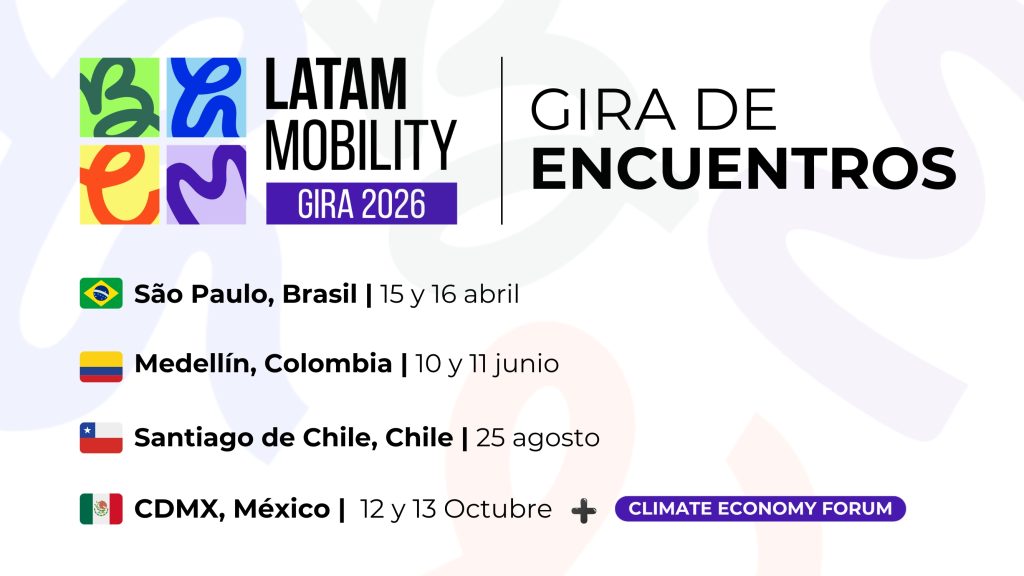
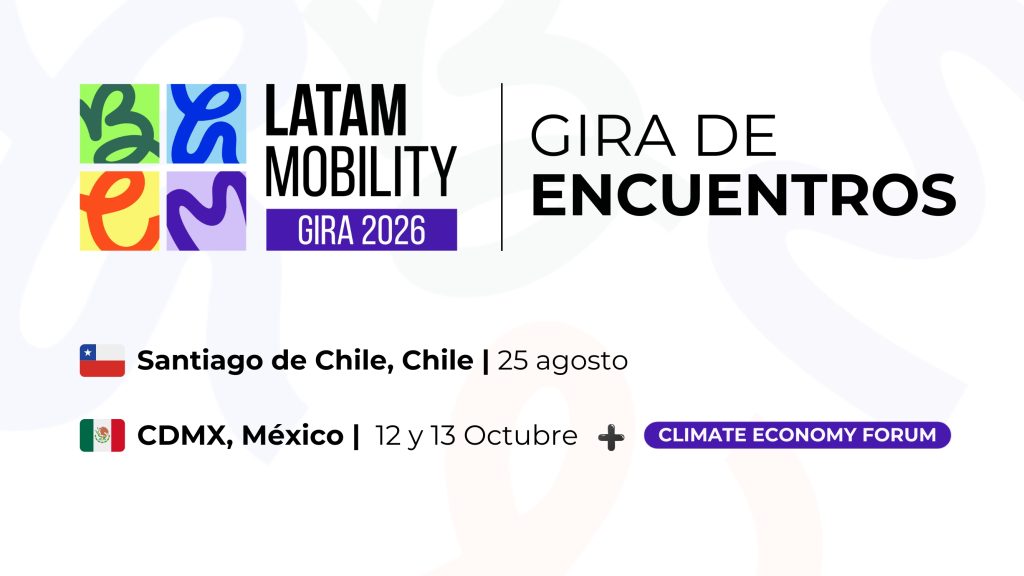
The Latam Mobility 2026 Tour will continue in Santiago, Chile on August 25, bringing together experts and strategic players to further strengthen the sustainable mobility ecosystem in the region.
The tour will conclude in Mexico City on October 12–13, alongside the Climate Economy Forum, in an event that will bring together leading figures from the sector to continue driving the transition toward more efficient, sustainable, and low‑emission transportation systems in Latin America.
The transition is already underway. The Latam Mobility 2026 Tour will be the meeting point to accelerate decisions, connect key players, and collaboratively build sustainable mobility for Latin America.