



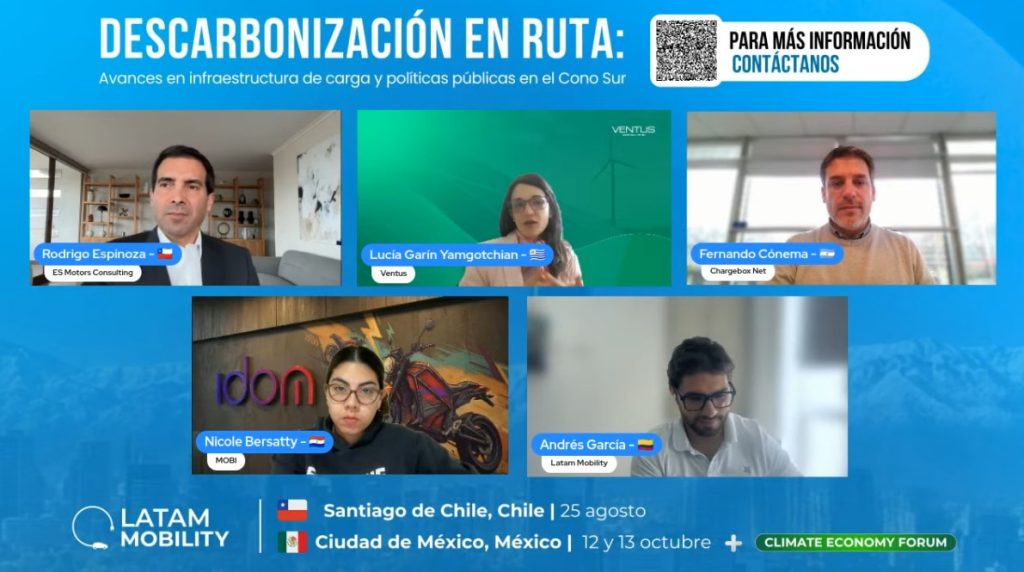
Latam Mobility hosted the webinar “Decarbonization on the Road: Advances in Charging Infrastructure and Public Policies in the Southern Cone,” a virtual gathering that brought together prominent experts from Chile, Argentina, Uruguay, Paraguay, and Bolivia to examine the progress, challenges, and opportunities of sustainable mobility across the region.
The event, moderated by Andrés García, Director of Latam Mobility, provided a platform for dialogue and reflection on the present and future of electromobility in Latin America.
The webinar featured four top-tier speakers representing different segments of the electric mobility value chain in the Southern Cone: Rodrigo Espinoza, Manager of ES Motors Consulting (Chile); Lucía Garín Yamgotchian, Manager of New Business, Renewable Developments, and Hydrogen at Ventus (Uruguay); Fernando Cónema, Commercial Director of Chargebox Net (Argentina); and Nicole Bersattty, Co-founder and CPO of MOBI (Bolivia/Paraguay).
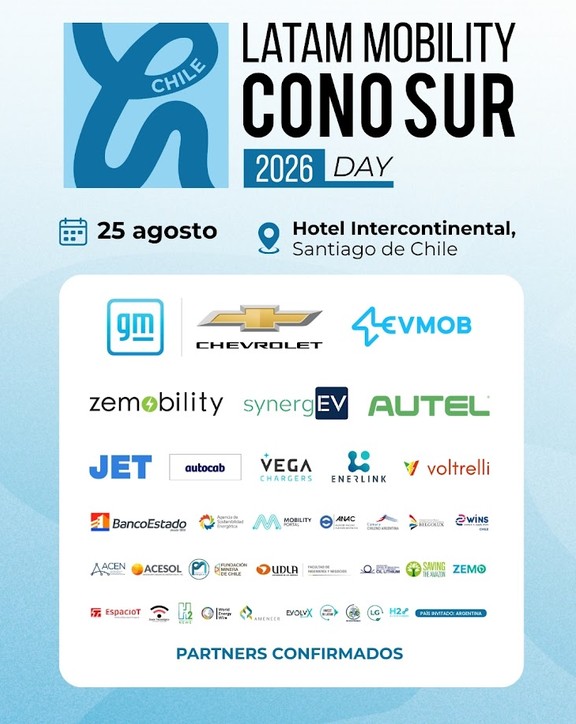
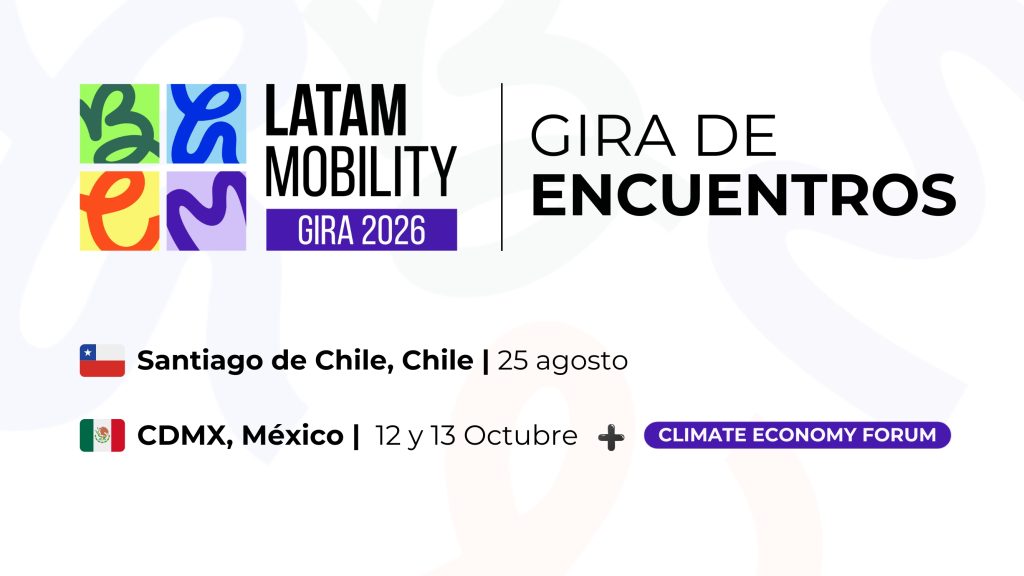
The webinar kicked off the countdown to the in-person gathering “Latam Mobility Southern Cone 2026,” which will take place on August 25 at the InterContinental Hotel in Santiago, Chile.
You may also be interested in | The great energy transition and networking hub arrives in Santiago de Chile: “Latam Mobility Southern Cone 2026”
The Regional Challenges of Electromobility
The conversation began with an analysis of each country’s reality regarding sustainable mobility, revealing that not all territories are advancing at the same pace.
Rodrigo Espinoza opened the discussion by describing the “two sides of the coin” in Chile: while Santiago’s public transportation is a global benchmark—with over 60% of its buses being electric, the highest rate outside China—the adoption of light electric vehicles in the country sits at just 6.1% in 2026. That marks significant growth from 2.8% in 2025, but it is still far from the 20% target set for 2030.
Espinoza highlighted that, although Chile produces one-third of the world’s lithium, the country still faces barriers like a lack of robust tax incentives, the heavy concentration of charging infrastructure in Santiago (with 2,600 public chargers, only 30% of which are fast chargers), and difficulties installing chargers in buildings due to condominium laws.
Lucía Garín Yamgotchian provided Uruguay’s perspective, a country that has already completed the first phase of its decarbonization journey with a 100% renewable electricity grid. In light transportation, the country has achieved an impressive milestone: one out of every two new cars sold is electric, although the total fleet electrification rate is still barely 2%.
However, Garín emphasized that the biggest challenge lies in heavy transport (50-ton loads), where direct electrification isn’t viable due to range and battery weight limitations. There, green hydrogen emerges as a key solution. She mentioned the Kahiró project, a pilot led by Ventus alongside 12 other companies, which aims to decarbonize freight transport through hydrogen-based haulage.
Fernando Cónema painted the picture for Argentina, a country that got a late start in electromobility, only gaining real traction in mid-2025 with a decree that eliminated import tariffs for electric and hybrid vehicles with a FOB value below USD 16,000.
Cónema identified structural barriers: an electricity grid with only 40% renewables, over 500 electricity distributors that make grid harmonization difficult, a strong concentration of infrastructure in Buenos Aires, and a fuel price barrier—since Argentina produces and refines its own oil, fossil fuels stay artificially cheap. The Chargebox Net executive emphasized that Argentina’s greatest challenge is coordinating public and private stakeholders to generate long-term certainty.
Nicole Bersattty rounded out the segment with the perspective from Bolivia and Paraguay, highlighting the advantages of Paraguay’s maquila regime—which allows entrepreneurs like MOBI to assemble products with a 1% tax burden—but also noting the lag in public policies.
Bersattty noted that fuel prices doubled in Bolivia in less than six months, sparking sudden interest in electric vehicles, yet without clear regulations for their registration. The Bolivian entrepreneur underscored that the lack of urban planning—bike lanes that are “just a painted line” and cities not designed for micromobility—is just as big an obstacle as the absence of tax incentives.
Business Models and Alliances: The Key to Unlocking Potential
The second panel shifted focus to profitable business models and the strategic alliances needed to accelerate the transition.
Lucía Garín was emphatic: “The brake is not technological, but the business model.” As long as fossil fuel remains cheaper than clean alternatives, the scales won’t tip on their own. She proposed “leveling the playing field” by eliminating fossil fuel subsidies and, where the equation still doesn’t add up, resorting to incentives like green bonds or targeted subsidies.
For heavy transport, Garín advocated for long-term alliances between renewable energy producers, transporters, and off-takers, backed by public and private financing that provides the certainty needed for large-scale investments.
Fernando Cónema agreed on the need for coordination, but focused on alliances with the financial sector. Banks, he said, must get involved in financing vehicles and infrastructure despite the current low market volume. He also called for differentiated commercial policies from electricity distributors so they don’t “strangle” early infrastructure developers with the cost of available power, suggesting promotional rates during the market’s initial growth phase.
Nicole Bersattty shared MOBI‘s experience, which operates on a battery-swapping model instead of conventional charging. For her, alliances with private parties are essential—pharmacies, supermarkets, and last-mile delivery chains like Rappi, which provide space for swapping cabinets in exchange for a steady flow of users. Bersattty emphasized that the public sector should limit itself to “providing the tools”: clear regulatory frameworks, tax incentives, and a 10- or 15-year city vision, rather than rushed solutions that create more problems than they solve.
Rodrigo Espinoza highlighted that, despite the barriers, there are success stories in Chile in last-mile fleets, with companies like Mercado Libre, Falabella, and major supermarkets that have profitably implemented electromobility. In heavy transport, 600 kW chargers are already being installed on some highways for electric truck pilots. Espinoza insisted that the future is electric and that the technology that endures is the one that “makes your life easier.” Home charging—if legal hurdles in buildings are eased—is key to mass adoption by individual users.

Charging Infrastructure: The Great Shared Challenge
The third pillar of the conversation was charging infrastructure. Rodrigo Espinoza outlined a roadmap for Chile: unblocking the installation of chargers in buildings, promoting fast charging along routes (especially Route 5, which connects the north and south), and moving toward interoperability so users can use a single app to access all public charging providers, even reserving a charger in advance to plan their trips.
Espinoza noted that Chile has adopted a unified charging protocol, which has facilitated standardization, but acknowledged that private efforts—such as Copec Voltex—have been the main driver of development, and that the State must accompany this with more active policies.
Nicole Bersattty shifted the focus to Paraguay, a country that is arriving later but has the opportunity to do it right. She warned that the country’s real estate boom is not considering electromobility in its new buildings, which will create a massive problem in 10 or 20 years.
Her advice: start with the private sector, which can bring international investment and lay the groundwork, and then move on to public policies. “You have the opportunity today to urbanize a city thinking about the future,” she stated.
Lucía Garín proposed a methodological approach: foresee, plan, and anticipate. The first step is an accurate diagnosis of the current situation and future demand scenarios to avoid reactive investments that arrive when it’s already too late.
To that end, she suggested using buffers such as battery storage to flatten demand peaks from fast charging, and emerging technologies like Vehicle-to-Grid (V2G) and Vehicle-to-Home (V2H), which allow vehicles to return energy to the grid and the home. In heavy transport, planning must be even more rigorous, with regulatory certainty of at least 5 years for projects to be financially viable.
Fernando Cónema wrapped up the segment with a focus on cross-border interoperability. Argentina, Uruguay, Chile, and Paraguay share porous borders, and electric vehicle users need to be able to charge their vehicles in all countries without having to download multiple apps or face incompatible standards.
Cónema announced that Chargebox Net is working on Argentina’s first charging hub with power outputs of up to 700 kW—a long-term bet aimed at showing that infrastructure development and vehicle arrivals must go hand in hand: “It has to be the chicken and the egg at the same time.”
The Future is Electric and Collaborative
The webinar wrapped up with final remarks, where each participant shared their vision for the future of sustainable mobility in the region.
Rodrigo Espinoza was categorical: “The future is electric.” He recalled that in 2025, one out of every four cars sold worldwide was electric, and that this trend will reach Latin America sooner or later. He encouraged entrepreneurs, users, and companies to “place their bets on electromobility,” because it is a technology that is here to stay.
Nicole Bersattty pointed to China as a benchmark. “Twenty-five years ago, the Asian giant adopted transition policies that seemed complex: it banned combustion motorcycles, offered financing, eliminated taxes, and supported the entire value chain. Today, more than 90% of vehicles in China are electric.”
Fernando Cónema, with over 10 years of experience in the sector, urged everyone not to lose the collaborative spirit. He acknowledged that there are many barriers, but also many people willing to collaborate without asking for anything in return. His message: there is room and space for everyone, and innovation in electric mobility is a growing sector that will reward those who persevere.
Lucía Garín closed with a call for the Southern Cone to unite. “The world is betting on renewables, and electromobility is key to decarbonizing. Individual problems are better solved together, and if the Southern Cone countries unite, they can become global benchmarks for the energy transition.”
Moderator Andrés García thanked the panelists and the audience and reminded everyone that the next in-person event will be on August 25 in Santiago, Chile, as part of “Latam Mobility Southern Cone 2026.” He also invited participation in “Latam Mobility Mexico 2026,” the largest in the region, which will close the 2026 tour. “The size of the challenges equals the size of the opportunities, and in sustainable mobility, there’s room for everyone,” he concluded.