



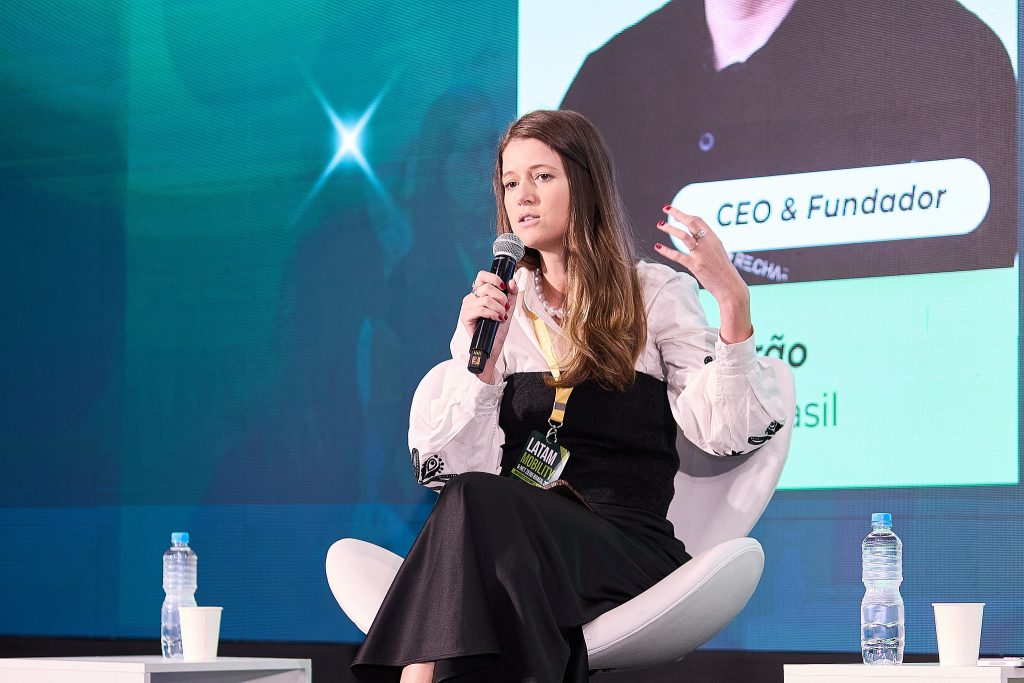
During the first day of the “Latam Mobility & Net Zero Brazil 2026” conference held in São Paulo, the panel titled “Charging Infrastructure: Hardware, Software, Engineering, and Integrated Solutions” took place, moderated by Daniela García, Country Lead at Invest In Latam.
The session brought together key players ranging from equipment manufacturing and specialized engineering to management software and charging network operation.
The moderator opened the discussion by noting that when electromobility is discussed, infrastructure often takes a back seat, but it is just as crucial as the vehicles themselves.
“Infrastructure involves hardware, software, engineering, and integrated solutions so that both beneficiaries and investors have clarity throughout the entire process,” said Daniela García.
You may also be interested in | Geotab study: electric car batteries retain more than 90% of their capacity after 160,000 km
WEG: National Technology, Local Manufacturing, and After-sales as Differentiators
Fernanda Bencke, from WEG, proudly emphasized that the Brazilian multinational, born in Santa Catarina, manufactures its chargers in Brazil with local engineering and exports them to Europe and the United States.
“We develop technology with Brazilian engineers tailored to our infrastructure reality,” she stated. WEG not only supplies chargers but also electrical panels, transformers, and electrical protections, offering an integrated solution that avoids the “patchwork” of multiple manufacturers.
Fernanda Bencke focused on after-sales service as a critical factor for scalability. According to data from the Brazilian Electric Vehicle Association (BVE), Brazil has 21,000 public and semi-public charging points, but the main problem is not a lack of equipment; rather, many of them do not work when users need them.
“A downed charger impacts availability, the investor stops billing, and the return on investment calculation doesn’t add up,” she explained. To address this, WEG developed the V-Mob Advanced Services system, which proactively monitors power modules to anticipate failures and reduce downtime.
EzVolt: Vertical Integration, Proprietary Networks, and Interoperability
Gustavo Tannure, from EzVolt, described his company as a vertically integrated charging network that was born in 2019. EzVolt operates its own network of charging points (B2B and B2C), offers management solutions for charging point owners, and is an app provider for automakers such as Chevrolet, Volvo, Audi, and BMW.
Gustavo Tannure revealed that nearly 70% of São Paulo’s electric buses use their charging solutions, with a presence in more than 20 bus depots in the city. The company has already surpassed 50 million reais in revenue and has over 240,000 app downloads.
Regarding interoperability, Gustavo Tannure drew an analogy with mobile telephony: just as roaming exists between operators, electromobility requires that management platforms communicate through a common language.
He explained that the OCPI (Open Charge Point Interface) standard allows a charger from one company to appear on another’s app, making life easier for the user. “The goal is for customers to easily find a charging point, with fewer apps, and in the future, the vehicle itself will authenticate and pay automatically,” he projected.
REVO Electric Revolution: Engineering for Standardization and New Markets
Luiz Santos, from REVO Electric Revolution (Austin Group), explained that his company operates in the engineering layer, designing and executing projects without providing hardware or software, but complementing the ecosystem with standardization and reliability.
He warned that, just as happened with solar energy, where only 20% of the companies that entered in 2016 remain active, the electromobility sector requires solid technical standards to avoid high project mortality.
Luiz Santos also looked toward the future: he mentioned eVTOLs (electric vertical takeoff and landing vehicles) , driven by Embraer, which will require charging infrastructure in unusual places such as building rooftops.
“Promoting electrification opens up space for other markets. It is the tip of the iceberg for many things to come, ” he stated. He anticipated that the next steps will be linked to battery storage and off-grid solutions that combine generation, conversion, and energy accumulation.
Re.Charge Brasil: Specialized Engineering for Large Projects
Arthur Carrão, from Re.Charge Brasil, presented his company as an engineering firm specialized in electromobility, working on project design, implementation, consulting, and charger maintenance.
“We only do electromobility projects and have worked on large charging hubs, bus depots, airports, terminals, and logistics warehouses that are electrifying their fleets,” he explained. The company focuses on the B2B market with highly complex projects.
Arthur Carrão highlighted that the last day of construction is the first day of operation, so combining engineering, real interoperability, and an ecosystem that works in an integrated manner from the start of the project is essential to reduce risks and ensure investment viability.
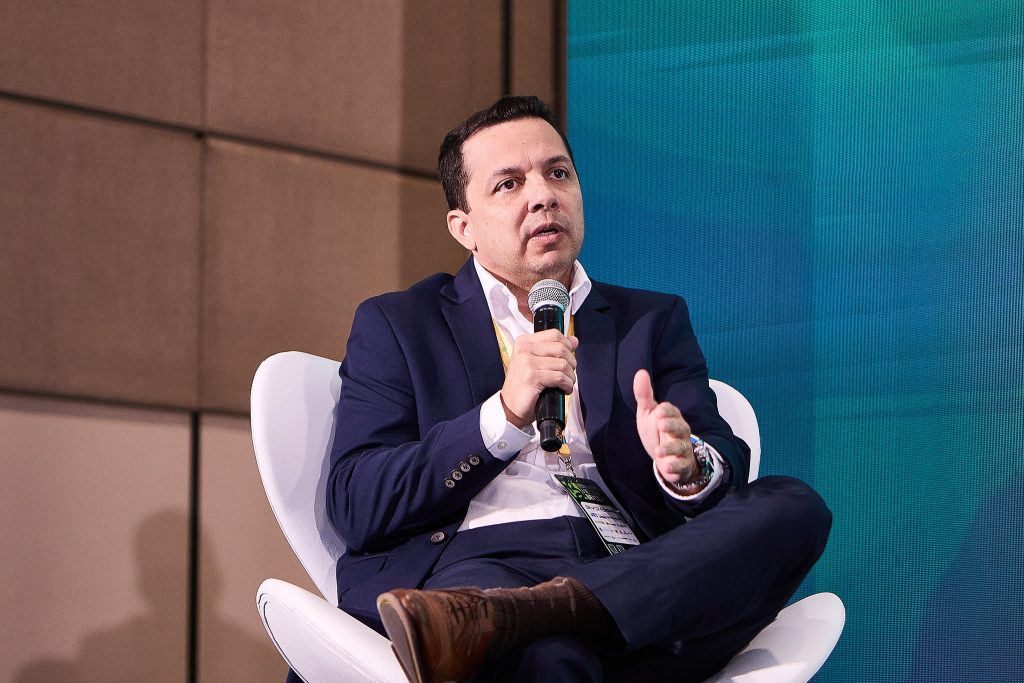
Spott: Data, Location and Capital to Scale Charging Networks
Thiago Moreno, from Spott, explained that his company was born in 2021 with the mission of scaling infrastructure in an agnostic and asset-light manner, providing a digital platform for the ecosystem.
“A charger without software, without good operation, without demand, and without capital is not enough,” he noted. Spott serves Brazil’s main charging point operators and last-mile fleets, such as Mercado Libre, managing the charging of nearly 2,000 electric vehicles.
Thiago Moreno highlighted two critical points: operational complexity (downtime kills the business) and location choice (location is more important than hardware) . “Getting the location wrong is much more expensive. You can start with an AC charger, test demand, and then invest in higher power,” he advised.
Additionally, Spott is part of the Pátria ecosystem, the largest infrastructure fund in Latin America, which allows them to help their clients raise capital to jump from 100 to 2,000 chargers. “The infrastructure asset has to be profitable. You have to grow with quality, not just volume, ” he asserted.
Growth driven by private demand
During the debate, panelists agreed that Brazil does not have direct public incentives for installing charging points; all growth has been driven by private investment.
Gustavo Tannure explained that network development has followed vehicle demand, solving the “chicken or egg” dilemma. Chargers exist because there are electric cars, and more and more ride-hailing drivers and fleet companies are opting for electromobility after verifying the total cost of ownership (TCO) .
“A driver who covers more than 200 kilometers per day recovers the price difference of an electric vehicle in about a year and a half,” he exemplified. Cheaper maintenance and lower cost per kilometer mean that even without subsidies, the financial equation works out for intensive users.
In their conclusions, the panelists sent a clear message: the time to invest in charging infrastructure is now, but it must be done intelligently:
- Fernanda Bencke urged business owners to start as soon as possible, because those already in the market have learned, made mistakes, and adjusted their models. She cited the client Esquina do Futuro, which builds charging points with a focus on the complete experience (café, restrooms, Wi-Fi) and prioritizes equipment availability.
- Thiago Moreno agreed that entering poorly is also expensive, so he recommends seeking advice from data and strategic partners.
- Arthur Carrão recalled that the heavy vehicle charging market (bus and truck fleets) represents only 1.5% of its potential, while the United States already has 250,000 charging points and China has 4 million. “There is plenty of room to grow, but it must be done with strategic alliances, seriousness, and a long-term vision,” he concluded.
- Luiz Santos added that energy storage and off-grid systems will be protagonists in the coming years, especially for high-power charging points (480 kW) that require battery banks to avoid grid collapse.
- Gustavo Tannure, in his final intervention, compared electromobility to the evolution of televisions: from tubes to plasma screens and then to LED. “We are in the first stage of a disruptive technology. Solid-state batteries will provide ranges of 1,500 km and change the rules of the game, ” he predicted.
Moderator Daniela García closed the panel by thanking the participants and highlighting that sustainable mobility must be environmentally and financially sustainable, and that the path to 100,000, 200,000, or 300,000 infrastructure points in Brazil will be built with collaboration, innovation, and reliability.

The Agenda to Decarbonize Transport
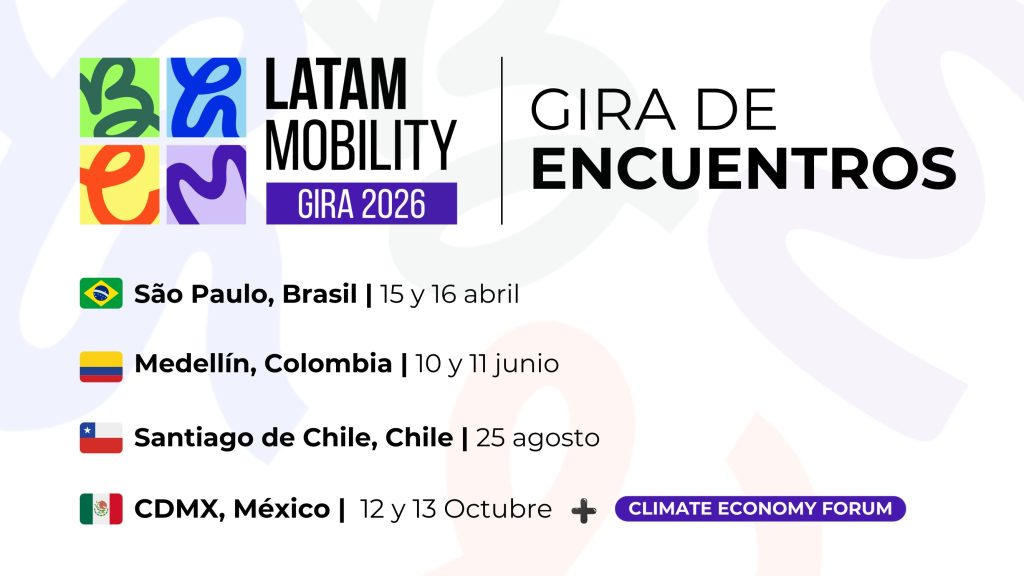
Latam Mobility promotes dialogue among the main players in the sector throughout its 2026 tour, which will visit the region’s key markets to delve deeper into these and other crucial issues for the transformation of mobility.
The Latam Mobility 2026 Tour will travel through some of the region’s most dynamic cities, Mexico City, Brazil, Colombia, and Chile, establishing itself as a unique space to connect the ideas, projects, and leaders who are transforming mobility and the climate economy in Latin America.
The transition is already underway. The 2026 Latam Mobility Tour will be the gathering point to accelerate decisions, connect key players, and collaboratively build sustainable mobility for Latin America.