


A massive real-world data study has just debunked one of the most persistent myths about electric vehicles: the supposed fragility of their batteries. Far from being a component doomed to a premature and costly death, modern lithium-ion batteries demonstrate a lifespan that could easily outlast the vehicle itself.
Geotab‘s telematics platform analyzed the behavior of tens of thousands of electric cars under everyday usage conditions and concluded that battery degradation is much slower than previously believed, offering robust and reliable performance for years.
Below is a complete breakdown of this revealing report, analyzing the real degradation rate, the impact of fast charging, climatic factors, and what this means for the future of electric mobility and the second-hand market.
You may also be interested in: Sustainability and Renewable Energy: Latam Mobility Calls for a Dialogue Space to Define the Course of Mobility in Chile
Data from over 22,000 vehicles
To get an accurate, speculation-free picture, Geotab — a global leader in connected vehicle solutions — conducted a large-scale investigation. The team analyzed aggregated telematics data from 22,700 electric vehicles, covering 21 different makes and models of passenger cars, utility vehicles, and even some light trucks. This analysis, based on several years of real-world usage data, is one of the most extensive and detailed studies on battery health to date.
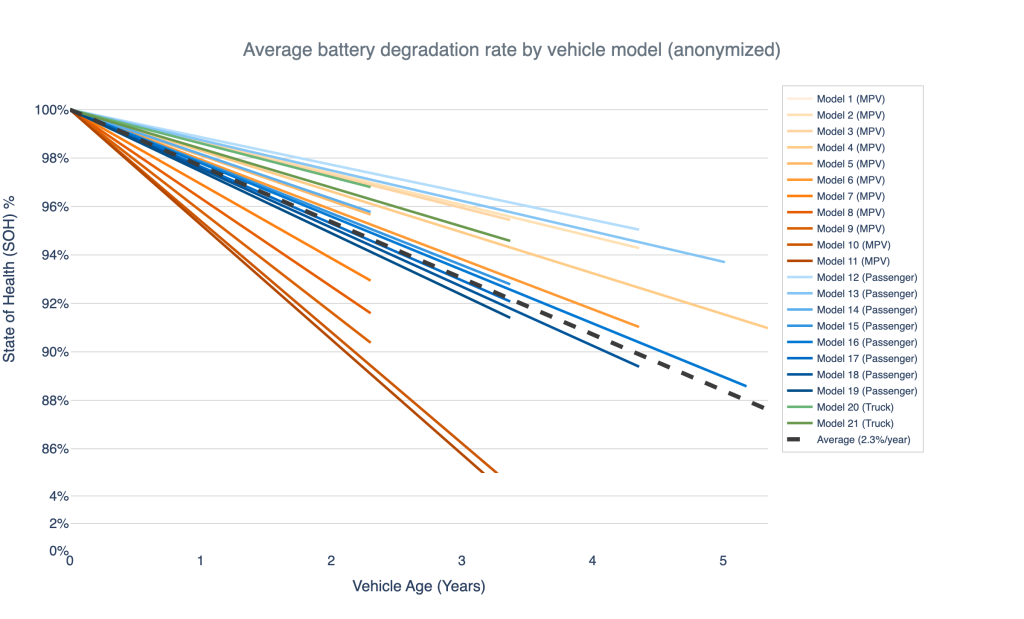
The resulting figures are compelling. The study revealed that the average annual degradation of EV batteries currently stands at around 2.3%, meaning that under average usage scenarios, an electric car would retain approximately 81.6% of its original capacity after eight years of service.
To put it in perspective, a 60 kWh battery that starts its life with a State of Health (SOH) of 100% would behave after eight years as if it had nearly 49 kWh available — a range loss that is perfectly manageable for most drivers in daily use.
It’s important to note that this 2.3% rate is slightly higher than the 1.8% recorded in previous Geotab analyses from 2024. This increase is not due to a technological flaw, but rather to a change in user habits: the increasingly frequent use of high-power DC fast charging.
As Charlotte Argue, Senior Manager of Sustainable Mobility at Geotab, notes, the data indicates that battery health “remains robust,” even as vehicles are charged faster and used more intensively.
Fast charging influences battery health
If the main news is that batteries last longer than expected, the most relevant nuance is how charging habits can accelerate or slow down degradation.
The Geotab study identified charging power as the operational factor with the greatest influence on long-term battery health — meaning that how we charge our vehicle has a more decisive impact than the climate itself or the vehicle’s age.
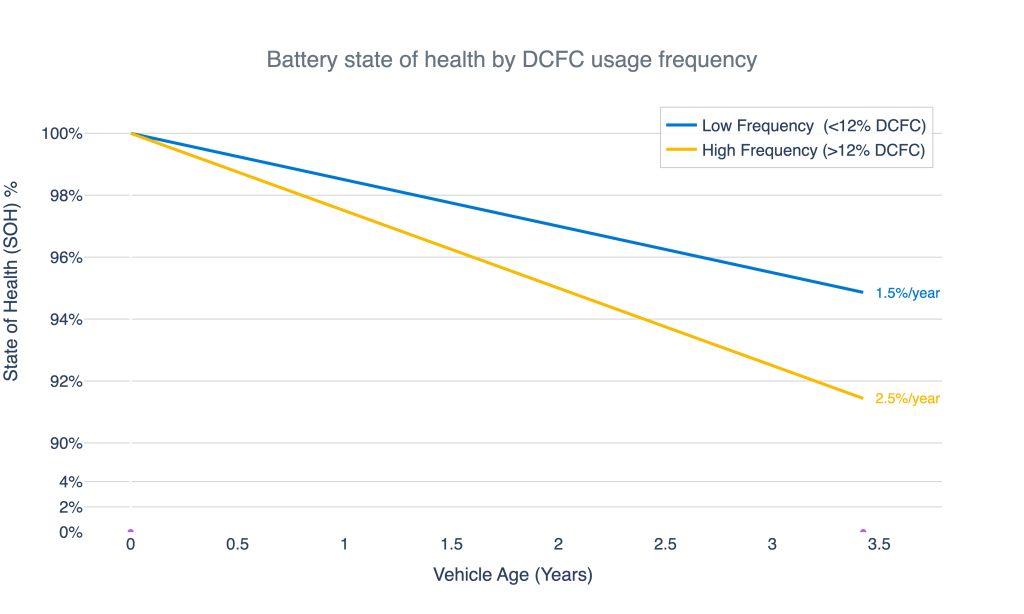
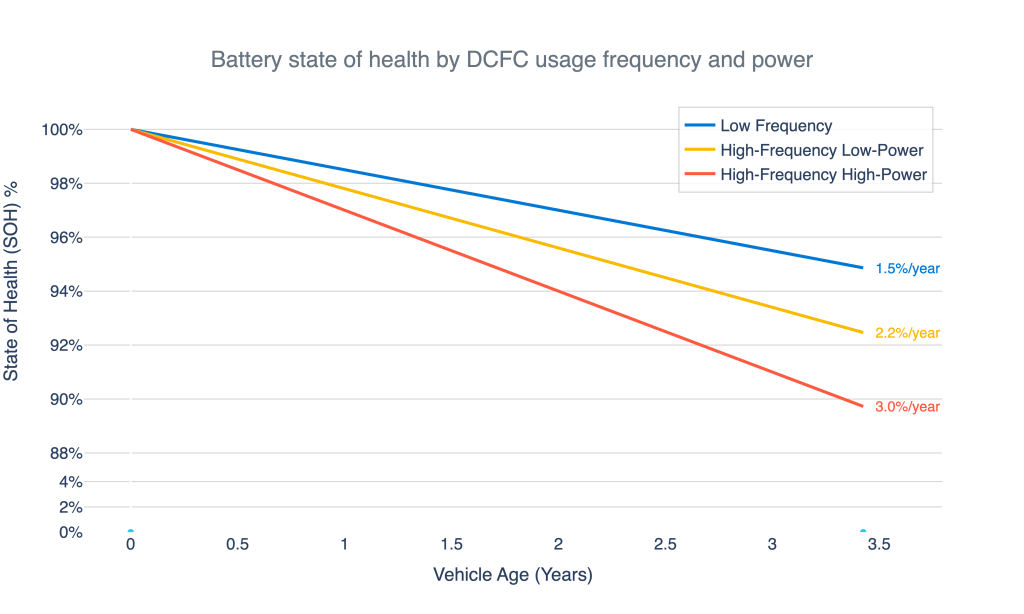
The results broken down by charging type are revealing and provide clear guidance. The healthiest practice is to prioritize slow or home charging (alternating current, AC) , which operates at reduced power levels. Drivers who use DC fast chargers for less than 12% of their charging sessions achieve an annual degradation rate of just 1.5%.
At the other extreme, intensive and habitual use of fast charging takes a toll: those who use fast chargers (above 100 kW) for more than 12% of their sessions see annual degradation rise to 2.5%. The most extreme case occurs among drivers who abuse not only frequency but also power.
When more than 40% of charging sessions are done at charging points over 100 kW, annual degradation jumps to as high as 3% per year. As experts warn, this percentage difference — which may seem small in the short term — has a very significant cumulative effect over the entire lifespan of the vehicle, as the latter group nearly doubles the capacity loss rate of the first.
Climate, thermal management, and other factors
Although charging is the main factor, the Geotab study also analyzed other variables that influence battery longevity.
Climate, for example, plays a secondary but not negligible role. Vehicles operating in warm or desert climates, where temperatures exceed 27°C (80°F) for more than 35% of the days in a year, show an additional degradation of approximately 0.4% annually compared to those operating in temperate climates — a relevant piece of data for fleet managers in countries with extreme conditions.
Here, a crucial design element comes into play: thermal management systems. Vehicles equipped with liquid cooling systems for their batteries manage to control heat — one of the main enemies of lithium-ion cells — much more efficiently than those using air cooling systems.
This advanced technology is one of the reasons why modern electric vehicles, even with more intensive use, maintain degradation levels within acceptable parameters, according to Geotab.
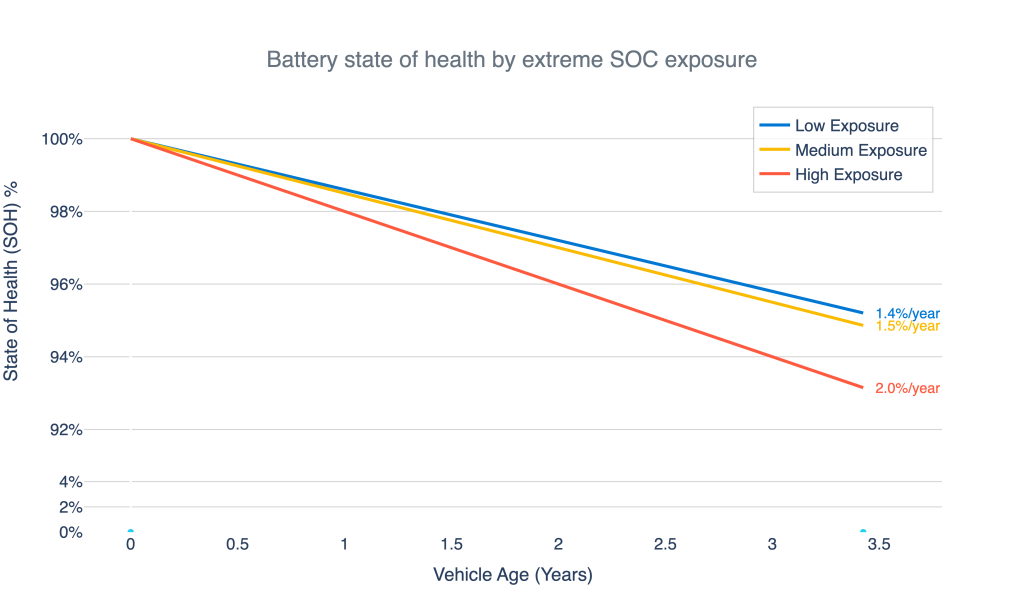
Another interesting finding is that strict daily charging limits may be less critical than previously thought. The study suggests that using a wider state-of-charge range does not generate significantly greater wear, unless the battery spends prolonged periods near 0% or 100% of its capacity — giving drivers some flexibility and reducing anxiety about micromanaging every charging session.
The second-hand market and the circular economy
The conclusions of this study have profound implications that go beyond the lab, and for the used electric vehicle market, Geotab‘s data is excellent news.
Traditionally, one of the biggest fears for buyers was purchasing a second-hand car with a battery on its last legs. However, the report shows that an EV with 160,000 kilometers (about 100,000 miles) does not suffer critical deterioration, as long as it has operated under normal conditions. This reality could stabilize and improve the residual value of these cars, fostering a more robust and reliable resale market.
Beyond the car, the study opens the door to a fascinating circular economy for batteries, because reaching the end of their useful life in a vehicle does not mean the battery ceases to be useful. Technically, this point is reached when its capacity drops to levels between 70% and 80%.
At that point, it is still perfectly suitable for other, less demanding applications, known as “second life” or “cascade.” These used batteries can be repurposed as stationary energy storage systems — for example, to store surplus solar energy in homes or to stabilize the electrical grid.
Recent research indicates that giving them a second life in this way is more effective at reducing greenhouse gas emissions than recycling them immediately. This second life allows the battery’s usefulness to be extended to more than 20 years, delaying its final recycling and maximizing the return on the resources used in its manufacturing. Therefore, it is a crucial step toward a truly sustainable, low-carbon mobility model.
Unstoppable growth of electrification
The picture painted by the Geotab study is that of a mature and reliable technology, precisely at a time of exponential growth in the electric market.
According to the International Energy Agency (IEA), global electric vehicle sales continue to rise unstoppably, driven by technological advances and energy transition policies.
In 2025, global electric vehicle sales reached a record 20.7 million units, representing a 20% increase over the previous year and accounting for more than a quarter of all cars sold worldwide.
China consolidates itself as the undisputed leader of this market, but growth is a global phenomenon. The share of electric vehicle sales is expected to continue increasing, surpassing 50% of the global market by 2035.
This context of massive growth makes the findings on battery durability more relevant than ever. Consumer confidence is a fundamental pillar for mass adoption, and having solid evidence that batteries are not a weak point, but a robust and durable part of the vehicle, is a crucial message.
The future of mobility is electric, and batteries have proven to be perfectly up to the challenge.
The Agenda to Decarbonize Transport
Latam Mobility promotes dialogue among the main players in the sector throughout its 2026 tour, which will visit the region’s key markets to delve deeper into these and other crucial issues for the transformation of mobility.
The Latam Mobility 2026 Tour will travel through some of the region’s most dynamic cities, Mexico City, Brazil, Colombia, and Chile, establishing itself as a unique space to connect the ideas, projects, and leaders who are transforming mobility and the climate economy in Latin America.
The transition is already underway. The 2026 Latam Mobility Tour will be the gathering point to accelerate decisions, connect key players, and collaboratively build sustainable mobility for Latin America.