


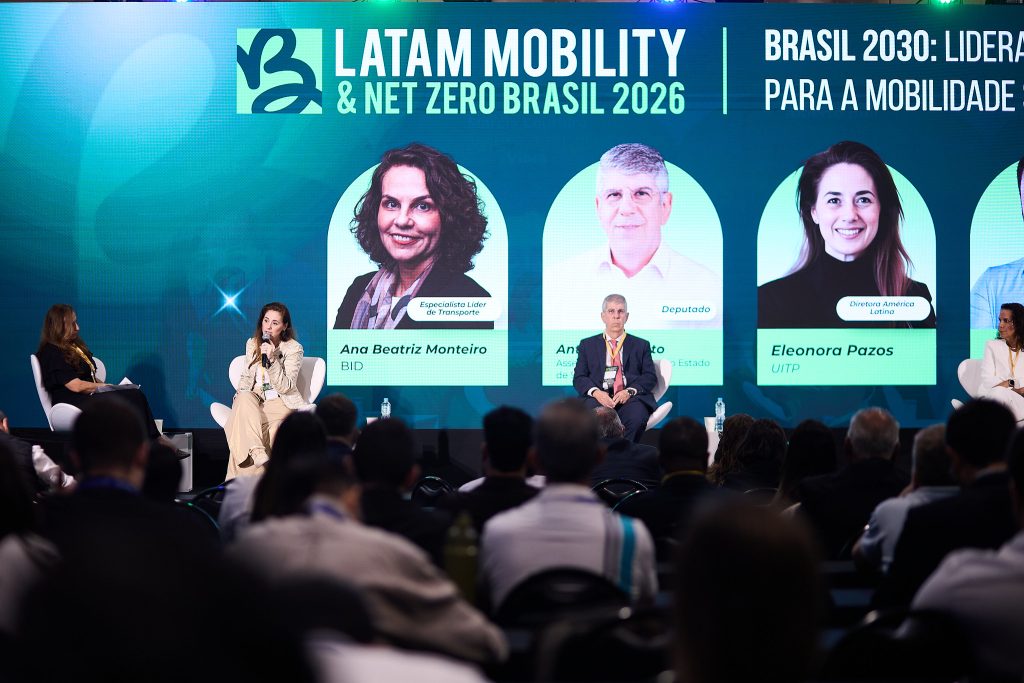
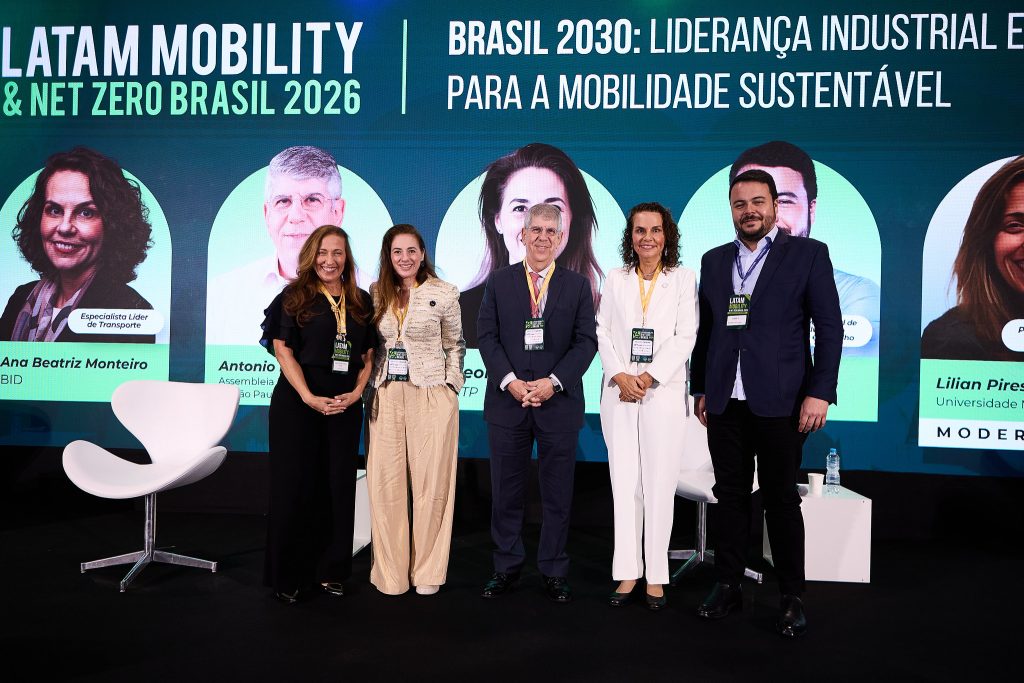
Within the framework of “Latam Mobility & Net Zero Brazil 2026,” the panel titled “Brazil 2030: Industrial Leadership and Governance for Sustainable Mobility” took place. The session, moderated by Lilian Pires, Professor of Administrative Law at Mackenzie University, brought together leaders from the public, financial, and technical sectors to discuss how industrial policies, technological innovation, and governance frameworks can position Brazil as a global benchmark for sustainable production chains and low-emission transport systems.
From the outset, the moderator set forth a central premise that ran through the entire discussion: the government is the key driver of these policies.
“We are in a process of clear evolution and improvement. Today we no longer debate the need for this transition, because it is already happening; rather, we discuss how we will improve this sustainable development and, consequently, the governance of this structure that involves the public sector, the private sector, and society as a whole,” Pires stated.
You may also be interested in | General Motors and Toyota Report Historic Growth in Electric Vehicles in Colombia
Technical Vision and International Experience
Eleonora Pazos, Director for Latin America of the International Association of Public Transport (UITP), opened the interventions by recalling that two decades ago, the electrification of public transport seemed like science fiction.
However, events such as the 2008 Beijing Olympics and the subsequent standardization work with the European Union laid the technical and operational foundations for the takeoff of battery-electric buses.
Pazos highlighted that Latin America has consolidated itself as the second continent with the largest electric bus fleet outside of Asia, with Chile and Colombia as the most mature markets.
“What we observe from UITP is the fundamental importance of public policy in transforming mobility. It is not just about vehicles, but about operating models, contracts, tenders, and technical assessments that must align with local realities,” she explained.
Moreover, she stressed that the current discussion transcends environmental concerns: “Today we are talking about energy independence. Global decisions of recent decades compel us to understand that electrification is also a matter of energy security and sovereignty for each country.”
Legislation and Incentives: São Paulo’s Experience
State Deputy Antonio Donato, from the Legislative Assembly of the State of São Paulo, shared his experience as the author of a pioneering law in 2014 that established incentives for electric and hybrid vehicles in the city of São Paulo, including the refund of the municipal portion of the IPVA (vehicle property tax) and exemption from the rodizio (traffic restriction) for environmental reasons.
Donato explained that although that law was not renewed in 2024, his move to the state assembly allowed him to push for new initiatives, such as the creation of a parliamentary front in defense of electromobility and a law regulating the right to charging in residential condominiums, a frequent obstacle to mass adoption of electric vehicles.
“Decarbonization and sustainability are not ‘either/or’ but ‘and.’ We must coexist with multiple alternatives, but electrification is especially advantageous in Brazil, given our clean energy matrix and energy availability. The great challenge today is overcoming powerful economic interests that hinder the installation of charging infrastructure at bus depots,” the legislator stated.
Donato also proposed leveraging the State’s purchasing power to electrify public fleets, including taxis and ride-hailing vehicles, generating scale and reducing costs. “A taxi driver in Brasilia told me he went from spending 5,000 reais on gasoline to just 1,000 reais on electricity. That savings circulates in the economy and generates positive externalities,” he illustrated.
Financing and Innovation
Ana Beatriz Monteiro, Lead Transport Specialist at the Inter-American Development Bank (IDB), emphasized that mobility decarbonization is a development agenda that goes far beyond financing.
The IDB, as the main financier of the public sector in Latin America and the Caribbean, has supported transition processes in Chile and Colombia for nearly a decade, and is currently accompanying the electrification plan for São Paulo’s bus fleet.
Monteiro explained the innovative model adopted by the city: given that an electric bus costs approximately three times as much as a diesel one, operators still pay the equivalent of a diesel bus, while the municipality subsidizes the remaining two-thirds by paying the manufacturer directly. “This model made it possible to raise funds at lower interest rates and has been possible thanks to joint work with the IDB, the World Bank, BNDES, Caixa Econômica, and Banco do Brasil,” she detailed.
A central point of her intervention was the need for scale and strengthening the domestic industry. “Brazil is a leader in the supply of diesel buses for Latin America. It cannot lose that prominence. Today, in São Paulo’s 1,200 electric buses, the participation of Brazilian industry is very significant, and that is key for local development,” she stated.
Monteiro also focused on health benefits: in the economic evaluation of the São Paulo project, nearly 50% of the benefits were associated with improved air quality.
“Today, air pollution in São Paulo is six times higher than recommended by the World Health Organization. We are not just talking about carbon, but fine particulate matter that directly affects people’s lungs. Sustainable mobility is, above all, a matter of transformed lives, ” she concluded.
Local Action from São Paulo
The Municipal Secretary of Economic Development and Labor of the São Paulo City Hall, Rodrigo Goulart, closed the interventions by highlighting the city’s pioneering role. He recalled that São Paulo was the first city in Latin America to create a specific secretariat for climate change and that it currently has 53% vegetation cover, in addition to expanding its permanent protected areas.
In terms of mobility, Goulart reported that the city already has 1,258 electric buses and expects to reach 2,200 by the end of the current administration, with an investment of 6 billion reais. “Seventy percent of carbon dioxide emissions in the city come from the collective transport fleet. That is why this transition cannot be postponed,” he emphasized.
The secretary also highlighted that the green economy already generates nearly 300,000 jobs in São Paulo, driven by public policies for clean mobility, waste collection with biomethane, and smaller electric vehicles.
“The city government demonstrates every day that it is possible to work hand in hand with the private sector. We receive suggestions and demands, and we are open to continuing to improve,” he stated.
Challenges Toward 2030
At the panel’s close, moderator Lilian Pires asked participants to identify the most urgent decisions regarding public policy and governance for the next three to five years.
Eleonora Pazos insisted on the need for a national electromobility policy that provides certainty and enables the development of local industry. Antonio Donato reiterated the importance of honoring already assumed public commitments, such as concession contracts and the goals of the Paris Agreement.
For her part, Ana Beatriz Monteiro was emphatic: “There can be no failure to observe public commitments. Brazil has targets for 2030, and electromobility technology is the one best prepared to provide the necessary answers.“
With these reflections, the first panel of Latam Mobility & Net Zero Brazil 2026 left a clear conclusion: the transition to sustainable mobility is already underway, but its success will depend on the government’s ability to induce, finance, and regulate a profound change that involves industry, academia, civil society, and the financial system.
The path to 2030 demands bold decisions, multisectoral cooperation, and a development vision that places people’s health and the planet’s sustainability at its core.
A 2026 of Consolidation for Mobility
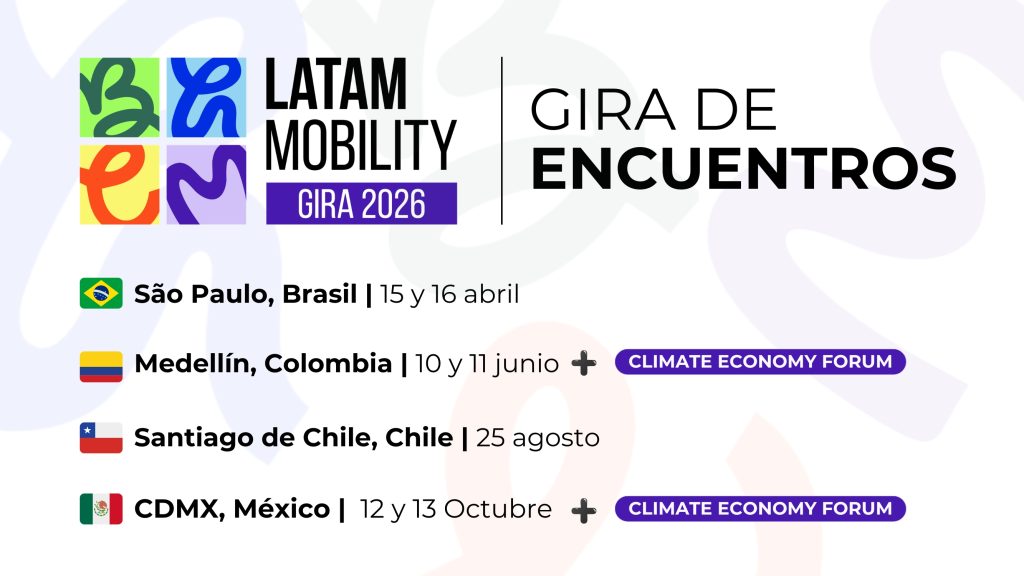
The Latam Mobility 2026 Tour continues its journey through the region, with the next meeting taking place in São Paulo, Brazil, on April 15 and 16. There, leaders from the public and private sectors will gather to analyze the progress and challenges of sustainable mobility, the electrification of transportation, and new opportunities for the energy transition in Latin America.
This event has established itself as a key platform for connecting companies, authorities, startups, and institutions that are driving innovative solutions in clean transportation, charging infrastructure, renewable energy, and new technologies for the mobility of the future.
After Brazil, the tour will continue in Medellín, Colombia, on June 10 and 11, and then arrive in Santiago, Chile, on August 25, bringing together experts and strategic stakeholders to further strengthen the sustainable mobility ecosystem in the region.
The tour will conclude in Mexico City on October 12 and 13, alongside the Climate Economy Forum, at an event that will bring together industry leaders to further drive the transition to more efficient, sustainable, and low-emission transportation systems in Latin America.
The transition is already underway. The Latam Mobility Tour 2026 will be the meeting point to accelerate decisions, connect key stakeholders, and collaboratively build sustainable mobility in Latin America.