



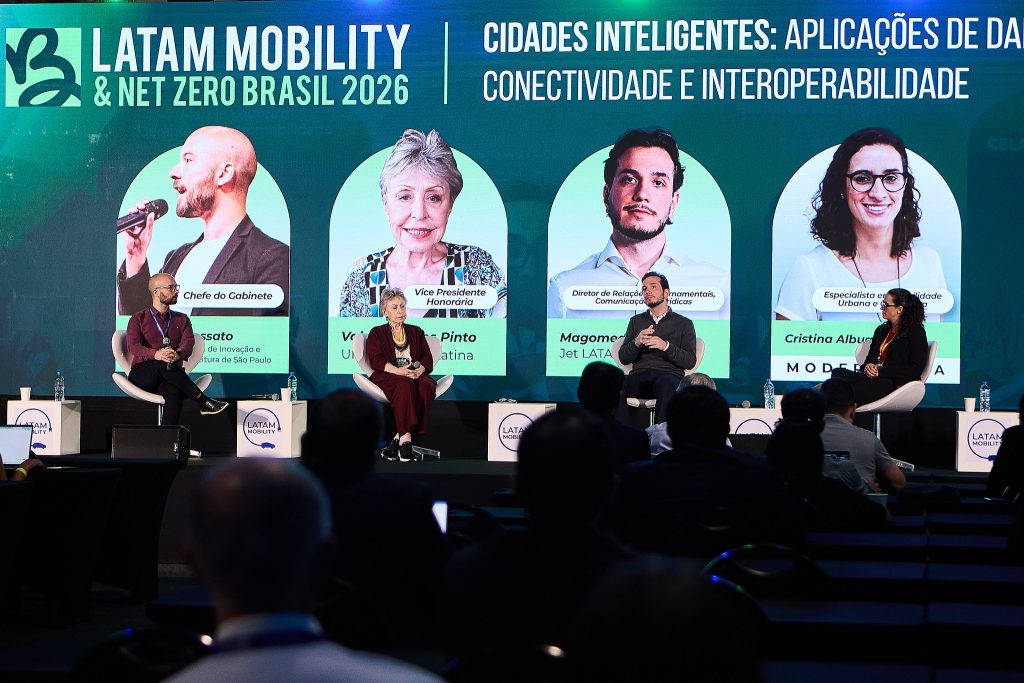
Within the framework of Latam Mobility & Net Zero Brazil 2026, a panel titled “Smart Cities: Data Applications, Connectivity, and Interoperability” was held to analyze the role of data, connectivity, and interoperability in mobility management, as well as the cybersecurity challenges for smart systems, infrastructure, and urban services.
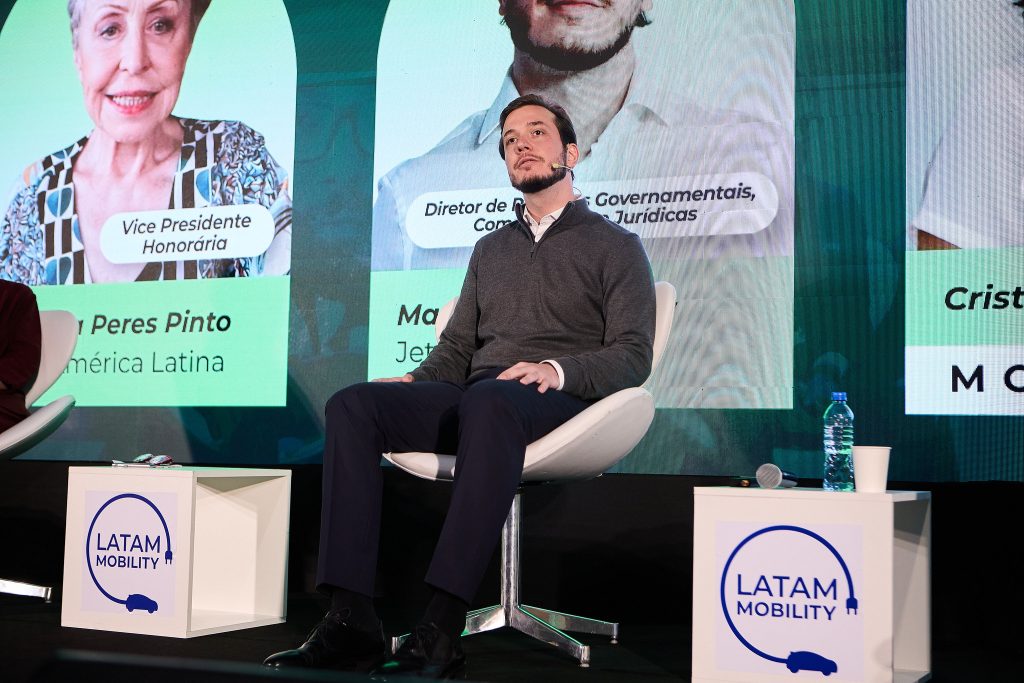
The debate was moderated by Cristina Albuquerque, an urban mobility specialist and consultant, and featured Rafael Rossato, Magomed Kolgaev, and Valesca Peres Pinto.
Throughout the session, topics ranged from shared micromobility and physical & fare integration to data‑driven decision‑making in public management, as well as the deep structural challenges of digital inclusion and inequality in access to connectivity in Brazil. The panelists agreed that the digital transformation of cities will only be effective if it leaves no one behind.
Also of interest | C40 and GCoM drive multi-level coordination to structure electromobility projects in Brazil
Data, Heat Maps, and Multimodal Integration
Magomed Kolgaev opened the panel by explaining how JET uses heat maps and high/low demand analysis to identify the most common routes and decide where to place scooter and bike‑sharing parking spots. He noted that this data can also be used to propose public infrastructure such as bike lanes and cycle paths.
He distinguished two types of integration: physical integration and digital integration. For physical integration, they aim to locate rental stations near bus stops, subway stations, and other modes to solve the last‑mile problem. To do this, they use three types of locations: user points of interest (homes, offices), key public transport points, and tourist spots. According to their statistics, more than 70% of scooter trips are for transportation rather than leisure.
On digital integration, Kolgaev explained that they share dashboards with cities and carry out API integrations. The major pending challenge is fare integration with public transport — so users don’t have to switch between multiple cards or payment apps. As progress, they’ve already launched subscription products and minute packages, which are very popular in Brazil. Kolgaev stressed that micromobility does not replace public transport — it complements it.
They currently operate in 48 Brazilian cities, including not only large capitals but also smaller municipalities like Sorocaba, Campinas, Campos do Jordão, and São José dos Campos. The company runs driving schools on weekends to teach users of all ages — including seniors — how to safely use scooters and the app.
Additionally, they apply differentiated fares and bonuses in lower‑income areas, following the guidance of municipal governments. Magomed Kolgaev concluded: “We want to build something big together with the government, where people can use multiple modes of transport in an integrated way.”
Data‑driven public management: São Paulo’s experience
Rafael Rossato presented the work of the São Paulo Municipal Secretariat of Innovation and Technology. He noted that the municipal government has decided “to stop making decisions based only on intuition and move to data‑driven decisions.” As a result, they mapped over 200 indicators and obtained ABNT ISO certification as an “intelligent and sustainable state,” achieving three platinum ratings. This allows real‑time monitoring of mobility, education, public health, and other sectors.
Rossato explained that the secretariat plays a dual role: on one hand, it runs programs that directly serve citizens; on the other, it acts as a bridge for other areas of the city government to implement their policies.
Among the concrete initiatives, he mentioned an advanced artificial intelligence unit included in the municipal goals plan, and the objective of reducing bureaucracy in public management to eliminate the idea that the public sector is backward or slow. “We want to be at the forefront and bring the state of the art of public management,” he stated.
On digital inclusion, Rossato connected mobility with access to technology. He recalled that the city already has Wi‑Fi on buses, though he acknowledged that’s not enough. Therefore, they maintain an ecosystem of 140 telecenters and 17 Fab Labs , located mainly in the Unified Educational Centers (CEUs).
Furthermore, he noted that telecenters remain essential because having a cell phone in hand is not enough to have full internet access. The idea is to address the problem of poor or illiterate use of the internet from an early age, and to complement connectivity with training and community equipment.
Digital inclusion as state policy
Valesca Peres Pinto, honorary vice president of UITP Latin America (International Association of Public Transport), offered a critical and structural perspective. She acknowledged Brazil’s progress: 87% of the population connected to the internet via mobile devices, sixth in the world in number of domain registrations, and solid internet governance. However, she warned that the COVID‑19 pandemic exposed deep inequality in the distribution of those benefits.
According to recent research from NIC.br, only 33% of the Brazilian population over age 10 has full access and digital skills (handling applications, broadband, understanding security and data protection). Another third has occasional access but with difficulties (expensive equipment, limited data plans, lack of skills). The remaining third has no interest or feels fear of using the internet — not due to age but due to a lack of digital literacy. She emphasized: “The main factor uniting those two thirds is that they don’t understand how to use the internet.”
Valesca stated that digital inclusion is not a luxury or a kindness but an essential necessity for the Internet of Things to benefit everyone. In Brazil, analog and digital literacy must be done simultaneously, replicating the speed with which the country urbanized in the 20th century.

She gave concrete examples: the World Bank will finance internet connection for 1 million isolated family farming units; protecting the Amazon requires satellite internet, because without connectivity, Ibama inspectors cannot control criminal exploitation. “The backwardness of remote regions drags all of Brazil down,” she asserted.
Finally, Valesca mentioned the operational control centers of Rio de Janeiro, Campinas, and São Paulo as examples of integrating mobility, security, weather, and disaster prevention data. However, she warned that organizational resistance exists because each entity considers “data to be its own property.”
Therefore, she explained that digital inclusion must serve as a political pressure factor to force database integration and for society to demand tools such as escape routes in response to weather alerts or urban bunkers. She concluded that there is no single solution for all of Brazil: the North, Northeast, small towns, rural areas, and urban areas require different paths, and connectivity infrastructure must be a state policy.
Commitment to inclusive, data‑driven mobility
Moderator Cristina Albuquerque thanked the panelists and highlighted the need for a holistic view that integrates mobility, data, and social inclusion. The participants agreed that without digital literacy and equitable access to connectivity, smart cities will be only for a few.
The panel “Smart Cities: Data Applications, Connectivity, and Interoperability” was part of the Latam Mobility & Net Zero Brazil 2026 program, an event that reaffirms the commitment to sustainable mobility and the digital transformation of cities in Latin America.
A year of consolidation for mobility
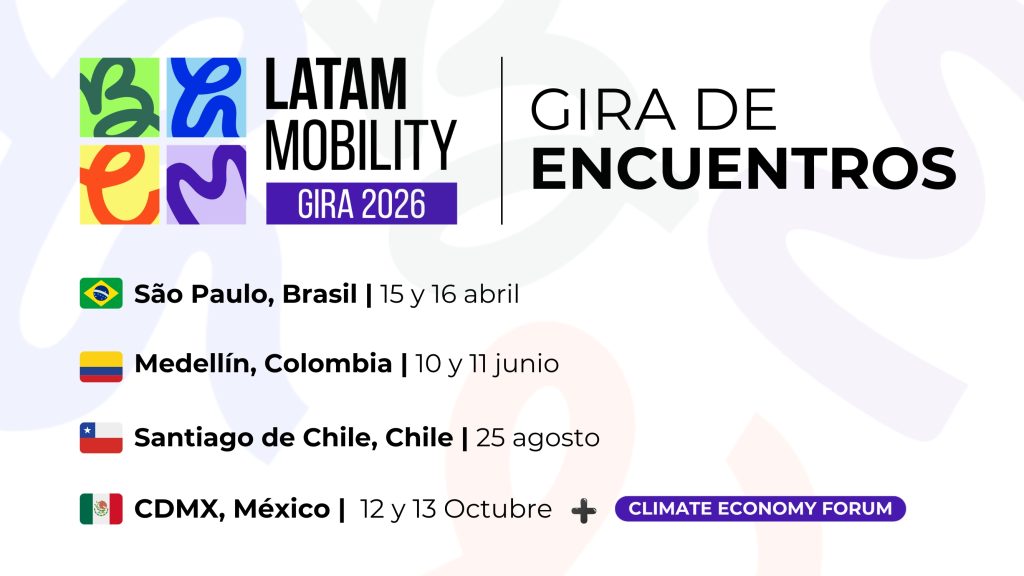
The Latam Mobility 2026 Tour continues its journey in Medellín, Colombia, on June 10–11, and will later arrive in Santiago, Chile, on August 25, bringing together experts and strategic players to further strengthen the sustainable mobility ecosystem in the region.
The tour will conclude in Mexico City on October 12–13, alongside the Climate Economy Forum, in an event that will bring together leading figures from the sector to continue driving the transition toward more efficient, sustainable, and low‑emission transportation systems in Latin America.
The transition is already underway. The Latam Mobility 2026 Tour will be the meeting point to accelerate decisions, connect key players, and collaboratively build sustainable mobility for Latin America.