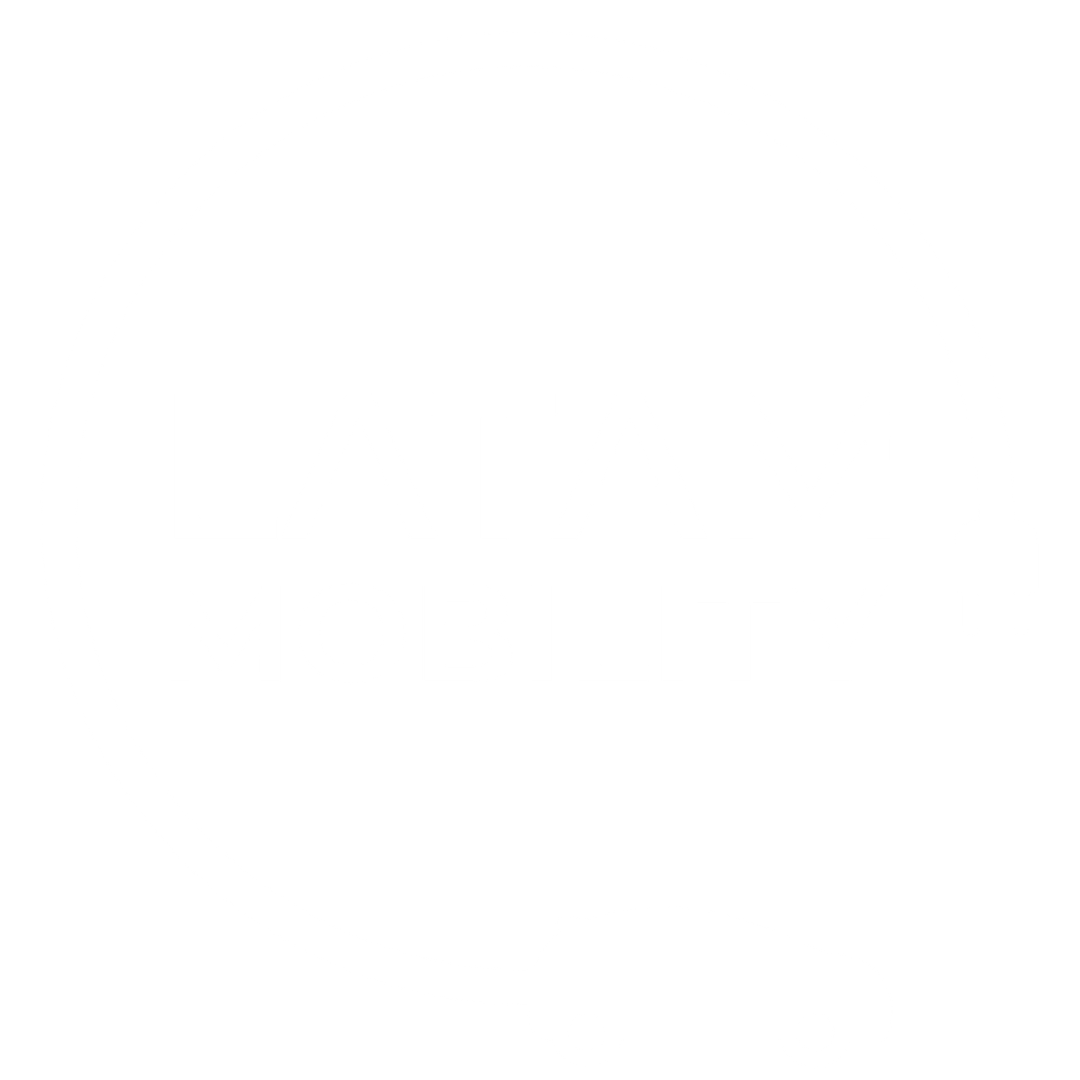




Within the framework of the first day of “Latam Mobility & Net Zero Brazil 2026,” the keynote address titled “Charging Solutions Portfolio: Innovation, Technologies, and Market Applications” was delivered by Bruno Iván Zavaleta, Data Center and Critical Power Latin America CTO at Huawei.
The presentation addressed the fundamental role of charging infrastructure in unlocking the potential of electromobility in the region.
Bruno Iván Zavaleta began his intervention by pointing out that while Brazil could have already doubled its electric bus fleet, the main obstacle is not a lack of electrical energy, but rather the lack of adequate infrastructure at charging points.
“The country has enough energy, but the problem lies in the infrastructure: wiring, transformers, and the capacity to bring that energy to where it is needed,” the executive explained.
Currently, São Paulo has approximately 1,300 electric buses and expects to add 1,200 more in the short term, which will double charging demand. Faced with this scenario, Huawei proposes integrated technological solutions that allow scaling infrastructure efficiently and cost-effectively.
You may also be interested in | Sustainability and renewable energy: Latam Mobility convenes a dialogue space to define the course of mobility in Chile
Global Lessons
Bruno Iván Zavaleta placed the debate in an international context. In China, the most advanced country in this field, two rounds of electrification have already been completed (public transport and taxis), and it is currently in the third wave, focused on electric logistics trucks, with nearly 72% penetration in passenger vehicles.
In Europe, Norway leads the transition with almost 96% penetration of electric buses. In Asia-Pacific and the Middle East, cities like Hong Kong and Singapore are also advancing with penetration rates between 30% and 60%. “The world is turning toward electromobility, not only for environmental reasons but also for energy independence,” Bruno Iván Zavaleta emphasized.
Furthermore, Bruno Iván Zavaleta distinguished two main scenarios for charging. The first is within cities, where the challenge is having sufficient electrical capacity at the charging point due to limitations of existing transformers and wiring. The second is on roads and highways, where charging points are often far from high-power energy sources.
The executive revealed a key fact: 50% of the investment needed to install a charging point goes toward prior electrical infrastructure (transformers, cables, adaptations). “That’s why we need solutions that reduce that cost and accelerate the return on investment,” he stated.
Huawei’s Integrated Solution
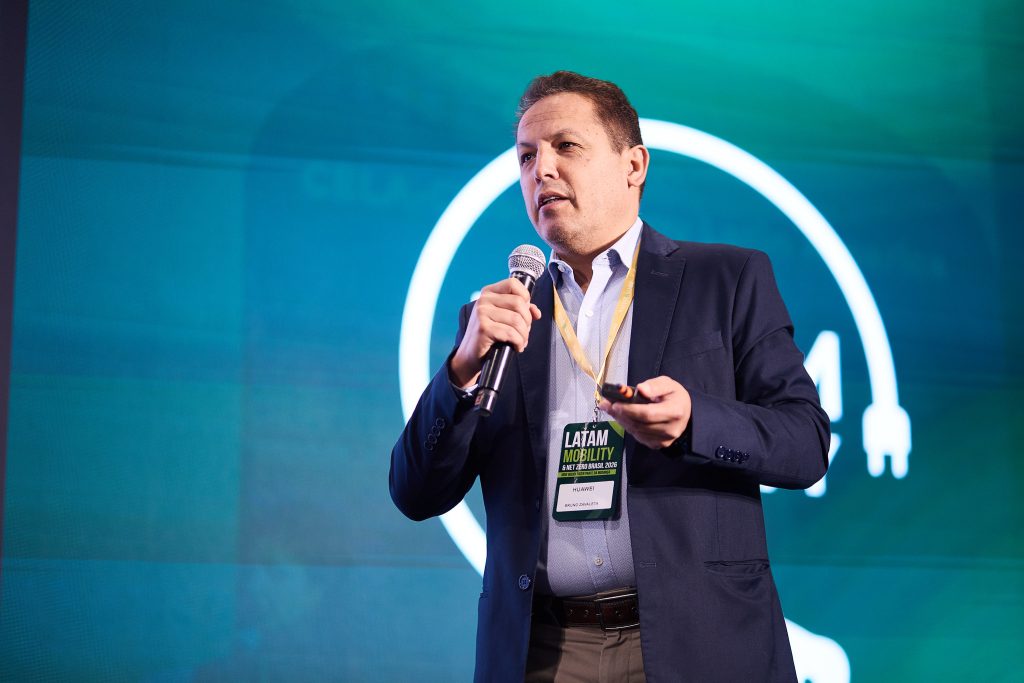
Facing these challenges, Huawei presented its technological proposal: an end-to-end solution integrating three essential components. First, a clean energy system based on solar panels with smart inverters capable of generating the required power.
Second, an energy storage system that allows accumulating surplus solar energy for use when there is no sun; and third, ultra-fast chargers operating at powers between 600 and 720 kilowatts, far above current standards.
“We are not talking about 40-kilowatt chargers, but high-capacity, intelligent, fully interconnected systems,” Bruno Iván Zavaleta stressed. Huawei’s solution not only integrates the equipment but also manages it centrally using artificial intelligence.
The presented portfolio offers three competitive advantages. The first is superior quality, as it is a single system with a comprehensive warranty, not separate warranties for each component. The second is revenue optimization: the system, using AI algorithms, decides when to use grid energy and when to use stored or solar energy, based on hourly prices and demand, thus maximizing the charging operator’s profitability.
“If right now grid energy is more expensive than what we have stored, the system automatically balances the supply to improve the bottom line,” the CTO explained. The third advantage is safety, both operational and for people and the vehicles themselves. All systems include advanced protections to prevent accidents or damage during charging.
Smart Distribution and Modular Applications
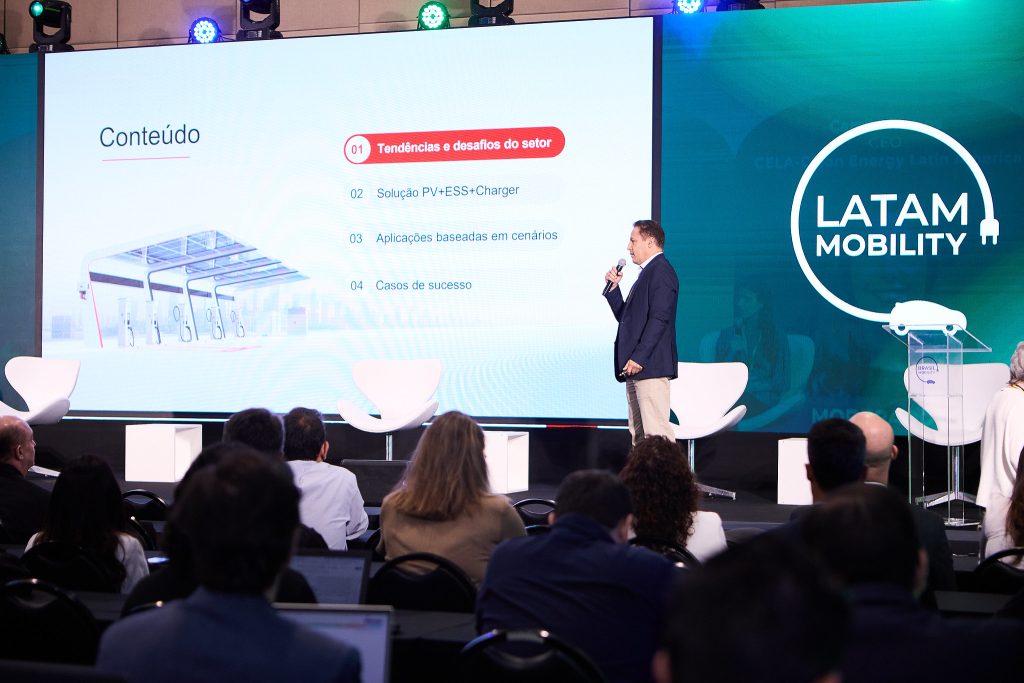
Bruno Iván Zavaleta introduced the concept of “power pooling” — similar to a pool of water with multiple outlets that open as needed. At a charging station with several vehicles connected simultaneously (a small car, a bus, or a truck), the system allocates power dynamically and efficiently, avoiding losses from idle capacity.
The executive showed real-time monitoring examples, where the operator can visualize each component, control consumption, manage the cost of energy sold, and handle demand peaks that would otherwise generate financial penalties.
Huawei’s solution adapts to different scales through a modular architecture. There are industrial systems of 215 kilowatts per module, which can scale from one to twenty modules, reaching capacities of several megawatts.
For large fleets, such as that of the São Paulo government, storage systems of up to 5 megawatts can be implemented, connected directly to DC bus chargers.
Bruno Iván Zavaleta highlighted the technological evolution: from systems connected in alternating current (AC) to current systems that operate entirely in direct current (DC), eliminating losses from unnecessary conversions. “Connecting the DC charger directly to the DC storage system optimizes efficiency and reduces costs,” he stated.
“We can work alongside you to develop a fully integrated, efficient charging solution with a very positive return on investment,” he noted.
The presentation makes clear that electromobility is not just about vehicles, but about complete ecosystems where intelligent, renewable, modular charging infrastructure is the backbone for Brazil and Latin America to meet their decarbonization goals by 2030.
The Agenda to Decarbonize Transport
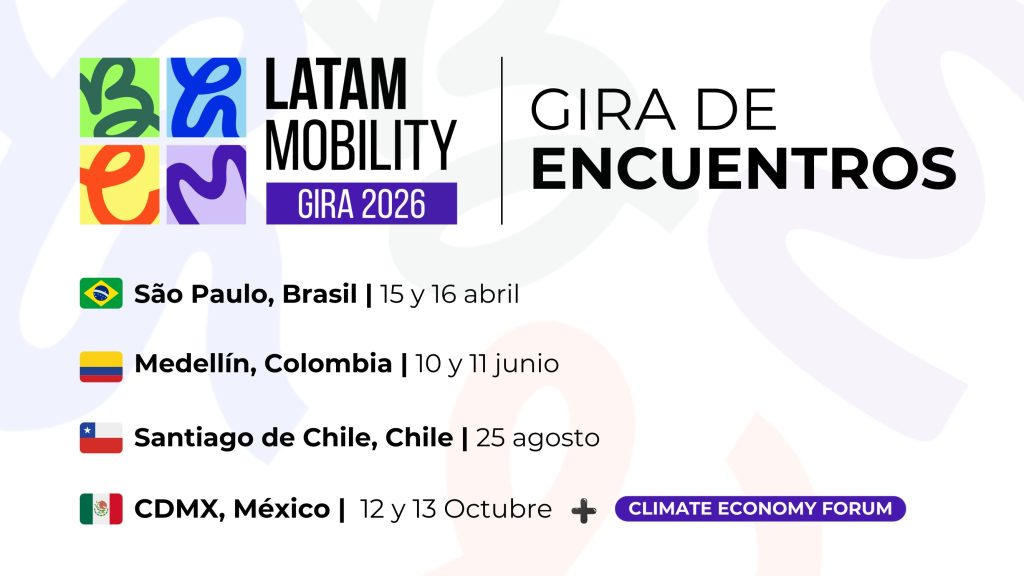
Latam Mobility promotes dialogue among the main players in the sector throughout its 2026 tour, which will visit the region’s key markets to delve deeper into these and other crucial issues for the transformation of mobility.
The Latam Mobility 2026 Tour will travel through some of the region’s most dynamic cities, Mexico City, Brazil, Colombia, and Chile, establishing itself as a unique space to connect the ideas, projects, and leaders who are transforming mobility and the climate economy in Latin America.
The transition is already underway. The 2026 Latam Mobility Tour will be the gathering point to accelerate decisions, connect key players, and collaboratively build sustainable mobility for Latin America.