


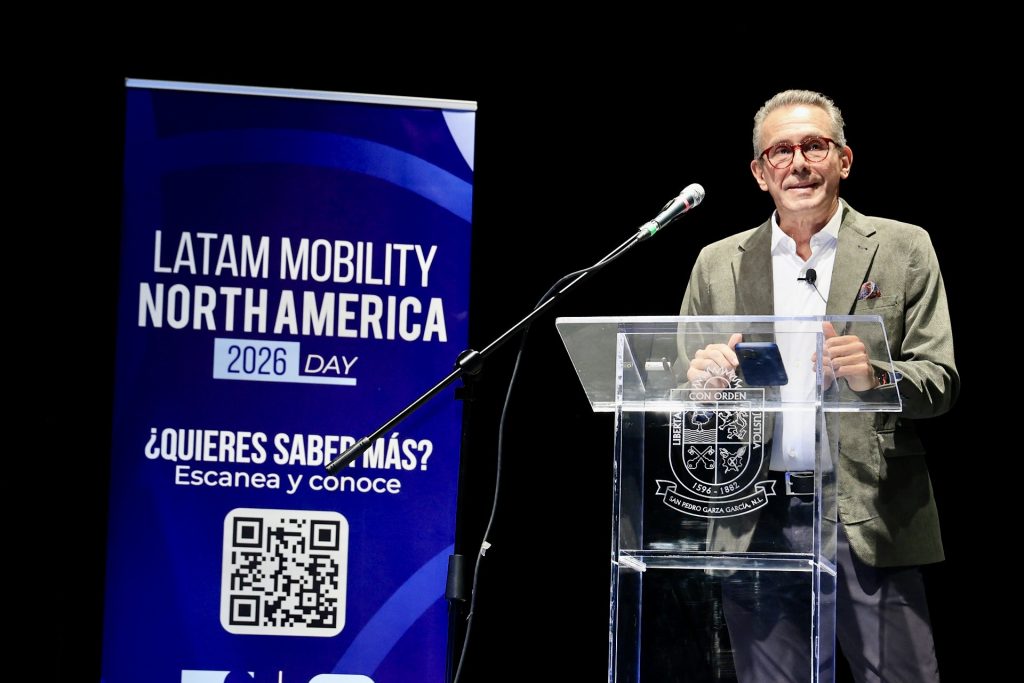
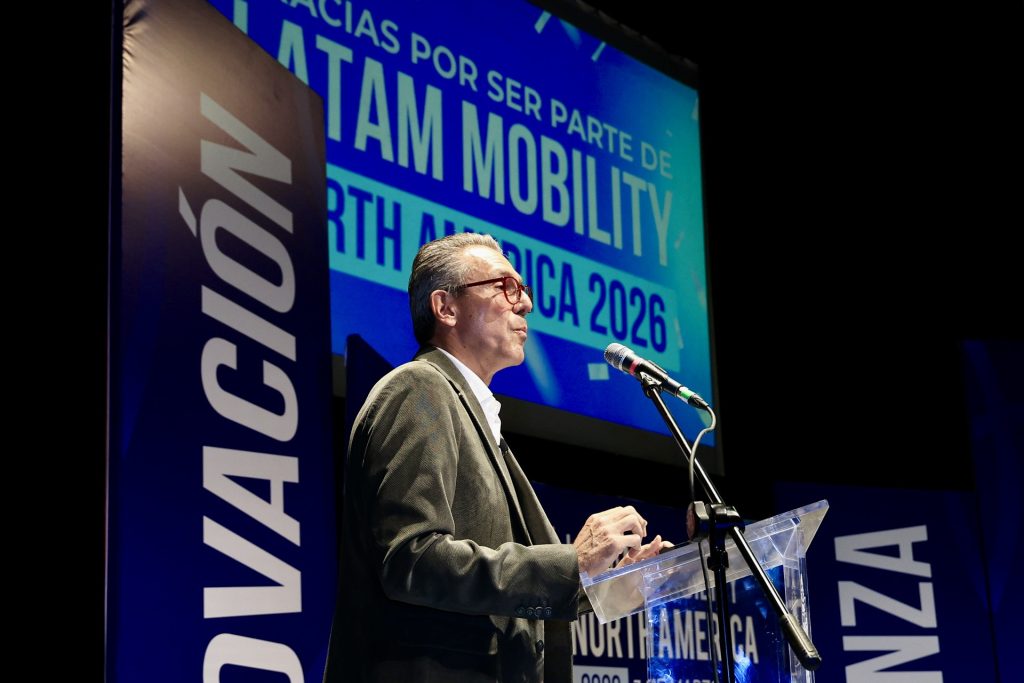
Within the framework of «Latam Mobility North America 2026,» Carlos Magaña, General Director of Flixbus México, delivered a presentation titled “Megatrends in Passenger Transportation,” in which he shared his vision of the current state and future of the motorcoach industry globally.
Taking advantage of Flixbus‘s privileged position as a company present in 45 countries and a leader in the mobility as a service concept, Magaña presented revealing data on the market size, the trends transforming it, and the specific challenges Mexico faces in this area.
The keynote, which took place at the Auditorio San Pedro in the municipality of San Pedro, started from a forceful premise: passenger transportation worldwide is in the midst of transformation, and the speed at which different markets adapt to this change will make the difference in their future competitiveness and sustainability.
You might also be interested in | “Playground de Electromovilidad” Launched to Accelerate Heavy-Duty Transport Electrification in Mexico
A Gigantic Market in Full Expansion
Magaña opened his remarks by contextualizing the magnitude of the passenger motorcoach industry globally. With interesting data, he pointed out that the value of this market amounts to nearly 800 billion dollars.
To put this figure in perspective, the executive compared it to other sectors: it is approximately 1.5 times the value of the smartphone industry, seven times the value of the global film industry, and comparable to the value of the aviation industry.
But the most relevant thing, he underscored, is not just its current size, but its dynamism. “The annual growth rate is 12%, significantly higher than any economic trend,” he stated.
Furthermore, he highlighted that this growth gives specific weight to the relevance of the topics being discussed at the Latam Mobility summit and justifies the need to pay attention to the trends shaping the market’s evolution.
Sustainability: The First Pillar of Transformation
The first of the three major trends Magaña identified was sustainability. On this point, the executive was clear in stating that the current model based on “extract, produce, consume, and discard” is obsolete, and that the industry is migrating towards a paradigm of “reduce, reuse, recycle, and regenerate,” which connects the economy, society, and the environment.
Magaña offered a comparative view of how different regions of the world are addressing this challenge. In Europe, particularly in Scandinavia, legislation is playing a fundamental role as an incentive for the transition. In Asia, specifically in China, production lines are being significantly modified to produce vehicles with environmentally friendly energies.
The global goal is clear: by 2035, it is expected that 90% of new engines will no longer be combustion engines, and by 2040 the aim is to achieve zero emissions.
However, the executive raised an uncomfortable but necessary question: “What is Latin America and Mexico doing about it?” And he himself offered an answer: “I celebrate forums like this because in reality we see that there are great areas of opportunity and we are not moving with the agility of other markets.”
To gauge the challenge, Magaña recalled that according to Deloitte studies, about 14% of global emissions come from motorcoach transportation. And although 17 million electric vehicles were sold worldwide last year, this figure represents barely 1% of the global vehicle fleet, estimated at 1.5 billion units. “This speaks to the size of the challenge and the need to keep moving forward,” he asserted.
From Support to System Enabler
The second major trend analyzed by Magaña was the impact of technology on innovation in the sector. Unlike the past, when technology was mere support, today it has become the central enabler of the system, radically transforming consumer behavior.
The executive broke down this trend into three fundamental sub-pillars. The first is data-driven mobility. Companies are investing millions of dollars in obtaining data points and developing algorithms to make real-time decisions, enabling everything from route optimization to demand predictability.
The second sub-pillar is machine learning and artificial intelligence. Magaña cited the example of Barcelona, where there is automatic traffic light control that, based on current demand, dynamically modifies traffic control. Added to this are applications in preventive fleet maintenance and other actions that improve operational efficiency.
The third sub-pillar is the Internet of Things (IoT), with successful cases mainly in Asia, where dynamic route enablement is observed, with routes continuously modifying to adapt to transportation needs.
The real challenge, Magaña explained, lies in the growing demand from users. According to Deloitte projections, by 2027 there will be 1.2 billion transportation users globally. And what makes this scenario complex is that each of those users expects personalized treatment.
“Imagine that volume of people expecting individualized treatment. Companies that fail to adapt to this reality will be at risk of extinction, as has happened in other sectors,” he warned.

Intermodality: The Integrated Experience
The third major trend identified by Magaña was intermodality. In the past, he explained, transportation was spoken of as if it were individual and isolated modes. Today, the consumer combines traditional means and expects to have a single integrated purchasing experience.
This is where major digital platforms and concepts like mobility as a service emerge, allowing the user to combine different modes of transport, even incorporating “comfort” and active mobility such as walking or using a bicycle, into a single user experience.
Magaña cited successful examples globally. In London, there are major urban concepts to reduce fleets and seek efficiencies in the consumer experience. In Germany, Deutsche Bahn (the train provider) has a partnership with Lufthansa to offer an integrated air and train ticket.
In Amsterdam, the airport is integrated with the train station. “We are going to see this continuously more and more, because that is what the passenger demands: integrated solutions,” he stated.
The Mexican Case: A Historic Opportunity
After analyzing the global panorama, Magaña focused on Mexico and Latin America. His diagnosis was clear: “Mexico is advancing, but it needs a greater boost.” Consumer appetite and behavior in Mexican urban areas is very similar to that in other parts of the world, indicating that the demand for better mobility services already exists.
However, he identified a major area of opportunity in the regulatory framework. “The regulations haven’t been updated in years, the average fleet is significantly aged, and that limits competition. With less competition, there is lower service quality and higher prices,” he explained.
Despite these obstacles, the opportunities that exist today in the country are gigantic. Magaña highlighted the nearshoring phenomenon and proximity to the United States, as well as the strategic position of Monterrey, the major development and urbanization hubs, and the growing investment arriving in Mexico.
To gauge the sector’s relevance, the executive shared concrete data: the bus passenger transportation market in Mexico is worth 2.3 billion dollars and is a significant contribution to the national GDP. But the most impactful figure was another: 96% of trips taken by any passenger using any means of transport in Mexico are by bus.
This figure reflects the country’s enormous dependence on this mode of transport, explained in part by its extensive geography, which has more than 46 cities with over 500,000 inhabitants.
“The need for mobility is incredible, it’s immense,” Magaña underscored. “And knowing that we have that need for connectivity and that the primary transport is by bus, everything we do to migrate towards renewable energies and sustainability will be a benefit not only for the country’s economy, but for Mexicans and for the environment.”
A Call to Action
The Flixbus keynote at «Latam Mobility North America 2026» made it clear that passenger transportation is not only a major economic sector but is at the center of the transformation towards more sustainable, technological, and integrated mobility.
The global trends are clear, and although Mexico faces significant challenges in its regulatory framework and fleet modernization, the opportunities opened by nearshoring and urban growth are immense for those who know how to seize them.
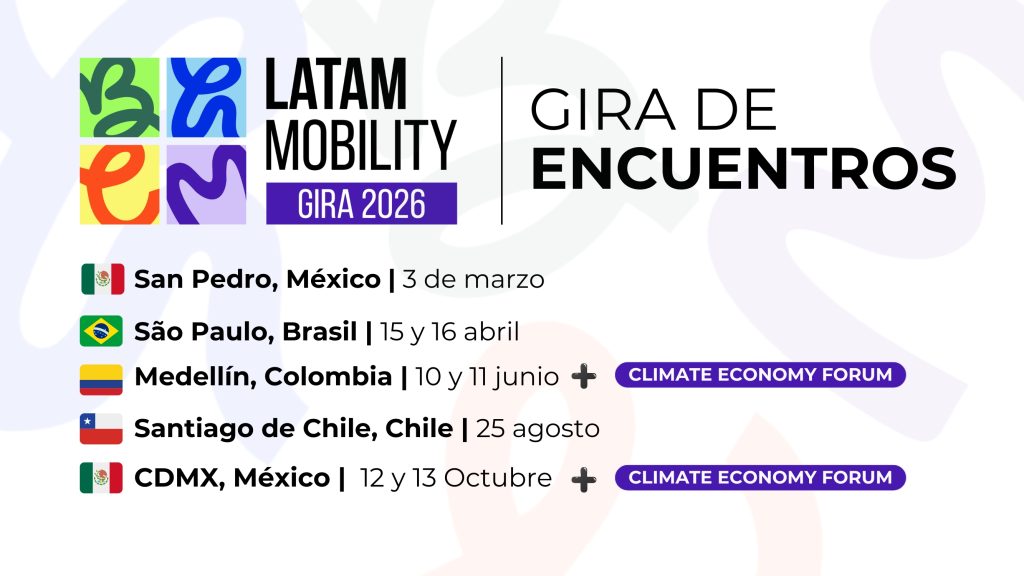
This dialogue is part of the efforts that Latam Mobility is promoting throughout its 2026 tour, which will visit the region’s main markets to delve deeper into these and other crucial issues for the transformation of mobility.
The Latam Mobility 2026 Tour will travel through some of the region’s most dynamic cities, Mexico City, Brazil, Colombia, and Chile, establishing itself as a unique space to connect the ideas, projects, and leaders who are transforming mobility and the climate economy in Latin America.
The transition is already underway. The 2026 Latam Mobility Tour will be the gathering point to accelerate decisions, connect key players, and collaboratively build sustainable mobility for Latin America.