


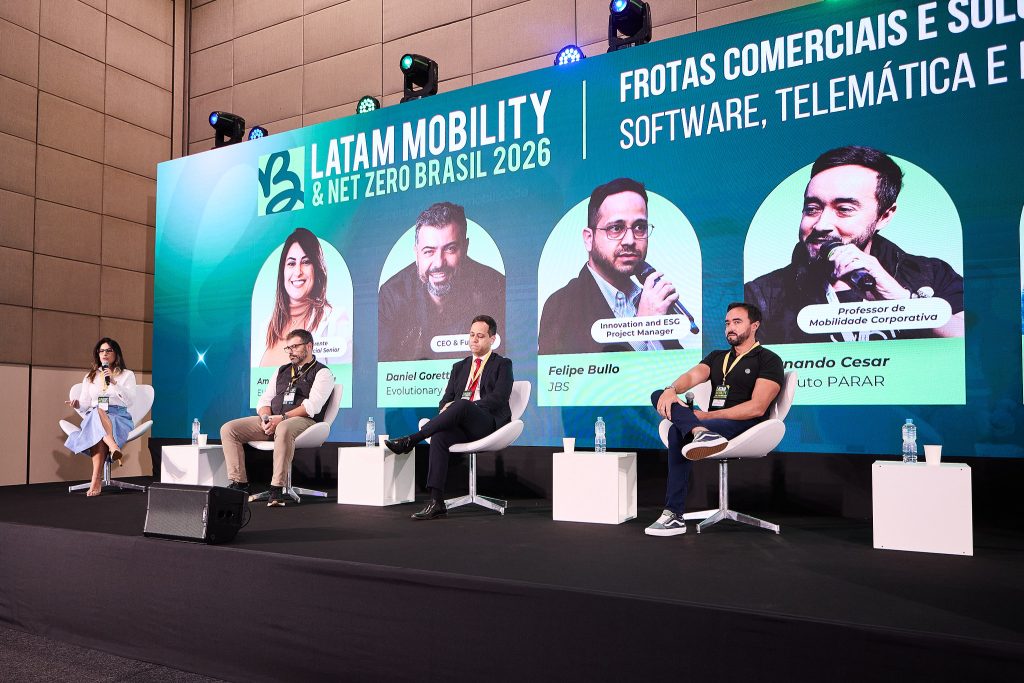
During the first day of “Latam Mobility & Net Zero Brasil 2026,” the panel titled “Commercial Fleets and Logistics Solutions: Vehicles, Software, Telematics, and Artificial Intelligence” took place, moderated by Paulo Miguel Jr, Vice President of the Brazilian Car Rental Association (ABLA).
The session brought together key players in the electric mobility value chain applied to fleets, ranging from vehicle manufacturers and rental companies to technology consultants and large logistics operators.
The moderator opened the discussion by noting that while electric vehicles are often perceived as more expensive, in the world of commercial fleets the analysis cannot be limited to the purchase price; it must encompass all operating costs, utilization time, and environmental and social benefits.
You may also be interested in | Geotab Study: Electric Vehicle Batteries Retain Over 90% of Their Capacity After 160,000 km
EVMOB: End-to-end Comprehensive Electrification Solutions
Amanda Vieira Souza, from EVMOB, presented her company as a 100% electric vehicle rental company founded by Pátria, the largest investment fund in Latin America, with over 270 billion reais under management.
“We are more than a rental company: we offer an end-to-end electrification solution,” she explained. The process begins with an in-depth analysis of the client’s operational fleet, evaluating timing, movements, and economic viability. “We do not believe in large-scale electrification projects without economic viability,” she emphasized.
EVMOB not only selects the right vehicle and designs the logistics, but also manages the charging infrastructure and offers driver training and post-implementation data analysis.
Amanda Vieira Souza highlighted that vehicle availability is key in logistics: electric vehicles have faster maintenance and spend less time idle, which positively impacts TCO.
Evolutionary Business: Consulting for the Transition
Daniel Goretti, from Evolutionary Business, recounted his 15-year career in the automotive industry and his work on electrification projects at Amazon and Wemo in the United States. His company provides personnel training (from operators to leaders), consulting for fleet electrification, and technological development alongside automakers for light, heavy, and off-road vehicles.
Daniel Goretti stressed that electrification is not just about buying trucks; it requires diagnosis, route studies, topography, and efficiency analysis. “Small design decisions (tires, brakes, transmission) can affect range by 15% or 20%,” he warned.
He proposed a three-step process: diagnosis, pilot project, and scaling, and highlighted the importance of partnerships with companies that have the experience to guide this path.

JBS: Five Years of Experience and Lessons Learned
Felipe Bullo, from JBS, shared the concrete experience of the group’s transport division. JBS has 1,600 heavy and extra-heavy trucks, and through its No Carbon arm, it has operated 281 electric delivery trucks since 2020. “The first good news is that it is feasible; otherwise, we wouldn’t have 281 units after five years,” he stated.
According to Felipe Bullo, the secret lies in study and partnerships. “You can’t buy an electric vehicle one day and put it into operation the next.” JBS started with 30 units in 2020, using telemetry from day one, measuring real data for three months before scaling to 100 and then to 280. Telemetry was a precondition.
Felipe Bullo highlighted that electric trucks do not cause problems; they have far fewer parts than combustion vehicles, and over five years, the battery has maintained 90% useful life compared to the guaranteed 85%. “They just work,” he summarized.
Additionally, the company faced the challenge of dispersing the fleet across different regions of Brazil (Pará, Northeast), which forced it to develop a maintenance network with local partners. Felipe Bullo concluded that the relationship with the Chinese supplier is agile (responses within hours) and that TCO benefits from lower repair needs and predictable energy costs compared to diesel volatility.
Arrow Mobility: Autonomous Van with AI
Julio Cesar Balbinot Jr, from Arrow Mobility, presented the vehicles the company had on display: the Arrow One, an American-style delivery van, and the Arrow 2, a lower-cost model to democratize access to electric vehicles. He explained that by removing the front engine, cargo volume can be increased by 60% within the same length, leveraging a design specific to logistics applications.
Julio Cesar Balbinot Jr revealed an innovative project approved by FINEP (a Brazilian government agency): the development of an autonomous van with embedded artificial intelligence.
He clarified that this is not a vehicle that drives autonomously on public roads, but rather one that automates internal processes at the logistics center: the vehicle moves on its own inside the depot, loads packages with an RFID system that counts and verifies each one, and the driver receives the vehicle ready to go, avoiding long morning lines that can last up to two hours.
“The driver does not need to enter the logistics center, saving time and wear and tear,” he explained. Additionally, the system’s cameras can identify suspicious behavior around the parked vehicle and alert a security center.

Instituto PARAR: The Challenge of Technical Training
Fernando Cesar, representing Instituto PARAR and also as CEO of Unique (a technology integration company for urban mobility), made an initial provocation: “Electrification is not synonymous with decarbonization; it is one of the allies, but not the only one.”
He focused on cost per kilometer and the preparation of technical teams. “Mechanics’ training was based on combustion engines; many are scared of the new technology. And the new generation does not show the same attraction to this industry.”
Fernando Cesar highlighted that successful fleets use telematics as a management tool to monitor vehicles remotely, guide drivers on acceleration, braking, and cornering, and thus extend component lifespan.
He gave concrete design examples: one manufacturer places the electronic management system at the rear of the bus, accessible, while another places it on the roof, requiring work at height and special regulations (NR10, NR35). “That also impacts TCO,” he warned.
The Advantage of Telemetry in TCO
Moderator Paulo Miguel Jr added an often-overlooked point: driver comfort. Electric vehicles do not vibrate, have no engine noise, and allow air conditioning to be used without major impact on consumption, which reduces fatigue and improves productivity.
Amanda Vieira Souza added: “Drivers start fighting to drive the company’s electric fleet. The difference in their daily workday is enormous.”
Daniel Goretti insisted that choosing the right route is as important as choosing the vehicle. Telemetry allows modeling efficiency based on geolocation, slope, and load type.
And Felipe Bullo closed with practical advice: “The first step is not to take risks. If you enter without structure, without analyzing load, energy demand, without telemetry, you may mistakenly conclude that it’s not worth it.”
The panel left several clear conclusions:
- Electromobility for fleets is economically viable when analyzing TCO (total cost of ownership) and not just the purchase price.
- Telemetry and data analysis are essential before, during, and after electrification.
- Strategic partnerships between manufacturers, rental companies, logistics operators, and service centers are key to overcoming maintenance and scaling challenges.
- Technical training and system integration (hardware, software, artificial intelligence) will make the difference between success and failure.
Paulo Miguel Jr thanked the panelists and highlighted that the sustainable mobility infrastructure market in Brazil is valued at over 1 billion reais, with enormous growth potential. “The electric vehicle is no longer the future; it is the present, especially for commercial and last-mile fleets.”

The Agenda to Decarbonize Transport
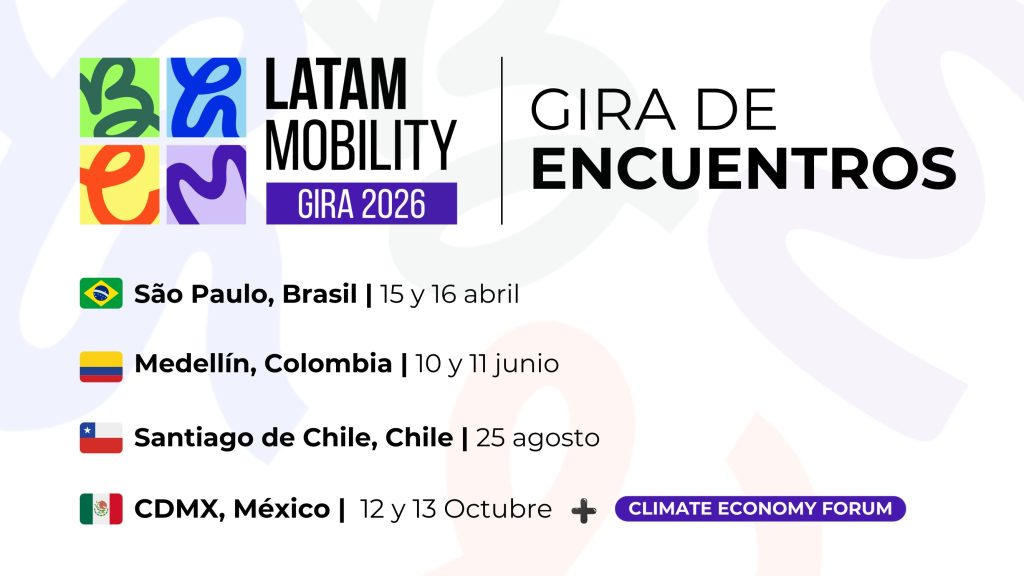
Latam Mobility promotes dialogue among the main players in the sector throughout its 2026 tour, which will visit the region’s key markets to delve deeper into these and other crucial issues for the transformation of mobility.
The Latam Mobility 2026 Tour will travel through some of the region’s most dynamic cities, Mexico City, Brazil, Colombia, and Chile, establishing itself as a unique space to connect the ideas, projects, and leaders who are transforming mobility and the climate economy in Latin America.
The transition is already underway. The 2026 Latam Mobility Tour will be the gathering point to accelerate decisions, connect key players, and collaboratively build sustainable mobility for Latin America.